1
Upload Your Photos
Upload 6 clear photos of your face securely and privately through our online portal.
Drag and drop file To upload
POSES REQUIRED


The nasolabial angle, also known as nasal tip rotation in rhinoplasty literature, is the angle formed between the base of the nose and the upper lip. It is used in facial analysis to assess profile balance and how the nose meets the lip. This measurement plays a key role in how harmonious the face appears from a side view.
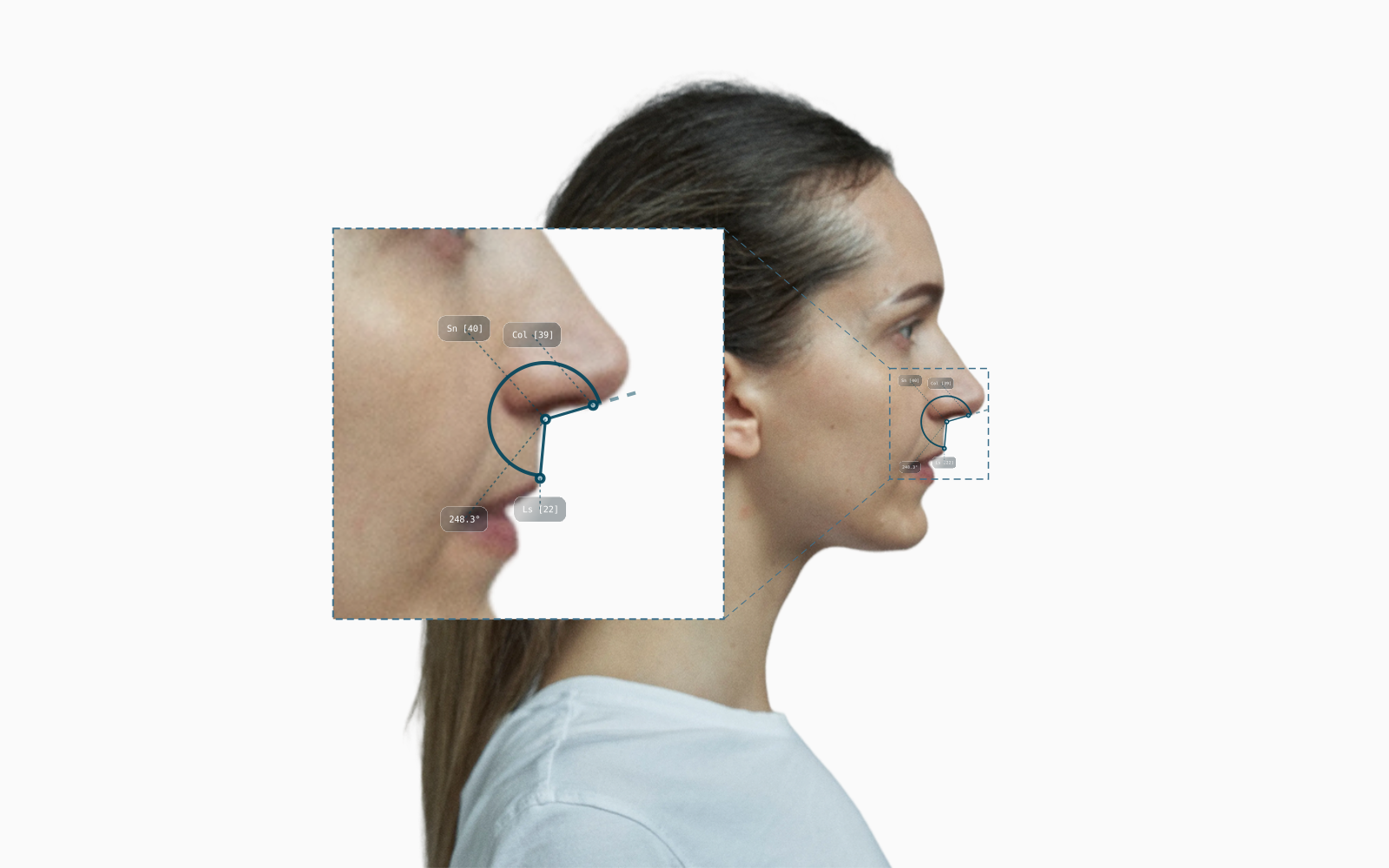
How It's Measured
The nasolabial angle measures the relationship between the nose and the upper lip using a side profile view. It is defined by:
This helps determine whether the nose appears proportionate to the rest of the face.

Left: the original profile. Right: the same face with the nose tip rotated up, which opens the nasolabial angle from 97.6° to 105.6°. Nothing else about the face or the photo changed. Hover the image to zoom into the measurement.
Why It Matters
The nasolabial angle sets how the lower nose and upper lip read together in profile. Small shifts move three things at once:
The ranges below show what's typical for the major populations.
In rhinoplasty literature the nasolabial angle is also called nasal tip rotation. Both terms describe the same geometry between the columella and upper lip.
90°–95°
Men
95°–110°
Women
90°–110°
Typical Range
These values vary depending on individual facial structure and background.
Demographic Variants
Normative ranges vary by population. Each row links to a dedicated page with full citations.
Demographic | Ideal range | Source |
|---|---|---|
African men | 90°–98° | |
African women | 92°–106° | |
East Asian men | 88°–96° | |
East Asian women | 94°–108° | |
Caucasian men | 90°–95° | |
Caucasian women | 95°–110° |
Upload 6 clear photos of your face securely and privately through our online portal.
Drag and drop file To upload
POSES REQUIRED
We measure 160+ facial markers, including skin quality, symmetry, eye shape, brow density, and more.


You’ll receive a plan highlighting your strengths, areas for improvement, and best ways to improve your appearance.
Emma’s Report
January 16, 2026
Explanation
Your forehead wrinkle depth aligns with expectations for your age and demographic, falling on the lower end of our predicted range.
Your Questions
Healthy values sit between 90° and 110°, with women a few degrees above men on average. Studied means vary by ethnicity: 97.9° in Turkish males, 104.3° in Han Chinese males, and roughly 100° to 105° across Indian populations (Çakır et al., 2014), (Bali et al., 2023). There is no single global ideal; the right reference depends on which population the profile belongs to.
Acute (under 90°) means the nose tip points downward relative to the upper lip, which reads as a droopy or under-rotated tip. Values under 80° are classed as a true droopy tip in rhinoplasty practice (Daniel, 2009). Obtuse (over 110°) means the tip rotates too far upward, which reads as over-rotated or pig-nosed. The healthy zone sits between, with the exact target dictated by sex and ethnicity rather than a fixed degree.
Yes. The tip droops with age as the supportive cartilages weaken, which closes the angle progressively. Older patients are often candidates for tip rotation surgery for this reason (Daniel, 2009). The age-related shift is meaningful but small in absolute degrees: most healthy adults stay within a 90° to 110° band well into their seventies.
It is measured on a right-profile photograph between three soft-tissue landmarks: the columella (Col), the subnasale (Sn), and the labrale superius (Ls). The angle reads at Sn, between the line from Col to Sn and the line from Sn to Ls. Modern clinical analyses derive the value from landmark coordinates on a standardised side-profile shot, which is faster and more reproducible than physical calipers on the face.
Yes. Tip rotation surgery is one of the most common moves in cosmetic rhinoplasty, used to lift a droopy tip or to deproject an over-rotated one. The exact target depends on the patient's ethnic phenotype rather than a single textbook degree (Daniel, 2009). Healthy Caucasian noses tend to cluster near the Powell and Humphreys tip-projection ratio of 2.8:1, which is a common reference point Western surgeons aim for (Chatrath et al., 2005).