1
Upload Your Photos
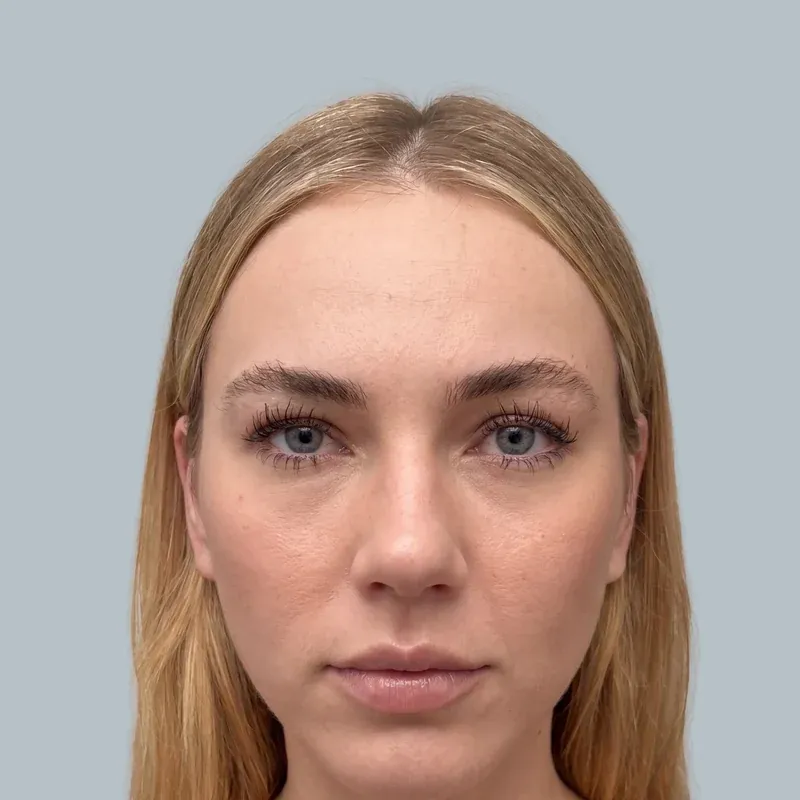
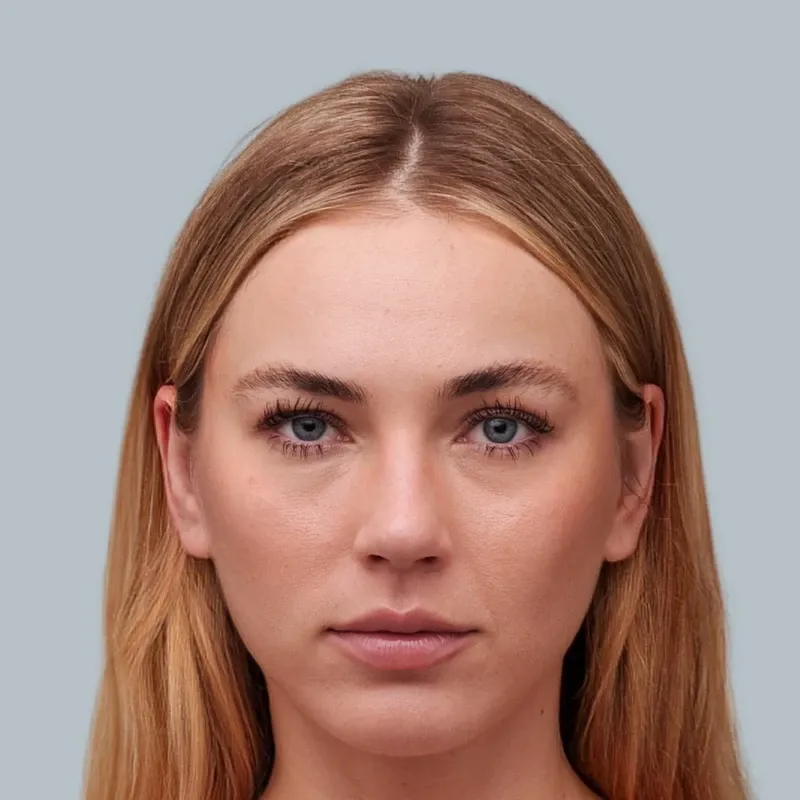
Upload 6 clear photos of your face securely and privately through our online portal.
Drag and drop file To upload
POSES REQUIRED


Most glow-up content online either promises overnight transformation or drowns you in fifty conflicting tips. Neither version tells you what the process feels like while you're in it.
It starts with a photo. Someone sends you one from last night and the face in it is not the face you thought you had. What follows is weeks of searching, then a plan, then the long unglamorous stretch nobody warns you about.
You got ready before going out last night, checking yourself in the mirror multiple times and feeling good about how you looked. The night itself was fun with a camera flashing every once in a while. You were genuinely looking forward to seeing the photos. Someone sends them the next day and you scroll through and find yourself. Your face looks wider than you remember, features less defined. You don't look the same as you imagined. The difference isn't drastic but it bothers you.
This experience repeats itself across thousands of Reddit threads. The pattern is almost identical each time. On r/loseit, someone described going to their best friend's wedding and feeling decent the whole time. When they saw themselves in the photos later, they wanted to cry. "I felt delusional too, like how bad was I lying to myself cause I sure didn't look that bad in the mirror when I was at home." They immediately untagged themselves.
Someone else spent 45 minutes getting ready before going out and finally felt okay about how they looked. Then they caught their reflection in a car window at a slightly different angle. That reflection unraveled the whole confidence they had built up in those 45 minutes.
The mirror has been showing you a version of yourself that cameras don't capture. When you look in a mirror, you find your best angle without thinking about it and adjust your expression automatically. You've done this for so long it became instinctive. Cameras capture whatever is there at that moment, without any of that adjustment. Apart from that, psychologists Nicholas Epley and Erin Whitchurch (1) ran a study where they showed people a range of photos of their own face, some manipulated to look slightly more attractive, some slightly less. People consistently chose the more attractive version as the accurate one. The brain does not neutrally record your appearance and adjusts the image upward. Because of this the dissonance between reality and our own perceptions of our face catches us by surprise.
And then you look at the photos again and start noticing things in other contexts. Your jawline looks softer than you believed. Your face looks tired more often than you realized. You understand that this is how other people have been seeing you all along.
You decide you want to look better.
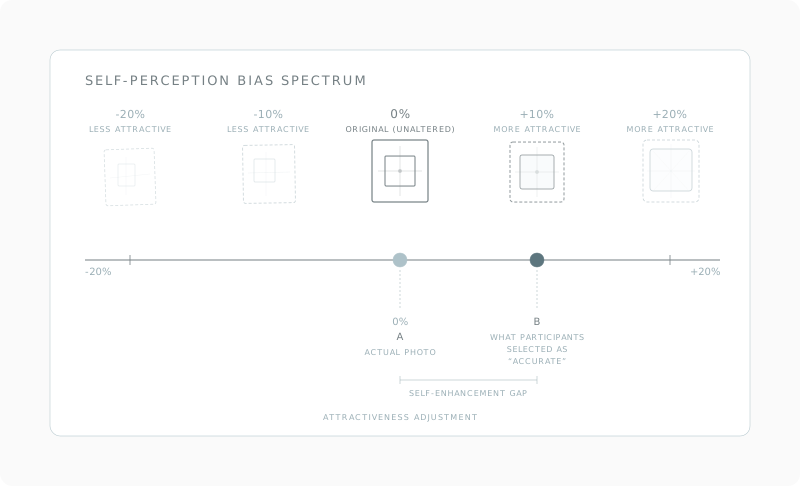
Epley and Whitchurch (1). The scale runs from 20 percent less attractive to 20 percent more. A is the unaltered photograph. B is the version participants picked as the accurate one.
You open Google late at night and type "how to look better" into the search bar. The phrase feels slightly embarrassing but you need answers. You hit enter. The screen fills with results. The top of the page is ads for teeth whitening kits and hair growth supplements you have never heard of. You scroll past them. The first result is a WikiHow article titled "How to Improve Your Appearance." You click it. The article is divided into six sections. Under these headings are steps that include everything from "Spray a cologne or perfume on pulse points" to "Stand up straight, smile, and make eye contact" to "Wear clean, well-fitting clothing."
You scan through it. Step 3 under Haircare says "Get a good quality haircut and regular trims" with a full paragraph about finding an experienced stylist. Step 1 under Skincare & Hygiene tells you to wash, tone, and moisturize twice a day, mentioning cleansers and moisturizers but again without naming specific products. Step 2 under Mental & Physical Health advises you to "Eat a diet rich in vitamins, minerals, proteins, and healthy fats." None of this tells you what you actually need to do for your specific face and what your life looks like.
You go back and try "glow up guide" instead. The results show articles from Teen Vogue, Cosmopolitan, and a dozen listicles. You click one titled "20 Tips on How to Have A Glow Up." You scroll through it. Most of the ads on it promise transformation in a few days. The advice repeats: find your skin type, get a flattering haircut, update your style, work out regularly, improve your diet, fix your sleep schedule. The information overwhelms you and yet most of it doesn't feel impactful. You have no idea which of these tips would actually help.
You keep reading anyway, not wanting to close the laptop yet.
YouTube videos show the same thing. The thumbnails have before-and-after comparisons where the "before" image is always darker with flat lighting and the "after" is brighter with better lighting and a confident expression. You can't tell which changes are real and which are just camera tricks until you risk trying it yourself. The comment sections and Reddit tell a different story. Someone wrote "Why is this all so complicated?" These comments feel more relatable than the videos. One comment sticks with you. Someone writes: "I have to fight with myself every single day not to buy more skincare. It's so ridiculous." It has 275 likes. No one is selling anything. They're just tired. Now you start checking the comments before you even watch the video. The comments are honest in a way the videos are not. The videos want you to buy something. The comments have nothing to sell.
Since YouTube didn't help much and the comments were better anyways, you try Reddit instead. Let's see what people are saying. You go to r/SkincareAddiction looking for clear advice. One highly upvoted post says to start simple with cleanser, moisturizer, and sunscreen. You screenshot it because it feels manageable. Then you keep scrolling. A few posts down, people are arguing about which skincare brands actually work. CeraVe versus Cetaphil versus La Roche-Posay versus Avene. Going back to look at your screenshot, you're not sure anymore. Every answer seems to cancel out the previous one. At each turn the rabbit hole just keeps deepening and widening, shaking the confidence you built at every step.
You find a post where someone is just venting. You click on it immediately because that is exactly how you feel.
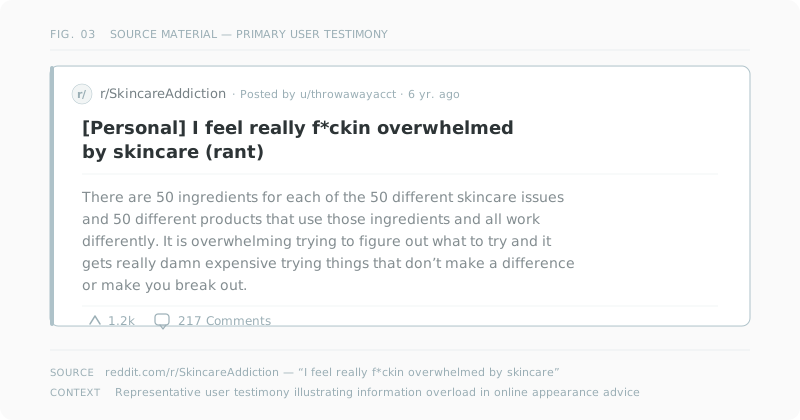
r/SkincareAddiction, 1.2k upvotes and 217 comments. The lines quoted below are from this post.
The person writes: "There are 50 ingredients for each of the 50 different skincare issues and 50 different products that use those ingredients and all work differently. It is overwhelming trying to figure out what to try and it gets really damn expensive trying things that don't make a difference or make you break out."
They are not recommending anything or giving any advice. They are just as tired and confused as you. You feel less alone for a second, but no closer to an answer. And while scrolling you find another post that says, "Overwhelmed by where to start... so many options and conflicting advice!" Seems like everyone is confused about brands.
The confusion runs deeper than brands, the community is not neutral either. Post a photo asking for feedback and the response depends heavily on who you are. Men mostly get a handful of short replies telling them they look fine, if they get any reply at all. MentalHealth.com analyzed a thousand posts on r/amiugly and counted the gap. Women received an average of 54 comments per post. Men received 14. (2) The same question draws a different amount of attention. The result is that many people asking for help walk away with almost nothing useful.
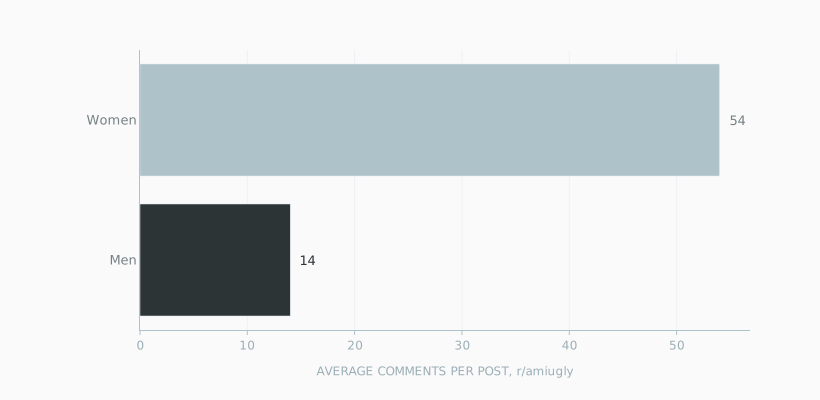
MentalHealth.com (2019), 1,000 posts. The same question, asked by different people, drew very different amounts of help.
But even when responses come, a separate problem lies beneath it all. Most of the advice that fills these threads, the tutorials, the before-and-afters, the product breakdowns, was produced with a specific person in mind. A review of dermatology content across Instagram, YouTube, and Twitter (3) found that volume of posts featuring light skin tones dwarfs the posts featuring darker skin tones. On YouTube the gap is the most extreme. Darker skin appears in just 6.25% of content. On Instagram it is 20.3%. On Twitter, 26.8%. The routines getting pushed to the front page, the ones with thousands of upvotes and comment section recommendations, were not made for everyone. The online discourse is full of advice that might not work for you at all.
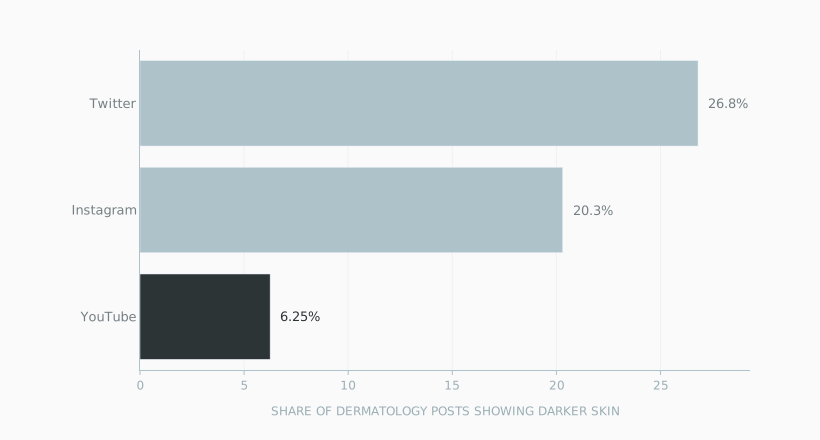
Paradkar and Kaffenberger (2022), 168 posts from 21 dermatology accounts across the three platforms.
Well if the information is not tailored for you, nor can you find a skin care brand, at least you can get a haircut that suits your face shape. Right? You open a new tab and try to determine your face shape using guides with diagrams: oval, round, square, heart, diamond. Holding your phone up to compare your reflection to the drawings, you think you might be oval. Or maybe round. The lighting in your room makes it hard to tell. The guide tells you to measure the width of your forehead, cheekbones, and jawline, but you don't have a measuring tape. Eyeballing it doesn't help. You still can't tell. All the advice about "haircuts for your face shape" becomes useless if you can't figure out what your face shape is.
You've been reading for forty-five minutes with seven tabs open. You learned the names of fifteen products and saved screenshots of advice you're no longer sure about. You still can't figure out your face shape. Appearance advice is personal and visual by nature, and text written for a general audience cannot account for what is happening on a specific person's face. The WikiHow article was written for every face at once, which means it was written for no face in particular. The Reddit thread about CeraVe versus Cetaphil is a conversation between strangers whose skin has nothing to do with yours. Every piece of advice assumes you already know things about yourself that you don't know. And none of this advice is about your face. It's about faces in general.
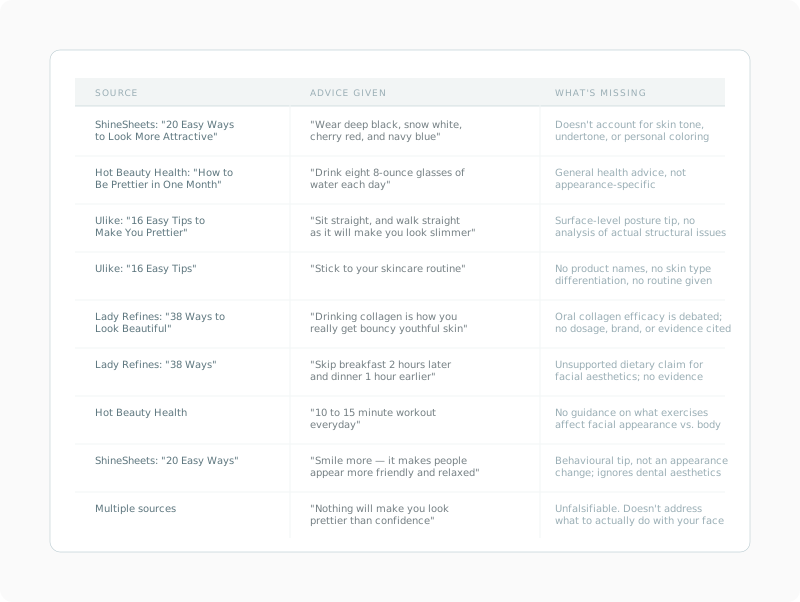
Advice from published glow-up listicles, set beside the detail each one leaves out. Sources are named in the first column.
You need someone to actually look at YOUR face and not faces in general. An analysis might show that your cheekbones are well-defined but hidden by soft tissue, which would mean losing fat makes the biggest difference. That costs nothing except time and consistency. Same analysis might show that your under-eye area would improve more from better sleep than from expensive products. Your hair might already work well for you and just need a different cut.
When you have clear and actionable information, every step you take has a clear reason behind it based on your actual features rather than on what worked for someone else. With it you stop collecting random advice and follow a focused sequence of priorities where the actions build on each other instead of being scattered across a to-do list. That is what a QOVES analysis is. You upload photos from a few angles, software maps several hundred points across your face, and a human reviewer checks what it found before the report reaches you. It costs $150 and takes up to 28 days. What comes back is a list of what would change your face most, ordered by how much difference each one makes.
It will not tell you everything. Bone structure is bone structure, and no report moves it. Anything surgical sits outside what a set of photographs can responsibly recommend. What it does is tell you which of the fifty tips apply to your face, and which ones you can stop reading about.
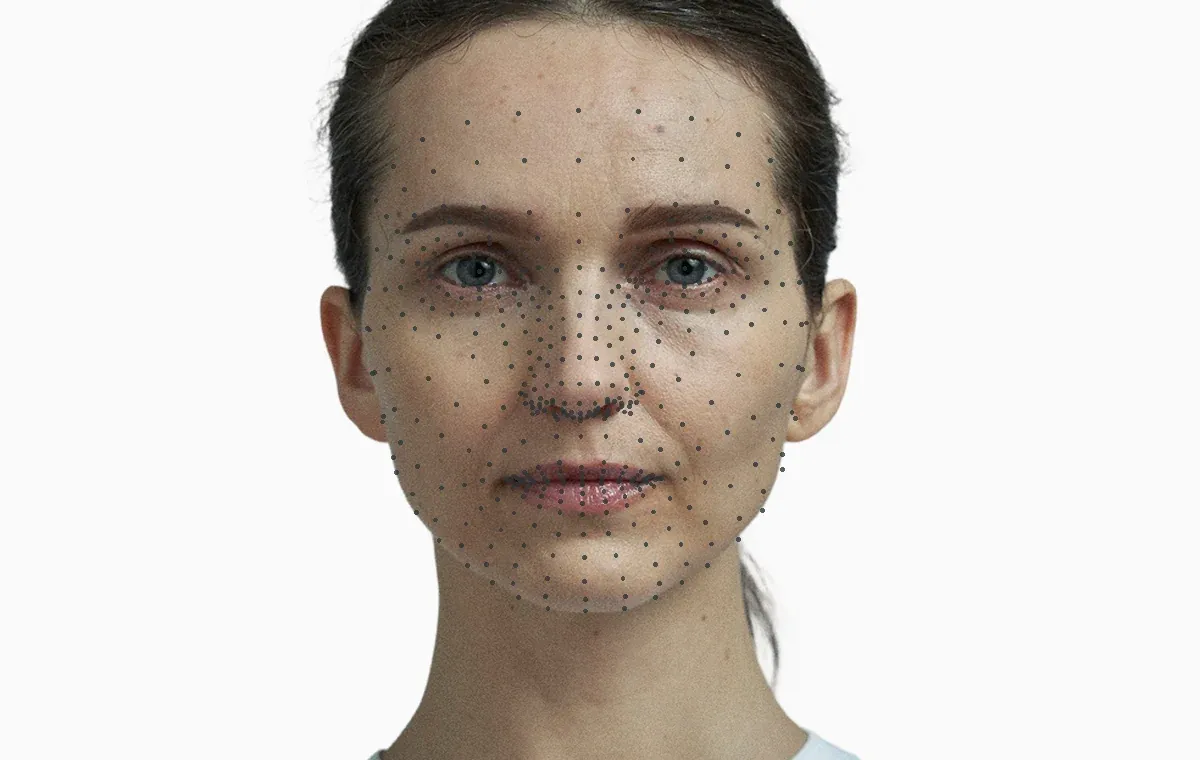
A landmark map of the kind the measurement runs on. The points locate features so proportions can be compared against a reference, which is the part a written guide cannot do for your face.
Before committing to an analysis, a specific fear tends to surface. What if it shows something that cannot be changed. What if knowing is worse than not knowing? The fear is reasonable, and it is worth saying plainly that this can go badly. A score you did not ask for, read on a bad day, can make you feel worse about a face that was fine. If you already check your reflection more than you want to, a report is not what you need.
It helps in the opposite situation. You have spent weeks collecting advice, none of it aimed at you, and you want to know where to start. A specific answer is easier to act on than a vague suspicion, even when the specific answer is not the one you hoped for.
After the analysis stage you will be way more well informed and it will feel different from the earlier phase. You're less frantic and not chasing down every possible tip. You have a plan and know which direction you're going. But then the actual work starts, and the actual work is much less interesting than making a plan.
The execution phase is boring in the way that real change is always boring. It's repetitive and cumulative. You do the same things on Wednesday that you did on Monday and again on Friday even when you don't feel like it.
The beginning is good. You have a new routine, enjoy having a plan, and feel like you've started something. Then week three arrives and nothing looks different. You start wondering if the problem is the routine or something about you. Week five passes and you're still waiting. You miss a few days because of work, then a week for a different reason. At some point, you catch yourself thinking, "I've been doing all of this and nothing looks different." A lot of people hit that moment and start over. They change products, switch routines, try something new they saw online. The urge to quit and restart at this stage is predictable and almost universal. Starting something new produces the sensation of forward motion and staying in a routine that shows no visible results yet produces the sensation of stagnation.
TikTok makes it harder. You're weeks deep into a routine where results probably exist but aren't visible yet, and the algorithm shows you someone who claims they transformed in twenty-four hours using rice water. You know it's just lighting and good camera angles, but it still affects you. The pull toward the next reset, the next promising product, the next approach that might work faster, is a constant presence during this phase. Doing the same unremarkable thing on an unremarkable day is the work that actually produces results.
One person on r/Fitness describes their journey as both too slow to notice yet too significant to not notice at the same time. They express it as, "it's hard to look in the mirror and think I look that much better, but to see pictures of myself 2-3 years ago there is a significant difference."
Gradual changes that happen over weeks and months don't register when you look in the mirror every day. You look the same to yourself on day sixty as you did on day one because your brain normalizes what it sees regularly. This is how human perception works. (4) Don't mistake this for lack of progress because the changes ARE happening, just too gradually to see yet.
The people who glow up and post dramatic before-and-after photos almost always describe the same approach: they did fewer things but did them consistently and measured progress less frequently. When you finally compare photos from month one to month four, the difference is obvious. Your face looks more defined and your features have more structure. The person in month four looks noticeably better than the person in month one.
And then you start noticing it in other ways. You scroll past a photo from a recent night out without flinching. You catch your reflection in a window and don't immediately look away. These moments accumulate into feeling more comfortable in your own skin, less self-conscious when someone pulls out a camera.
You go back and look at the original photo. The one that started this journey. If someone took the photo today with the same lighting and angle, maybe you wouldn't mind it. Maybe it will be your next profile picture.
Upload 6 clear photos of your face securely and privately through our online portal.
Drag and drop file To upload
POSES REQUIRED
We measure 160+ facial markers, including skin quality, symmetry, eye shape, brow density, and more.


You’ll receive a plan highlighting your strengths, areas for improvement, and best ways to improve your appearance.
Emma’s Report
January 16, 2026
Explanation
Your forehead wrinkle depth aligns with expectations for your age and demographic, falling on the lower end of our predicted range.
Your Questions
It costs $150. That covers the measurement, a human reviewer checking what the software found, and the written report that comes back to you.
Up to 28 days. The wait exists because a person checks the results rather than sending you whatever the software produced.
It depends on where you are. If you have spent weeks reading advice that was written for everyone and you want to know which parts apply to you, it saves you the guessing. If you are already checking your reflection more than you would like, it is not what you need.
It cannot move bone structure, and it will not recommend surgery, because that is not something a set of photographs can responsibly advise. It also cannot promise a result. It tells you which changes would make the most difference to your face, not how much.
No. The things that work are consistent and unglamorous, and you can find them without paying anyone. What an analysis buys you is the order to do them in.
Epley N, Whitchurch E. Mirror, mirror on the wall: enhancement in self-recognition. Personality and Social Psychology Bulletin. 2008;34(9):1159-1170.
MentalHealth.com. An examination of body image insecurity. 2019. Analysis of 1,000 posts on r/amiugly.
Paradkar KA, Kaffenberger JA. Skin tone representation in dermatologist social media accounts. Journal of Clinical and Aesthetic Dermatology. 2022;15(11):40-42.
Rhodes G, Jeffery L, Watson TL, Clifford CWG, Nakayama K. Fitting the mind to the world: face adaptation and attractiveness aftereffects. Psychological Science. 2003;14(6):558-566.
face
Selfie distortion
50%
Why You Look Different in the Mirror, in Photos, and to Other People
nose
Nasomaxillary angle
Nasomaxillary angle
25-32 female
67°
What is Nasomaxillary Angle?
nose
Double break angle
Double break angle
25-32 female
35°
What is Double Break Angle?