1
Upload Your Photos
Upload 6 clear photos of your face securely and privately through our online portal.
Drag and drop file To upload
POSES REQUIRED


The supratip break, also called the supratip break point in rhinoplasty literature, is a small dip on the bridge sitting just above the nose tip, where the lobule meets the cartilaginous dorsum. It is one of the markers of a refined nasal profile aesthetic, and tends to be more pronounced on female noses than male ones. The supratip break angle puts a number on that dip from a side-view photograph.
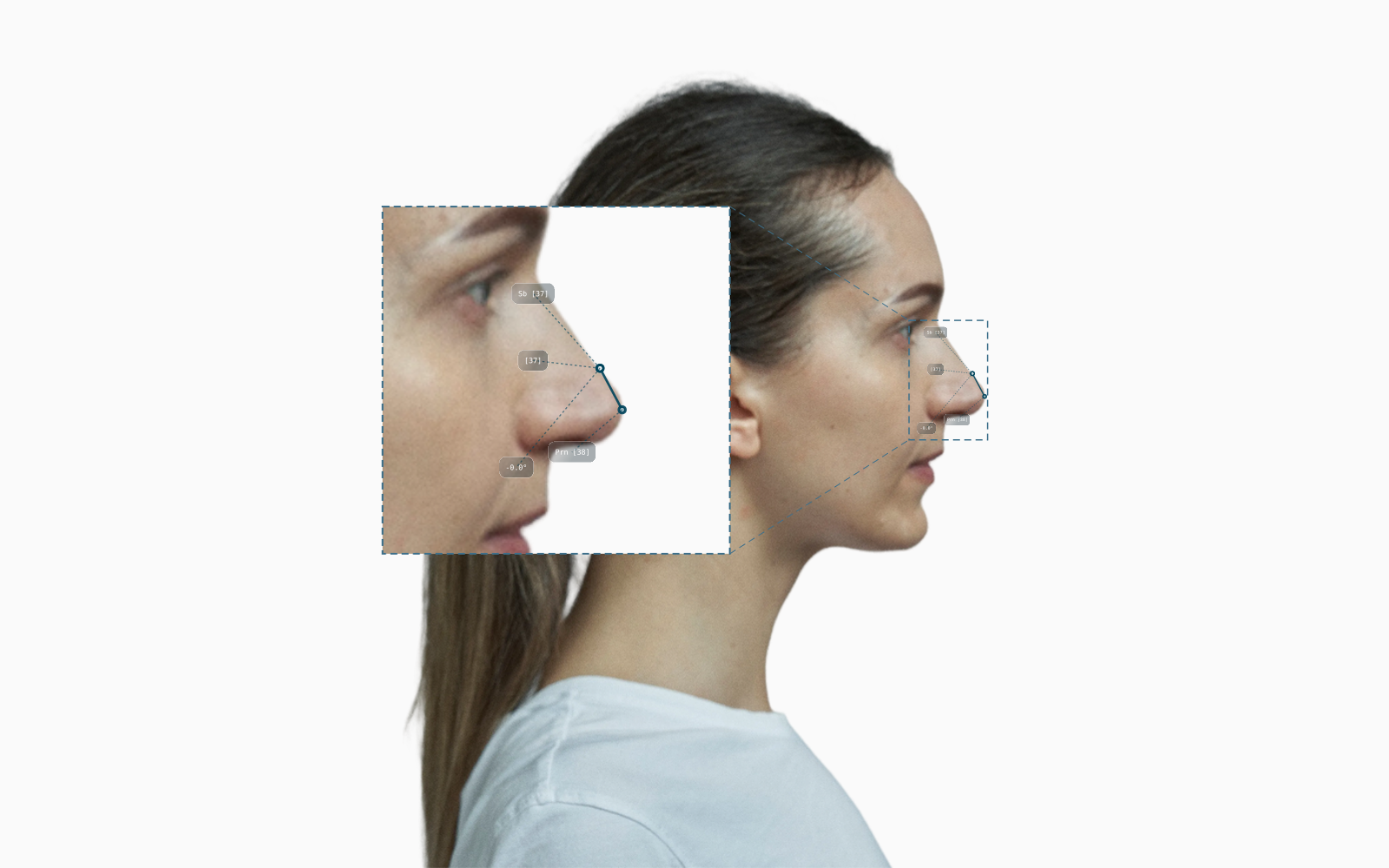
How It's Measured
The supratip break angle measures the dip in the lower dorsum from a side-view photograph. It is a three-point angle taken at the supratip on the bridge, between a ray going up toward the upper dorsum and a ray going down toward the tip (Naini, 2022):
A shallower angle reads as a more defined break and a more lifted tip. A reading close to 180 degrees describes a continuous dorsal line with little to no supratip dip.

Left: the original side-profile photo. Right: the same person with a straighter nasal bridge above the tip. The supratip break angle goes from 174.6° to 178.1°, and nothing else in the photo changed.
Why It Matters
The supratip break controls how the tip reads against the rest of the dorsum. A subtle break helps the eye separate the tip lobule from the bridge above, which is part of why the depression is more pronounced on attractive female noses and largely absent on a straight male profile (Naini, 2022). On a flat dorsum with no break, the tip blends into the cartilaginous bridge and the nose loses its definition.
Population samples show that observers consistently prefer noses with a straight or slightly concave dorsum over noses with a dorsal hump, particularly in women (Sforza et al., 2008). That preference does not produce one universal ideal angle, though. East Asian and African nasal profiles are typically lower at the radix and along the cartilaginous bridge, and a defined Caucasian-style supratip break can look out of place when grafted onto a flatter dorsum (Sforza et al., 2008).
Clinically, the supratip area is also where things go wrong after rhinoplasty. When postoperative scar tissue or unresected septum sits above the tip, the break disappears and the area swells into a pollybeak deformity (Bozzola, 2010). That is part of why surgeons treat the supratip break angle as a routine landmark before and after surgery. The typical ranges below are a starting point. The right target for any given face depends on the rest of the profile.
170°–178°
Men
160°–170°
Women
155°–180°
Typical Range
These values vary depending on individual facial structure and background.
Demographic Variants
Ideal supratip break angles vary by population and sex. A defined break suits Caucasian female profiles, while flatter dorsums are typical and aesthetically appropriate elsewhere. Each row links to the paper that established the range for that group.
Demographic | Ideal range | Source |
|---|---|---|
Caucasian women | ~160°–170° (well-defined break) | |
Caucasian men | ~170°–178° (shallow break, straighter) | |
East Asian profiles | Often near-straight; a Caucasian-style break is uncommon and not the aesthetic goal | |
Middle Eastern noses | Thick skin tends to mute the break visually; supratip swelling is a common postoperative complaint | |
Aged noses (both sexes) | Break flattens with age as tip ptosis develops; dorsal line lengthens |
Upload 6 clear photos of your face securely and privately through our online portal.
Drag and drop file To upload
POSES REQUIRED
We measure 160+ facial markers, including skin quality, symmetry, eye shape, brow density, and more.


You’ll receive a plan highlighting your strengths, areas for improvement, and best ways to improve your appearance.
Emma’s Report
January 16, 2026
Explanation
Your forehead wrinkle depth aligns with expectations for your age and demographic, falling on the lower end of our predicted range.
Your Questions
The supratip break is a small depression on the nasal dorsum directly above the tip, where the cartilaginous lobule meets the bridge. It is a subtle dip formed by the cephalic edges of the lateral crura diverging over the dorsum, and is typically more pronounced on the female nose than the male one (Naini, 2022). The supratip break angle is the way that dip gets quantified.
Not universally. A defined supratip break is part of the classic Caucasian female nasal ideal, but observers in studies of Asian and ethnically diverse noses tend to find straight or only mildly concave dorsums more attractive, with no requirement for a pronounced break (Sforza et al., 2008). On a male profile, a near-straight dorsum often reads more masculine than a defined supratip break.
Pollybeak deformity is postoperative fullness in the supratip region, where scar tissue, residual septum, or thick skin sits above the nasal tip and erases the supratip break. Clinically it is defined as an abnormal tip-supratip relationship in which the supratip sits at or above the level of the tip (Bozzola, 2010). It is the single most common reason patients come back asking for a revision rhinoplasty.
Yes. As the lower lateral cartilages and their supporting ligaments lose tensile strength with age, the nasal tip drops and the dorsal line lengthens. The supratip area smooths out and any youthful break tends to flatten, while the tip itself rotates downward (Bozzola, 2010). It is one of the visible signatures of an aged nose.
On a standardized right-profile photograph, three landmarks are marked: the rhinion at the bony-cartilaginous junction, the supratip just above the tip, and the pronasale at the most projecting point of the tip. The angle is taken at the supratip vertex. Photogrammetric angular measurements of this kind are not affected by image magnification and produce reliable inter-rater agreement on standardized photos (Aydoğdu et al., 2008).