1
Upload Your Photos
Upload 6 clear photos of your face securely and privately through our online portal.
Drag and drop file To upload
POSES REQUIRED


The facial convexity angle, also called the angle of facial convexity in cephalometric literature, is the soft-tissue angle measured at the subnasale between rays running up to the glabella and down to soft-tissue pogonion. It is the closest single reading to an overall side-profile score, since it already folds in chin projection, midface position, and forehead anchoring at the same time.
How It's Measured
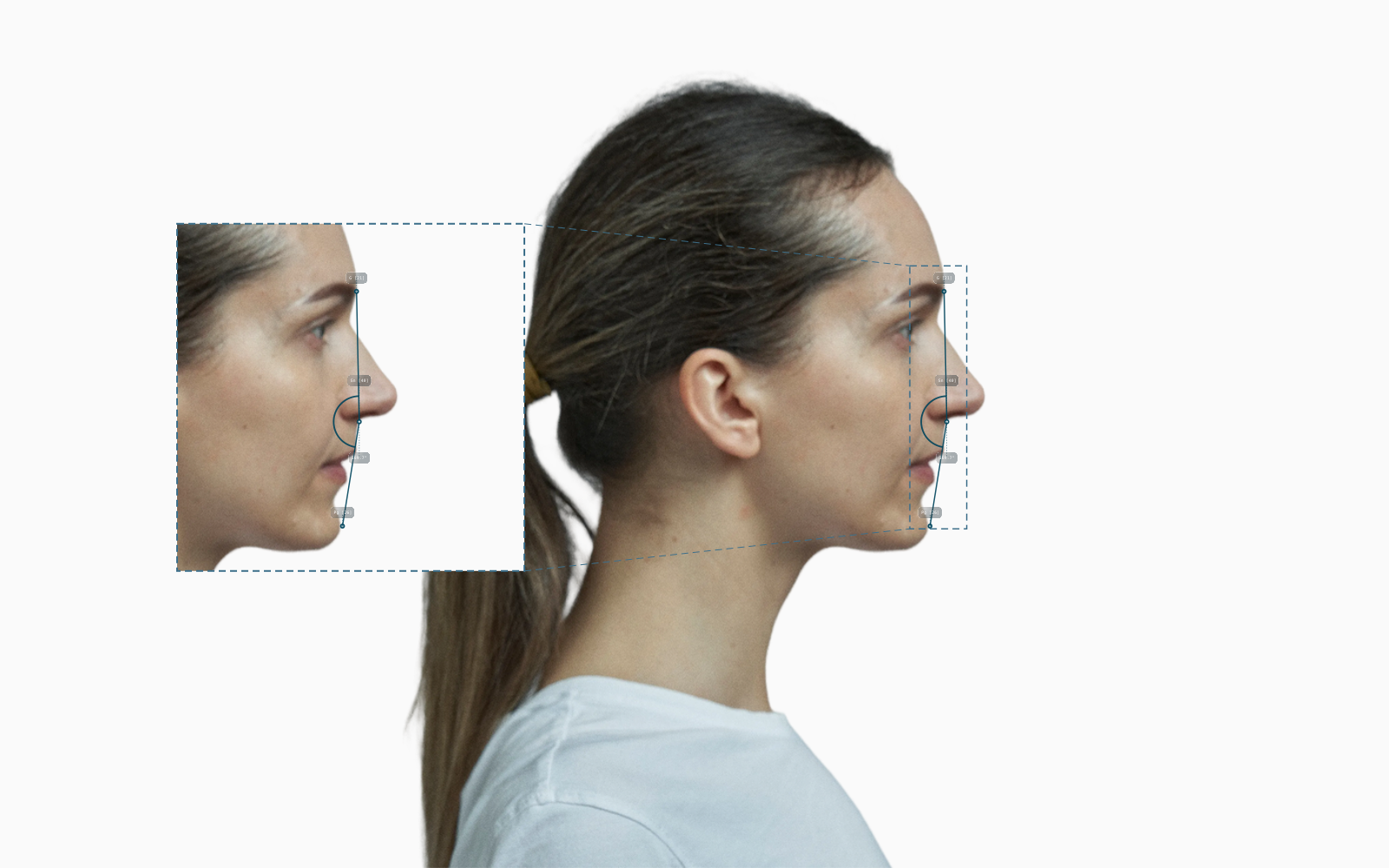
The facial convexity angle is taken on a right-profile photograph and reads off three soft-tissue landmarks that anchor the upper, middle, and lower face:
The vertex sits at subnasale, so the reading is reported as G–Sn–Pog. A straighter line through the three points gives a value close to 180°, which orthodontists call orthognathic. When the chin sits behind that line, the angle narrows under 180° and the profile is convex. When the chin sits in front of it, the angle exceeds 180° and the profile is concave (Sforza et al., 2010).

Left: the original side-profile photo. Right: the same person with a more convex profile. The facial convexity angle goes from 167.7° to 162.7°, and nothing else in the photo changed.
Why It Matters
Chin projection and the Ricketts E-line each isolate one feature against one reference. The facial convexity angle does something different. It uses three landmarks across the upper, middle, and lower face, which is closer to how human raters take in a side profile at a glance. Arnett and Bergman classify a profile under 165° as convex (Class II skeletal pattern, usually a recessive chin or protrusive midface) and over 175° as concave (Class III, usually a protrusive chin or recessive midface), with the orthognathic ideal sitting in the 165°-175° band (Riveiro et al., 2010).
Cross-population studies show this range varies more than most measurements. Persian adolescents centred between 162° and 179° regardless of sex, with no statistically significant dimorphism (Tavakoli et al., 2015). Northern European cephalometric atlases anchor the soft-tissue norm closer to a 168° mean with about ±4° standard deviation (Legan and Burstone, 1980; Bhatia and Leighton, 2014). A 10° drift in either direction reads to laypeople as a visibly retruded or protruded face, not a subtle one.
For surgical planning the angle of facial convexity is a starting point, not a target. A 158° reading tells you the profile is convex without telling you whether the maxilla is overprojected, the mandible underprojected, or both at once. The localisation comes from breakdown measurements like the chin projection angle, Ricketts E-line, and ANB (Bhatia and Leighton, 2014). The convexity angle points at which of those to look at next.
165°–175°
Men
165°–175°
Women
162°–179°
Typical Range
These values vary depending on individual facial structure and background.
Demographic Variants
Ideal facial convexity angles vary by population. Each row in the table below links to the paper that established the range for that group.
Demographic | Ideal range | Source |
|---|---|---|
Caucasian (Northern European) | 168° ± 4° | |
Persian (adolescent, both sexes) | 162°–179° | |
East Asian (both sexes) | 162°–172° | |
Class I orthognathic (Arnett-Bergman) | 165°–175° |
Upload 6 clear photos of your face securely and privately through our online portal.
Drag and drop file To upload
POSES REQUIRED
We measure 160+ facial markers, including skin quality, symmetry, eye shape, brow density, and more.


You’ll receive a plan highlighting your strengths, areas for improvement, and best ways to improve your appearance.
Emma’s Report
January 16, 2026
Explanation
Your forehead wrinkle depth aligns with expectations for your age and demographic, falling on the lower end of our predicted range.
Your Questions
The facial convexity angle is read at the subnasale on a right-profile photograph, with one ray going up to glabella (the most anterior point of the forehead between the brow ridges) and another going down to soft-tissue pogonion (the most anterior point of the chin). The number reported is the interior G-Sn-Pog angle at subnasale. Values close to 180° describe an orthognathic profile, values below describe a convex profile, and values above describe a concave profile (Bhatia and Leighton, 2014).
Chin projection isolates the soft-tissue chin against a single vertical reference line and tells you whether the chin alone reads as retruded, neutral, or protruded. The facial convexity angle uses three landmarks (glabella, subnasale, pogonion) and captures the midface and the chin against the upper face at the same time. A face can have a recessive chin and still register a near-orthognathic convexity angle if the midface is also recessed. The convexity angle is the holistic reading; the chin projection angle is the localised one (Sforza et al., 2010).
A convex profile (facial convexity under 165°) usually reflects a Class II skeletal pattern, most often mandibular deficiency, sometimes maxillary excess, or both. Correction depends on the source. Bony genioplasty or a chin implant advances the soft-tissue pogonion when the issue is isolated to the chin. Mandibular advancement orthognathic surgery moves the whole mandible forward when the deficiency is skeletal. Clear aligners or fixed orthodontics combined with growth modification work in adolescent patients before skeletal maturity (Bhatia and Leighton, 2014). The first step is always to identify whether the maxilla, the mandible, the chin pad, or a combination drives the angle reading.
A facial convexity angle under 165° classifies the profile as convex. The chin sits posterior to the line drawn from glabella through subnasale. In skeletal terms this is a Class II relationship, pointing at a recessive mandible, a protrusive maxilla, or a combination of the two. Layperson rating studies consistently find retruded jaw profiles less attractive than straight or slightly projected ones, which is why this is one of the most frequently corrected features in orthognathic surgery referrals (Khosravanifard et al., 2013).