1
Upload Your Photos
Upload 6 clear photos of your face securely and privately through our online portal.
Drag and drop file To upload
POSES REQUIRED


The eye almondness ratio, also known as eye aspect ratio in oculoplastic literature and the geometry behind almond eyes and hunter eyes, divides the vertical opening of the eye by its horizontal palpebral fissure length. Ratios sit in the 0.28–0.35 band for healthy adults, with lower values reading as longer, narrower eyes.

The eye almondness ratio — also surfaced as the eye aspect ratio or palpebral fissure aspect ratio in oculoplastic literature (Suga & Takushima, 2021) — divides the eye's vertical opening by its horizontal length, taken from medial to lateral canthus.
Lower ratios shape the long, narrow geometry behind almond eyes and the hunter-eyes look; higher ratios mean a rounder, wider-open eye opening.
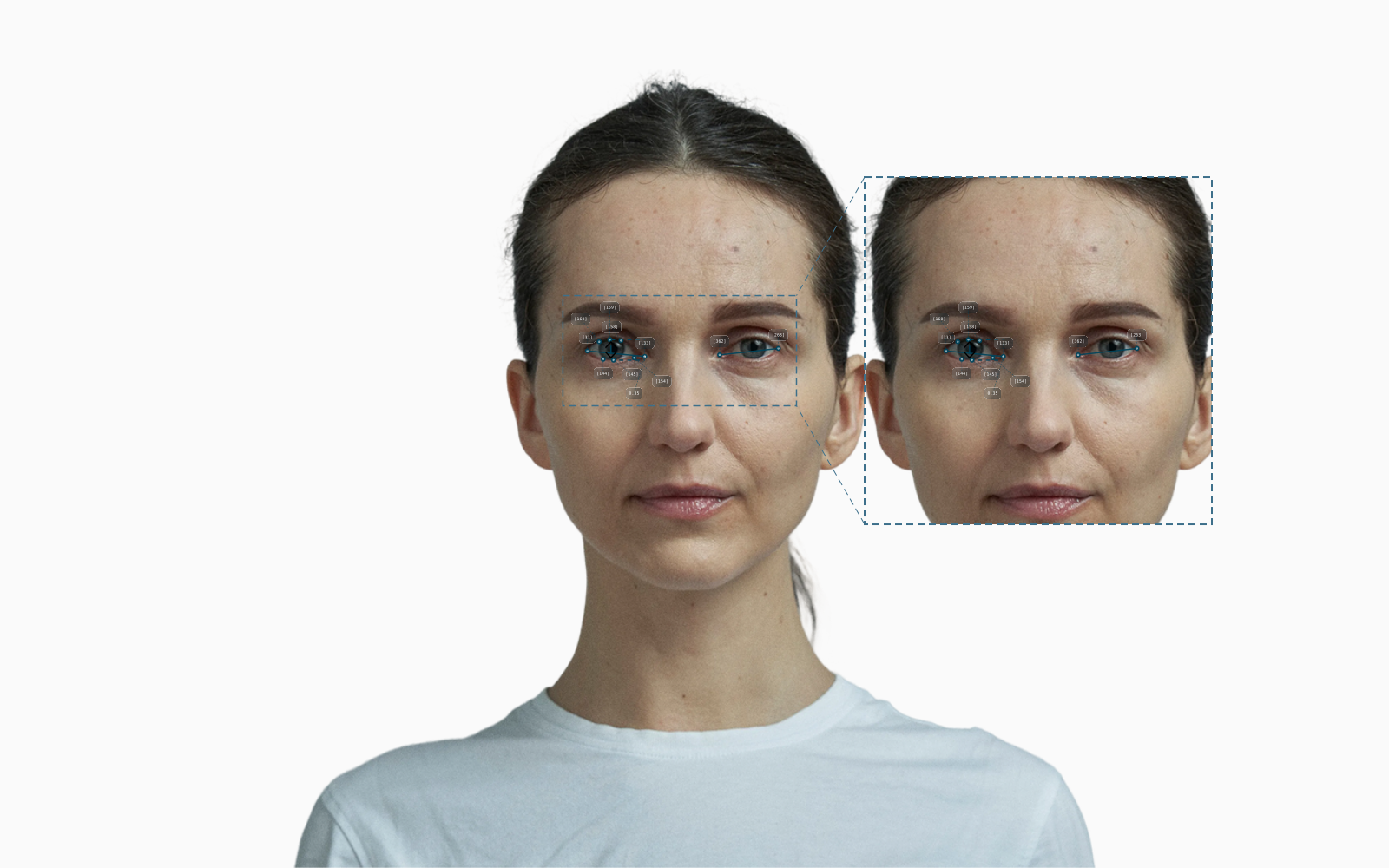
Left: the original front-facing photo. Right: the same person with a more open eye shape. The eye almondness ratio goes from 0.32 to 0.33, and nothing else in the photo changed.
The eye almondness ratio is the single quantitative anchor behind every conversation about almond eyes and hunter eyes, and it tracks closely with how attractive a face reads in eye-tracking studies. Faces with ratios near the lower half of the normative band — long, narrow openings — show the geometry rated most attractive across cultures (Bashour & Geist, 2007), especially when paired with a slight positive canthal tilt.
Ratio targets vary by population. The Asian periorbital region has historically shown different proportions, and clinical studies measure how surgical procedures shift the palpebral fissure shape toward a more open-eye geometry (Wang & Gu, 2026). The takeaway: a single global ideal eye almondness ratio misreads faces outside the population that defined it.
Ageing and gravity also drive the ratio higher over time — upper-lid ptosis lowers the upper-lid midpoint while the canthi stay anchored (Bazhitova, 2019), which is why blepharoplasty and canthopexy procedures cluster around restoring the lower, more youthful eye almondness ratio. See the demographic table below for the actual numbers.
0.28–0.33
Men
0.30–0.35
Women
0.28–0.35
Typical Range
These values vary depending on individual facial structure and background. Fig 2.
Ideal eye almondness ratios vary by population, sex, and age. Each row below links to the canonical paper that established the range for that group; ranges with no peer-reviewed data are deliberately omitted.
Demographic | Ideal range | Source |
|---|---|---|
Caucasian women | 0.30–0.35 | |
Caucasian men | 0.28–0.33 | |
East Asian women | 0.33–0.38 | |
All adults, both sexes | 0.28–0.35 |
Upload 6 clear photos of your face securely and privately through our online portal.
Drag and drop file To upload
POSES REQUIRED
We measure 160+ facial markers, including skin quality, symmetry, eye shape, brow density, and more.


You’ll receive a plan highlighting your strengths, areas for improvement, and best ways to improve your appearance.
Emma’s Report
January 16, 2026
Explanation
Your forehead wrinkle depth aligns with expectations for your age and demographic, falling on the lower end of our predicted range.
Your Questions
Hunter eyes is the looksmaxxing label for a face with a low eye almondness ratio paired with a positive canthal tilt and deep-set orbits. The eye reads long, narrow, and slightly upturned at the outer corner, which the literature describes as an inferomedial slant of the intercanthal axis (Hilger et al., 2011). The trait is heritable and largely set by orbital bone position and lateral canthus height, which is why it cannot be replicated with makeup alone.
Almond eyes are eyes whose almondness ratio sits near the population mean: long enough to taper at both corners, but with enough vertical opening to keep the iris visible. The clinical term is a normal-aspect palpebral fissure with intact upper-lid show (Romo & Pearson, 2005). Almond shape is the default shape of most healthy adult eyes, which is part of why it reads as attractive without reading as exaggerated.
Most rated-attractive faces in the literature converge on an almond-shaped eye with a slightly positive canthal tilt. Eye geometry is one of the strongest predictors of attractiveness rating, alongside skin texture and facial symmetry (Lefevre et al., 2024). The shape balances neotenous vertical opening with mature horizontal length, which signals both youth and adulthood without committing to either extreme (Naini et al., 2024).
Take a forward-facing photograph with relaxed lids and no smile. If the eye is visibly longer than it is tall, with both corners tapering and the iris just touched by the upper lid, the eye almondness ratio is in the almond band. Round eyes show iris fully exposed and a near-equal height-to-width balance. The QOVES analyser computes the ratio from the photograph directly and compares it to your demographic norm, which is more reliable than the mirror test.