Intro - 2026 / summer
Do freckles make you look more or less attractive?
We were interested in examining whether freckles have an impact on perceived facial attractiveness, so we ran an online experiment to find out.
- Participants
- 953
- Faces, rated both ways
- 40
- Additional points on a 0 to 10 scale
- 0.013
Context
Freckles are common but understudied.
Freckles are a benign form of skin pigmentation, shaped both by genetics, which determine how prone someone is to developing them, and by sun exposure, which brings them out and darkens them (Bastiaens et al., 2001; Praetorius et al., 2014). They are most common on lighter skin (Bastiaens et al., 1999; McLean & Gallagher, 1995), which is one reason research to date has concentrated on lighter-skinned faces.
Two kinds are usually distinguished (Praetorius et al., 2014). Ephelides are the small, 1-2 mm light-brown spots that appear in early childhood, darken over the summer, and fade with age, occurring mainly on the face, arms, neck, and chest. Solar lentigines are larger and darker, develop later in life, and appear on the face, the backs of the hands, and the forearms (Bastiaens et al., 2004). For our study, we focused only on ephelides, the type most people mean by "freckles."
People differ in their opinions on the aesthetic impact of freckles. Some people use products and treatments to reduce facial pigmentation in the hope of improving their appearance (Daftary et al., 2023; Ho et al., 2012), while others deliberately imitate freckles with makeup or cosmetic tattooing for the same reason.
Many studies have examined how facial pigmentation is perceived, in terms of attractiveness, health, and other judgements (Fink et al., 2001; Matts et al., 2007; Porcheron et al., 2014; Samson et al., 2010; Stephen et al., 2009). However, to the best of our knowledge, none has focused exclusively on how freckles affect perceived facial attractiveness (but see Utz et al., 2023, on perceptual adaptation to freckles). It also remains unclear whether findings from lighter-skinned faces extend across a wider range of skin tones (Coetzee et al., 2012; Stephen et al., 2012; Tan et al., 2018).
The question
Compare a face to itself.
Specifically, we asked: do freckles, on average, change how attractive a face is judged to be?
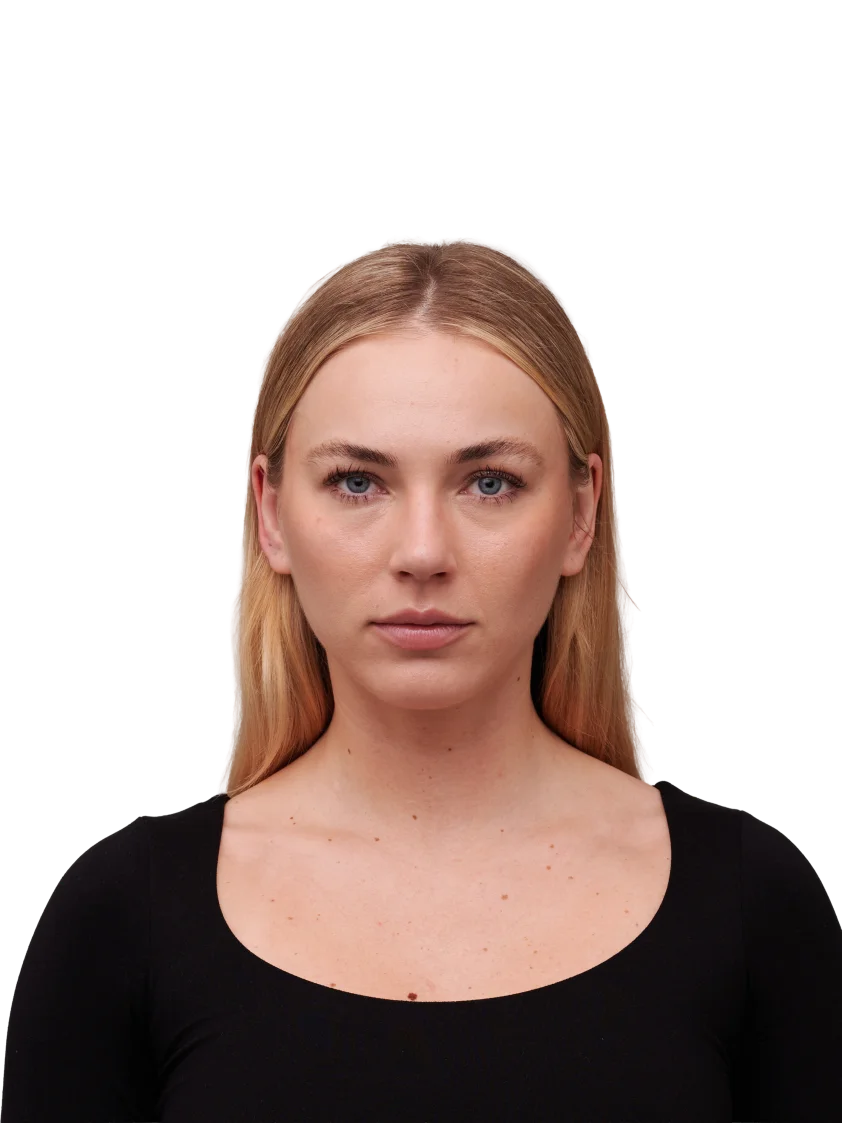
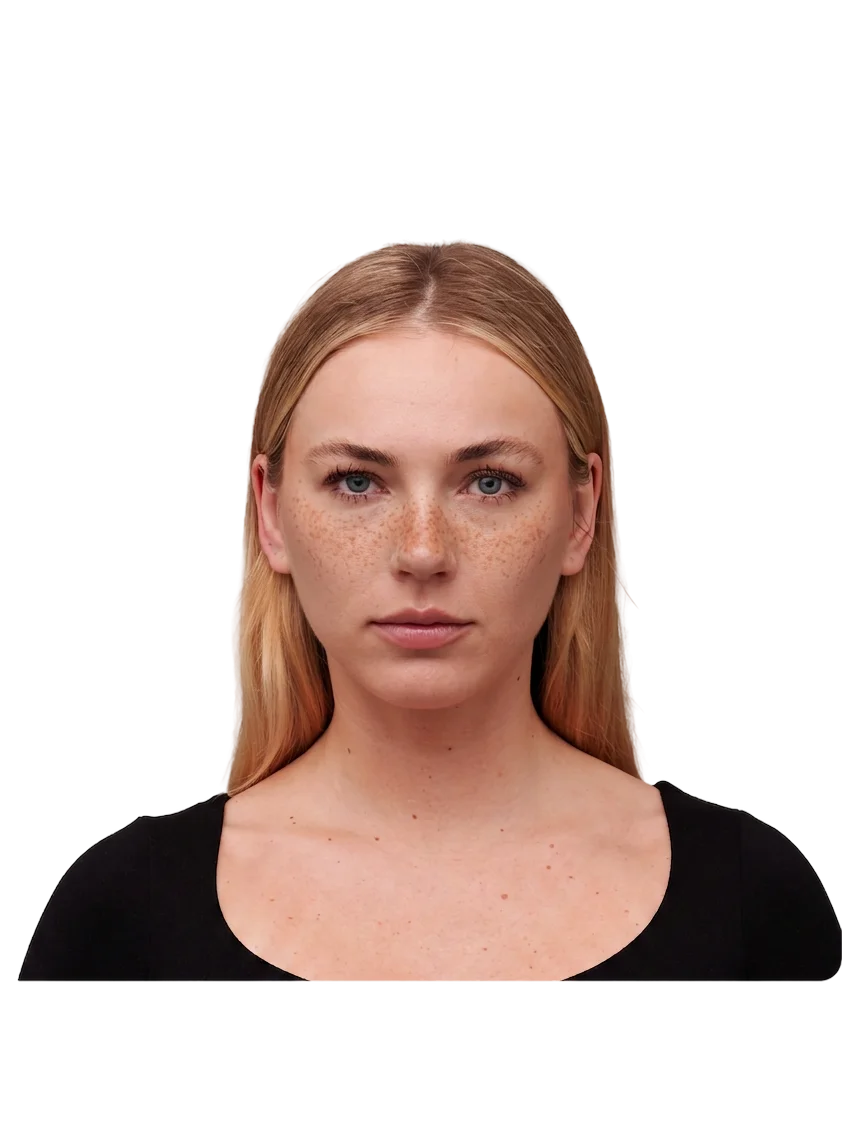
The difficulty is that faces differ from one another in countless ways. Comparing people who happen to have freckles with people who do not tells you very little, because any difference could come from a hundred other features. The only clean test is to show the same face both with and without freckles, changing nothing else. That is what we did.
We had no prediction about the direction of the effect. Our sample was large enough to reliably detect a difference of around 0.2 points on the 0-10 scale. Smaller effects may exist, but would arguably matter less in practice.
Without freckles
With freckles
What we did
Forty faces, each rated both ways.
We used facial images from a public dataset, the Face Research Lab London Set (DeBruine and Jones, CC-BY 4.0), selecting 40 faces with equal representation across ethnicity and sex. This way we obtained equal numbers of White, Black, East Asian, and West Asian faces, and exactly 20 female and 20 male faces. Because the London Set is mostly composed of White faces, achieving balance meant including nearly all of the non-White faces available in the database, while the White faces were sampled from a larger pool.
We then digitally added freckles to all of the faces included in the final sample using a large generative image model and a novel approach. This approach allowed us to confine the freckles to the nose-and-cheek region while keeping the faces’ true skin tone, texture, and identity untouched. The number of freckles applied varied between faces (from 65 to 166), reflecting differences in the size of the nose-and-cheek region across individuals.
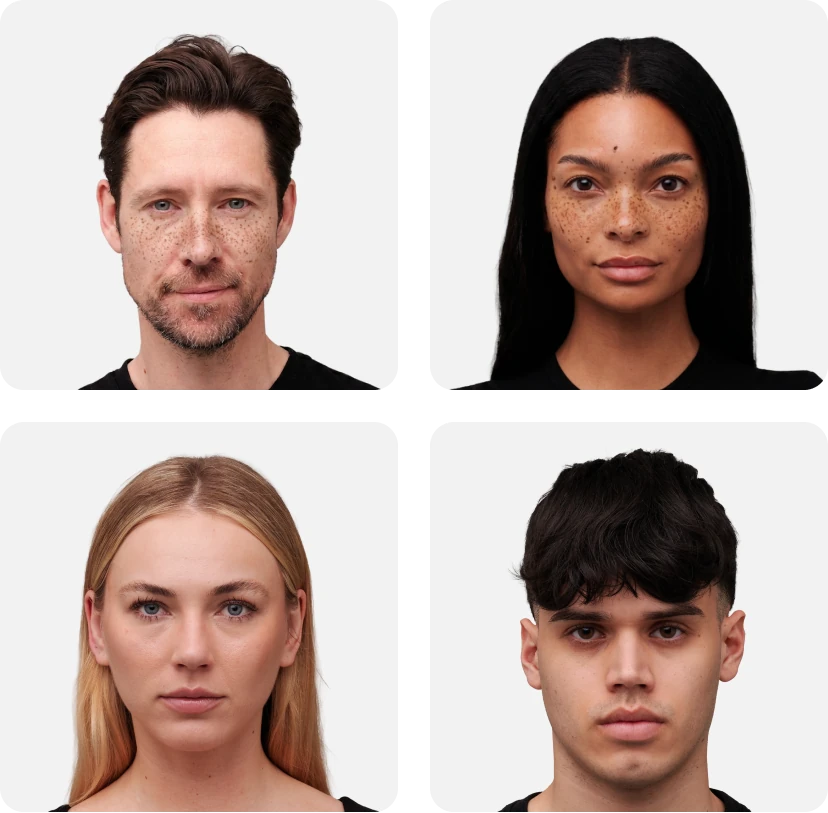
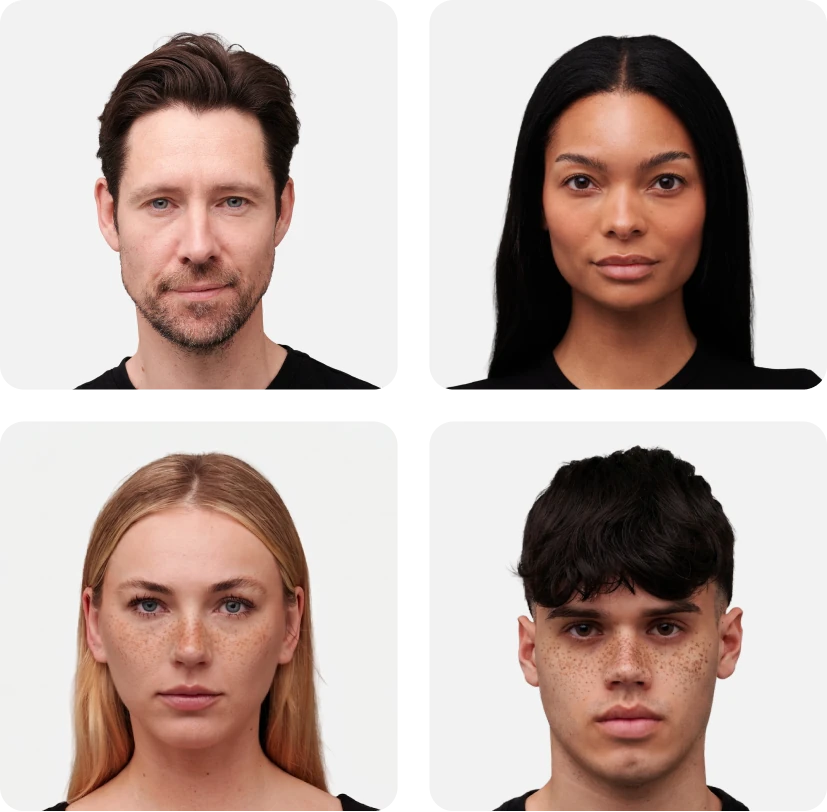
We posted the link to the experiment on our social media platforms (Instagram and LinkedIn), obtaining responses from 953 people. We assigned participants in alternating order to one of two groups, group A and group B, keeping the two groups approximately equal in size (A=468, B=485). In both groups, participants saw a series of faces one after the other, presented in a different random order for each participant. Participants were asked the following question in relation to every face:
The question
How attractive do you find this person? Please rate their face on a scale from 0 to 10, where 0 = Extremely unattractive and 10 = Extremely attractive.”

The design guaranteed that each group saw all faces, but only one version of a face: half the faces were shown with freckles and half without. The assignment of which faces were freckled was reversed between the two groups, so every face was rated both ways across the study, while no participant ever saw the same person twice.
This means we compared two versions of the same person rather than different people. Because every participant rated both freckled and unfreckled faces, differences in how generously people rate faces cancel out of the comparison, and the same is true for differences between the faces themselves.
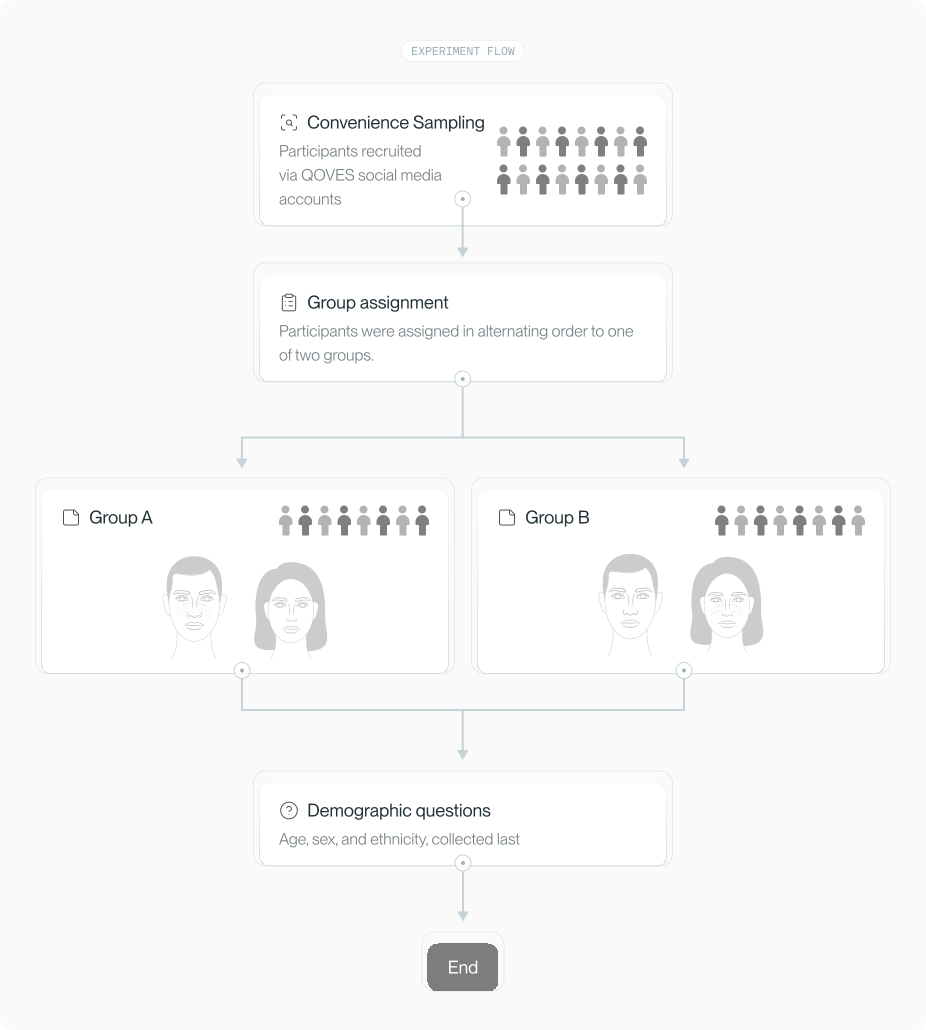
Once participants had rated all faces, they were asked some standard demographic questions and what they thought the study was about. We deliberately did not disclose in advance which facial feature we were studying, because naming freckles beforehand would likely have made participants pay special attention to them, so their ratings would no longer have reflected ordinary impressions. Asking what they thought the study was about let us check whether anyone worked it out. All participants were then fully debriefed.
Who took part
953 people, 92 countries.
Nearly half of our participants were 18-24 years old, and the number of participants decreased steadily across older age groups (Figure 1, left panel).
By a wide margin, most participants were men: 561 (61%) compared to 345 women (37%). Just 10 participants (1.1%) identified with another gender, and another 7 preferred not to say (center panel).
Most participants identified as heterosexual (88%). About one in ten identified with a different sexual orientation, most commonly bisexual (5%) or gay or lesbian (3%), and 1% preferred not to say (right panel).
Figure 1
Who our participants were
Counts among the 923 participants who completed the questionnaire. Percentages are of that group.
- 18-24
- 25-34
- 35-44
- 45-54
- 55+
Participants were resident in 92 countries (Figure 2). However, almost two thirds of participants lived in just ten countries, all of them in North America or Europe apart from India and Australia.
Figure 2
Where our participants live
Participant
- 1
- 2-5
- 6-10
- 11-25
- 26-50
- 51-100
- 100+
- None
What we found
The ratings barely moved.
From the two barplots shown below (Figure 3), we can see that the differences in scores between freckled and unfreckled faces were minimal; the distribution of scores and the average scores is basically the same.
Figure 3
How faces were rated, with and without freckles
Every rating given in the study, counted at each point on the 0-to-10 scale. The dashed line marks the average of each condition.
Unfreckled
Number of ratings
Rating (0-10)
Freckled
Number of ratings
Rating (0-10)
How small the effect is can also be seen in the graph below (Figure 4). Each row shows the average rating of a group of faces without freckles and with freckles, plotted on the real 0-to-10 scale, where the two points sit on top of each other. Each row therefore carries a magnified view of its own gap: across all faces the two averages differ by less than 0.01 points, and the largest difference in any group is under 0.06. Our analysis also shows that we cannot rule out that this difference is actually zero at the population level, and that the largest change compatible with our data is about 0.13 points, so even if freckles change how attractive a face looks, the change is still very small.
Figure 4
Average ratings with and without freckles
On the real 0-to-10 scale the two dots sit on top of each other, so each row carries a magnified view of its gap. The arrow points right where freckles raised the average and left where they lowered it.
- All faces+0.007Zoomed x81 · 0.02 points per step+0.0073.7963.803
- 3.76
- 3.78
- 3.80
- 3.82
- 3.84
- Female faces+0.021Zoomed x81 · 0.02 points per step+0.0214.1364.157
- 4.10
- 4.12
- 4.14
- 4.16
- 4.18
- Male faces-0.009Zoomed x81 · 0.02 points per step-0.0093.4583.449
- 3.42
- 3.44
- 3.46
- 3.48
- Black+0.033Zoomed x81 · 0.02 points per step+0.0334.0134.046
- 3.98
- 4.00
- 4.02
- 4.04
- 4.06
- 4.08
- East Asian+0.059Zoomed x81 · 0.02 points per step+0.0593.9584.017
- 3.92
- 3.94
- 3.96
- 3.98
- 4.00
- 4.02
- 4.04
- West Asian+0.008Zoomed x81 · 0.02 points per step+0.0083.2683.276
- 3.24
- 3.26
- 3.28
- 3.30
- White-0.056Zoomed x81 · 0.02 points per step-0.0563.9453.889
- 3.86
- 3.88
- 3.90
- 3.92
- 3.94
- 3.96
- 3.98
Average attractiveness rating (0-10 scale)
It is still interesting to see how the effect of freckles on attractiveness ratings, even though small, varied from face to face. For instance, we can observe in the plot below (Figure 5) that, in this sample, freckles were most beneficial for one face, raising its average rating by 0.23 points, and most detrimental for another, lowering it by 0.18 points.
Figure 5
Freckles helped about as many faces as they hurt
Each face appears once, on the side it landed. Bar length is how far its average rating moved.
Freckles lowered the rating
19 faces
By 0.091 points on average
Freckles raised the rating
21 faces
By 0.099 points on average
Bar length: change in average rating, full width = 0.229
Almost no characteristic we measured separates the faces that benefited from those that did not: neither sex, ethnicity, baseline attractiveness, nor the number of freckles applied. The one exception was the age of the face, with freckles faring slightly better on younger faces (Figure 6): every ten years of age was worth about 0.06 points less, so across the whole age range in our set, from 20 to 48, the effect shifts by around 0.16 points. However, the faces shown were mostly of people under 35, with only six aged 35 or over.
Figure 6
Freckles did slightly better on younger faces
One dot per face: where it sits left to right is the age of that face, up or down is how its rating changed. The dashed line is the overall trend.
Change in average rating
Freckles helped
Freckles hurt
Age of the face (years)
The people doing the rating mattered just as little. Men and women responded to freckles in much the same way, and older and younger raters barely differed either. One combination is still worth naming: when we looked at men and women rating male and female faces separately (Figure 7), only men rating female faces showed any change, giving slightly higher scores when freckles were added, by about 0.07 points. The other three combinations were indistinguishable from zero (men rating male faces, women rating female faces, and women rating male faces).
Figure 7
Only men rating female faces showed a change
One row per combination of who was rating and whose face they were rating. A dot on the centre line means freckles made no difference. Every rater saw both male and female faces, so all four rows come from the same people.
No difference
- Men rating women’s faces+0.066
- Men rating men’s faces−0.003
- Women rating women’s faces−0.010
- Women rating men’s faces+0.001
Change in average rating (0-10 scale)
Conclusions
No convincing evidence, either way.
We found no convincing evidence that freckles impact people’s attractiveness in any significant way, either positively or negatively. Furthermore, even if the effect we found could effectively be attributed to freckles, this effect is very small, equivalent to roughly 0.013 on a 0 to 10 attractiveness scale. It seems that one of the reasons for this small effect is that individual raters do differ in whether freckles help or hurt, by around a sixth (0.17) of a rating point either way. This means that the effect cancels out: for every person freckles nudge upward there is another they nudge downward, so the population average lands at 0.013.
However, it is not clear what factors determine the direction of the effect. In our sample, freckles were slightly more positive for female faces and for certain ethnicities, and slightly more negative for male faces and other ethnicities. They also fared a little better on younger faces, and when men were the ones rating women’s faces. These are patterns we can see in our sample. Whether they would hold for other faces and other raters is a question a further study would have to settle.
Overall, freckles do not seem to have a strong impact on facial attractiveness. With further studies we might be able to identify specifically which kinds of face benefit from freckles and which do not. In the meantime, it would be better for people to focus first on other aspects of their looks that have a greater impact and consider freckles afterwards.
Limitations
What we could not control.
Recruitment
Recruitment was carried out through QOVES social media, which means that most participants are very likely to be people following QOVES accounts and interested in facial aesthetics. This implies a challenge to the generalizability of the results. However, the ratings our participants gave the unedited faces corresponded closely with those collected independently by the creators of the London Set, which suggests they judged faces much as other samples have. Whether their response to freckles in particular is equally typical remains unknown.
Screen size
Participants could take part on any device, whether a laptop, tablet, or smartphone, provided the screen met a minimum size. Because each face was displayed at a size that scaled with the screen, the freckles appeared smaller, and were probably harder to see, on the smallest devices. This seems to have mattered: the effect of freckles differed between people who used different screen sizes, lowering ratings slightly among those on larger screens while having no measurable effect among those on smaller ones. Participants chose their own device rather than being assigned one, so we cannot be certain the screen itself was responsible, and relatively few took part on a large screen.
The stimuli
Freckles were confined to an anatomically defined nose-and-cheek region; the results therefore only apply to freckles that are confined to that facial region rather than to the natural range of variation. The number of freckles applied also varied only within a limited range (from 65 to 166). Within that range, the number made no difference to how the faces were rated, but we cannot say what would happen with substantially denser coverage. Moreover, even though we aimed to keep a similar contrast between skin tone and freckles for faces across ethnicities, it is still possible that they were less noticeable in some faces. Further studies would require a greater number and more diverse set of faces, freckles across a wider range of facial regions and densities, and more control over how they are generated so that they are equally visible across skin tones.
Open data
All our data is public.
The data collected and the data analysis script can be found on the corresponding Open Science Framework webpage for this project (https://osf.io/bpzag/files/osfstorage).
References
- 7
Ho, S. G. Y., Chan, N. P. Y., Yeung, C. K., Shek, S. Y., Kono, T., & Chan, H. H. L. (2012). A retrospective analysis of the management of freckles and lentigines using four different pigment lasers on Asian skin. Journal of Cosmetic and Laser Therapy, 14(2), 74–80. https://doi.org/10.3109/14764172.2012.670707
- 14
Stephen, I. D., Scott, I. M. L., Coetzee, V., Pound, N., Perrett, D. I., & Penton-Voak, I. S. (2012). Cross-cultural effects of color, but not morphological masculinity, on perceived attractiveness of men's faces. Evolution and Human Behavior, 33(4), 260–267. https://doi.org/10.1016/j.evolhumbehav.2011.10.003