QOVES
Research Fellowships
QOVES is interested in supporting scientific research that provides empirical answers to two key questions: (i) What makes a face attractive? (ii) What works to improve facial attractiveness?
We are also open to supporting investigations into the following topics: (iii) the social, environmental, and evolutionary reasons why we find certain facial features attractive, (iv) the effect of an individual’s physical appearance on their life outcomes, (v) how one’s facial features influence others’ perceptions, (vi) cultural variation in beauty standards and beautification practices (especially research that explains such variation with reference to the ecology), (vii) methods in facial aesthetics (e.g., facial measurement technology), (viii) mate preferences for physical attractiveness (especially research that explains their variation), and (ix) AI face perception. Exceptional applications outside of this topic list—so long as they relate to the study of physical appearance—will also be considered.
Who is eligible?
We believe anthropologists, psychologists, biologists, computational scientists and machine-learning researchers, sociologists, economists, dentists, dermatologists, as well as plastic and maxillofacial surgeons are all well-placed to send proposals for research that will provide insights into these topics; however, we are open to applicants from all fields. Our only requirements to apply for funding are as follows:
- Researchers must have IRB access through a home institution (e.g., your university).
- The lead or supervising author must have graduate-level research experience (current graduate students are encouraged to apply).
- At least one co-author must have a PhD, DPhil, or MD.
WHAT TO SUBMIT
To apply, we need your email so we can contact you, and we need to review your curriculum vitae and your research proposal. For your research proposal, please include a 3-page PDF that includes:
(i)
A 250-word abstract of your study proposal.
(ii)
A draft or outline of the introduction and methods section for the manuscript which will result from your proposed study.
(iii)
A timeline for your study, from now until submission.
(iv)
An itemized budget (for studies using human participants, this includes a per subject cost estimate and a sample size justified with a power analysis).
Reviewed by
this committee
SOCIAL SCIENCE APPLICATIONS
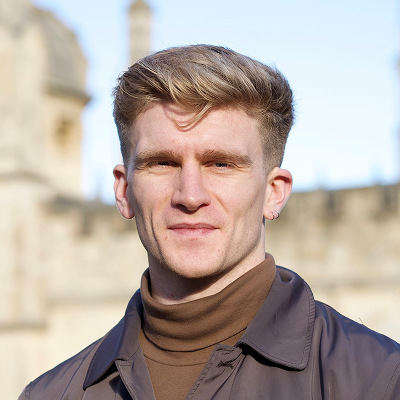
Macken Murphy
Chief Scientist
MSc Cognitive & Evolutionary Anthropology, University of Oxford

Santiago Grandas
Head of Psychological Research
MSc Psychological Research, University of Oxford
TECHNOLOGY APPLICATIONS

Mohit Mendiratta
Head of AI Research
Computer Vision Researcher, Max Planck Institute
Apply for Research Funding
To apply for funding, please submit your name, email, curriculum vitae, and a 3-page research proposal.
Access QOVES Technology for Research
Our company specializes in automated high-quality measurements from facial images and we have a state-of-the-art toolkit for stimulus construction.
If you would like morphological measurements of faces from photographs for your research (e.g., you wish to measure fWHR of participants) we can help provide those. Additionally, we have proprietary software that can produce realistic facial edits for stimuli (e.g., if you wish to edit the brows of faces to see how this affects participant perceptions), and we are open to using this technology to produce stimuli for studies.
If you are applying for funding, whether your study proposal includes Qoves tech will not affect your probability of acceptance.
If you would like to use QOVES technology for academic research, please email:
Recruit more participants
with QOVES
QOVES has 2M+ followers across platforms, and we are open to sharing your research with our audience to help expand your reach.
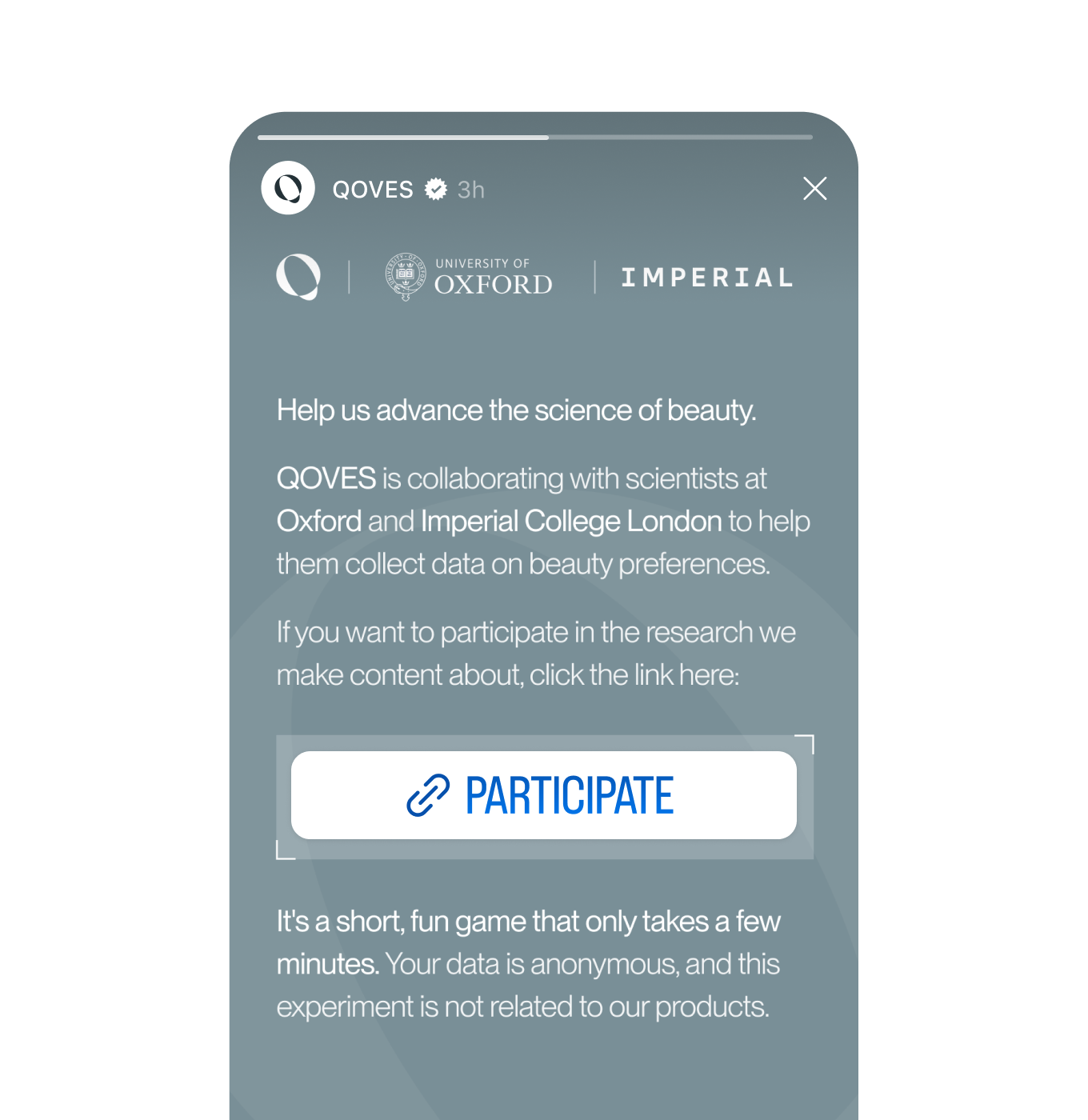
Recently, we have assisted researchers at the University of Oxford and Imperial with recruiting participants by sharing their participation link with our 1M+ Instagram followers.
If you would like to recruit participants using QOVES social media, please email:

Conditions of support: (i) all publications must mention Qoves in the acknowledgments, as well as in a conflict of interest statement (or equivalent) for studies where perceived conflict is plausible, (ii) data collection must begin within 6 months of application acceptance (extensions will be considered), (iii) successful applicants will make a good faith effort to thank Qoves in any public-facing discussion of the research resulting from the fellowship (e.g., on podcasts, in blog articles, in media interviews, etc).