1
Upload Your Photos
Upload 6 clear photos of your face securely and privately through our online portal.
Drag and drop file To upload
POSES REQUIRED


The canthal tilt, colloquially called fox eyes when the lateral corner sits high, is the orientation of the line connecting the inner and outer corners of the eye against the horizontal. It is one of the most cited shape signals in facial analysis, carrying information about youth, sex differences, and how alert or tired a face reads at a glance.
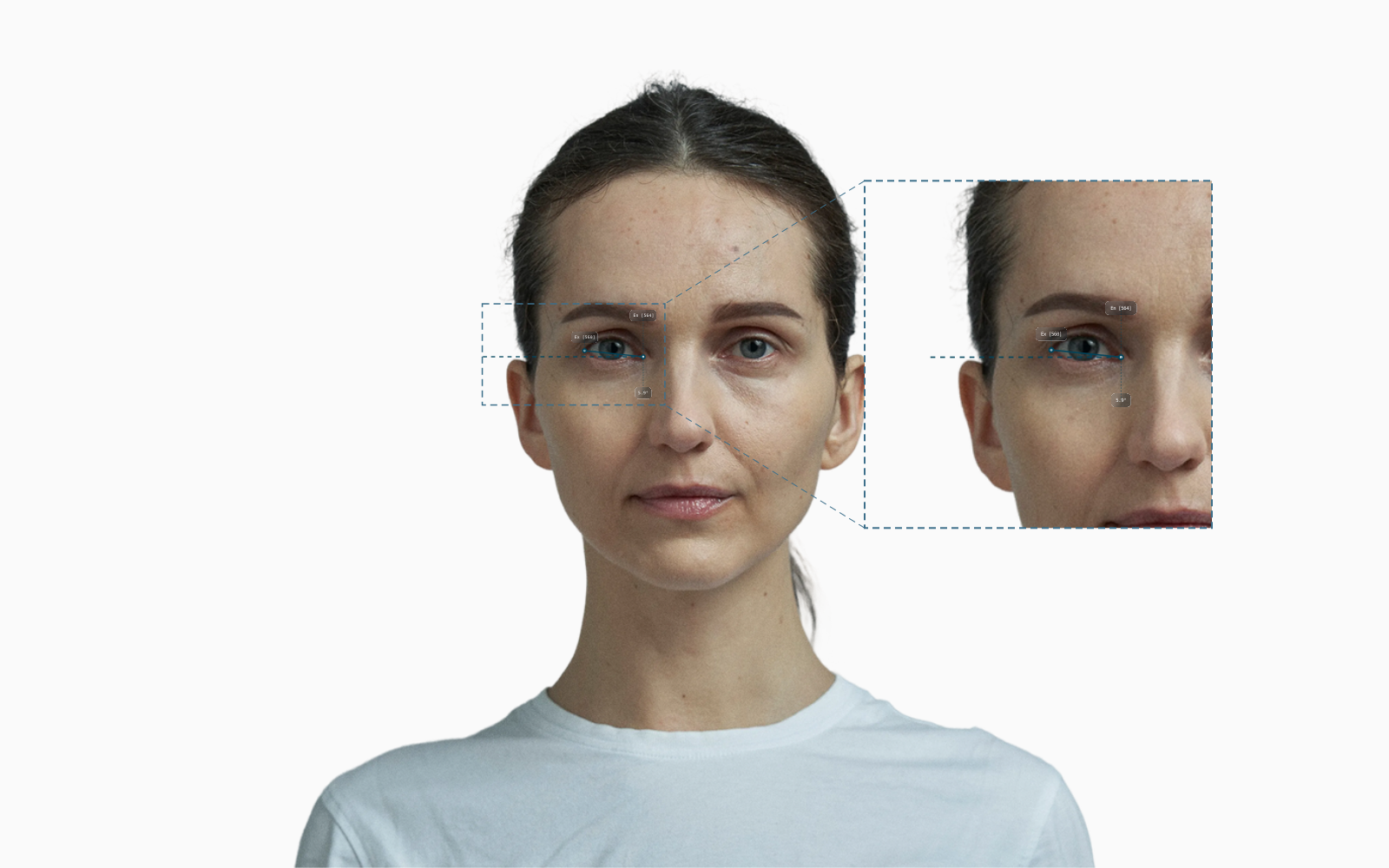
How It's Measured
Canthal tilt is the orientation of the intercanthal axis, the line that runs from the inner corner of the eye to the outer corner. Clinically, it is read against the true horizontal or the Frankfort plane (a head-position reference used in cephalometry, as documented in Naini, 2011):
When the lateral canthus sits higher than the medial canthus, the tilt is positive and the eye reads upturned. When it sits lower, the tilt is negative and the eye reads downturned. A flat axis is described as neutral. Naini (2011) notes that the modern convention is to describe the slant as inferomedial or inferolateral, avoiding older racialised terms.

Left: the original front-facing photo. Right: the same person with the outer eye corners lifted. The canthal tilt goes from 5.7° to 10.3°, and nothing else in the photo changed.
Why It Matters
Canthal tilt is one of the most legible youth and femininity signals on a human face. A slightly upturned axis lifts the periorbital region, narrows the visible eye opening at its lateral end, and is part of the cluster of features that perception research has repeatedly linked to attractiveness ratings in adult women, alongside large eyes, a short philtrum, and prominent cheekbones (Kuraguchi et al., 2015; Cunningham, 1986).
The signal is not universal, and that nuance matters in clinical work. Canthal-axis orientation varies meaningfully across populations: East Asian patients more often present with an inferomedial slant that participates in the characteristic eye shape, while many Caucasian and African profiles cluster closer to neutral or mildly positive. Reading every face against a single Western ideal misclassifies a healthy face as something to fix, which is one reason Naini (2011) recommends describing the slant by direction rather than against an absolute target.
The other reason this measurement carries weight is that it changes. Lateral canthal descent is one of the earliest visible signs of periorbital ageing. The lateral canthal tendon loosens, the lid margin drifts inferiorly, and a face that read as alert in its twenties reads as tired in its forties. Periorbital procedures from canthopexy through midface lift are explicitly designed to reset that vector (Pascali et al. discussion, 2017). For exact normative bands and where your axis sits against population means, see the stat-cards and demographic table below.
The fox eyes look that swept social media in the early 2020s is an exaggerated positive canthal tilt; the surgical and makeup trends both target the same anatomical axis.
0° to +4°
Men
+2° to +8°
Women
0° to +10°
Typical range
Fig 1. Canthal tilt is typically reported in degrees above (positive) or below (negative) the true horizontal. Individual values vary with bony orbit shape, ethnicity, and age.
Demographic Variants
Normative orientation varies by sex, ethnicity, and age. Each row links to a dedicated page with full citations and population means.
Demographic | Typical orientation | Source |
|---|---|---|
Women | Mildly positive, +2° to +8° | |
Men | Neutral to mildly positive, 0° to +4° | |
East Asian profiles | Often inferomedial slant, axis frequently sits higher laterally | |
Older adults (both sexes) | Lateral canthal descent reduces the axis toward neutral or negative |
Upload 6 clear photos of your face securely and privately through our online portal.
Drag and drop file To upload
POSES REQUIRED
We measure 160+ facial markers, including skin quality, symmetry, eye shape, brow density, and more.


You’ll receive a plan highlighting your strengths, areas for improvement, and best ways to improve your appearance.
Emma’s Report
January 16, 2026
Explanation
Your forehead wrinkle depth aligns with expectations for your age and demographic, falling on the lower end of our predicted range.
Your Questions
A negative canthal tilt means the lateral corner of the eye sits lower than the inner corner, so the intercanthal axis slopes downward from nose to temple. Naini's clinical convention is to describe this as an inferolateral slant of the palpebral fissure rather than using older racialised terms (Naini, 2011). The face often reads as more relaxed, tired, or sombre, but the value alone does not diagnose a problem; it has to be read against the rest of the periorbital region.
Most negative tilts come from one of two sources. The first is bony orbit geometry. The inclination of the lateral orbital wall and the position of the zygomatic tubercle are set in development and largely stable through adult life. The second is acquired lateral canthal descent, a hallmark of periorbital ageing in which the lateral canthal tendon loosens and the lid margin drifts inferiorly; Naini (2011) describes this as part of the typical descent of facial soft tissues, and corrective work is the focus of the periorbital-anchoring literature (Pascali et al. discussion, 2017).
Surgical correction of the lateral canthal axis is well established. Lateral canthopexy tightens the lateral canthal tendon and lifts the lateral corner; canthoplasty detaches and re-anchors the tendon for larger corrections; and vertical midface lift with periorbital anchoring addresses both the lid position and the supporting cheek descent at once. Pascali et al. (discussion, 2017) reviews the long-term outcomes and complication profile in 199 patients. Non-surgical paths (tape, brow training, makeup) shift perceived tilt but do not move the anatomy.
Perception research consistently associates a mildly positive tilt with higher attractiveness ratings in adult female faces, alongside the rest of the youth-coded cluster (large eyes, a short philtrum, full lips). Kuraguchi et al. (2015) frames this as the baby-schema component of beauty judgments. For male faces the evidence is more mixed. Cunningham et al. (1990) finds attractiveness ratings driven more by maturity cues than by tilt alone, so a neutral axis on a man often reads as composed rather than tired.