1
Upload Your Photos
Upload 6 clear photos of your face securely and privately through our online portal.
Drag and drop file To upload
POSES REQUIRED


The gonial angle, also called the mandibular angle or the jaw angle, is the angle formed where the ramus of the lower jaw meets its body. It is what makes a jawline read as square and angular or rounded and soft in profile, and it is the value plastic surgeons, orthodontists and laypeople actually mean when they talk about the lower third.
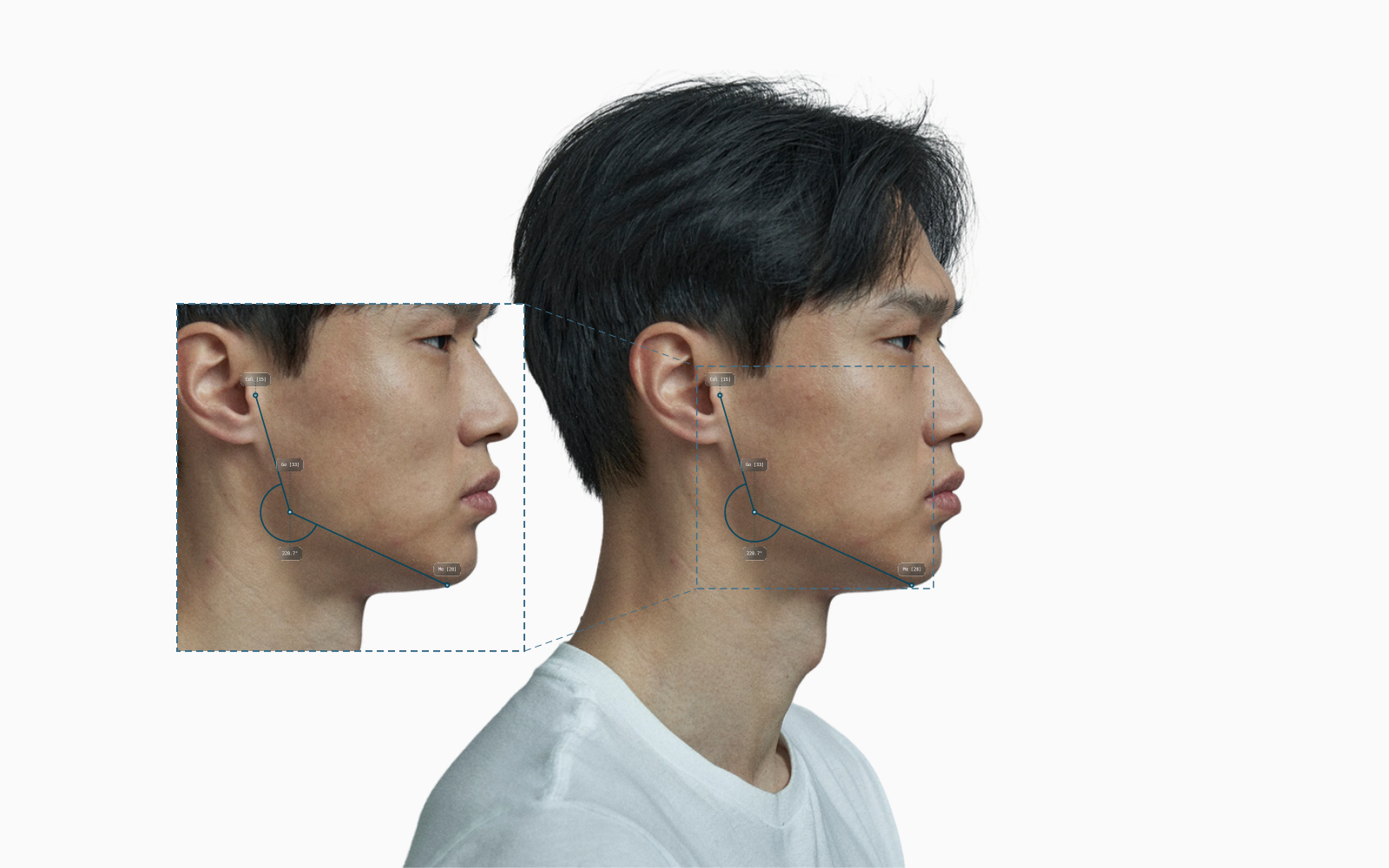
How It's Measured
The gonial angle is read off a side view of the lower face. Cephalometric tradition labels it Ar-Go-Me, the angle formed at the gonion between the posterior border of the mandibular ramus and the mandibular plane (Naini, 2014). It is defined by three anatomical landmarks:
A larger gonial angle means the ramus and body meet more gently, producing a softer jawline. A smaller angle means they meet more sharply, producing a more squared profile.

Left: the original side-profile photo. Right: the same person with a sharper jaw angle. The gonial angle goes from 138.0° to 130.3°, and nothing else in the photo changed.
Why It Matters
The gonial angle decides how angular the lower third of the face reads. A reduced angle goes with a hypodivergent face: increased bigonial width, masseteric hypertrophy and a square lower face (Naini, 2014). An increased angle pulls the same anatomy the other way, toward a hyperdivergent or long-face pattern with a longer lower third and a softer jaw line. The angle is highly correlated with the mandibular plane angle, so reading it well doubles as a quick read of the vertical growth pattern of the whole lower face.
It is also where the male and female face diverge most visibly. The male mandible carries broader bigonial width and the ramus drops down more vertically before turning anteriorly with a relatively pronounced corner. The female jaw line curves more gently from ear to chin (Naini, 2014). A broader, more defined male jaw is read as attractive and socially dominant across many studies and across cultures, with cross-cultural rating work tying broad male jaws to perceived dominance and mate value (Grammer & Thornhill, 1994). The same masculine architecture is theorised to function as a testosterone-mediated immunocompetence signal (Scheib et al., 1999), which is why a few degrees on this angle pull so much aesthetic weight.
The clinical implication is that no single ideal gonial angle exists. The most-cited Western reference is Riolo's 1974 norm of 124° ± 6° in males and 122° ± 4° in females, with a UK sample by Bhatia and Leighton centred slightly higher at 126° and 128° (both summarised in Naini, 2014). The values vary by population and by sex, so the right target for a jaw-filler, masseter botox or orthognathic plan is the band for the patient's phenotype rather than a universal number.
The ranges below give the typical bands.
Plastic surgeons and orthodontists also call the gonial angle the jaw angle or mandibular angle. Three names for the same geometry where the mandibular ramus meets its body.
118°–130°
Men
118°–126°
Women
120°–130°
Typical Range
These values vary depending on individual facial structure and population. Riolo et al. (1974) US norms shown.
Demographic Variants
Normative ranges vary by population. Each row links to a dedicated page with full citations.
Demographic | Ideal range | Source |
|---|---|---|
US men (Caucasian) | 118°–130° | |
US women (Caucasian) | 118°–126° | |
UK men (Caucasian) | 120°–132° | |
UK women (Caucasian) | 123°–133° |
Upload 6 clear photos of your face securely and privately through our online portal.
Drag and drop file To upload
POSES REQUIRED
We measure 160+ facial markers, including skin quality, symmetry, eye shape, brow density, and more.


You’ll receive a plan highlighting your strengths, areas for improvement, and best ways to improve your appearance.
Emma’s Report
January 16, 2026
Explanation
Your forehead wrinkle depth aligns with expectations for your age and demographic, falling on the lower end of our predicted range.
Your Questions
No single universal ideal exists. Studied means cluster around 120° to 130° in healthy adults, with women a few degrees higher than men in most samples. The most-cited US reference is 124° ± 6° in males and 122° ± 4° in females from Riolo et al. 1974, and a UK sample by Bhatia and Leighton centred slightly higher at 126° ± 6° and 128° ± 5° (both summarised in Naini, 2014). The right reference depends on the patient's population and sex rather than a textbook constant.
A high (obtuse) gonial angle is the cephalometric signature of a hyperdivergent or long face pattern. The mandibular plane is steeper, the ramus is taller and the lower third is longer, with the jaw line reading as softer and less defined (Naini, 2014). A low (acute) gonial angle is the opposite. It goes with a hypodivergent or short face pattern, with broader bigonial width, masseteric hypertrophy and a square lower face. Most healthy adults sit between 120° and 130°.
The male mandible is larger overall, with broader bigonial width, and the ramus drops down relatively vertically from the ear before turning sharply at the gonion. The female jaw line curves more gently from ear to chin (Naini, 2014). Numerically the means sit close together, a few degrees apart in most samples, but the perceptual difference is driven less by the angle alone than by how it interacts with bigonial width, ramus height and masseter mass. A broader, more defined male jaw is also rated as more attractive and socially dominant across many studies (Grammer & Thornhill, 1994).
It depends on which component is driving it. A high angle from a hyperdivergent skeletal pattern is a bone problem and is treated surgically, typically with orthognathic surgery to rotate the mandible counterclockwise, sometimes with mandibular angle reduction or a vertical-ramus osteotomy (Naini, 2014). A low angle that looks heavy because of bulky masseters is a soft-tissue problem and is more often treated with masseter botulinum toxin to slim the lower face (Carruthers et al., 2008). Jaw and chin fillers can sharpen the visual angle without changing the bony measurement. The clinic-side question is always which lever moves the look the patient wants: the geometry, the muscle bulk, or the soft-tissue contour.