Back to Insight

Facial Procedures

Do LED face masks work? What the trials show

LED face masks can soften fine lines a little, and the evidence is best for the skin around the eyes. In the strongest trial we found, 25 of 29 people who used a red and near-infrared mask at home for 12 weeks had visibly better crow's feet, against 5 of 30 using a low-power dummy mask (Park et al., 2025)(1).

Most other claims rest on less. Acne does best with blue and red light together, and the rosacea and eczema claims have little behind them. Side effects have been mild, but if you have an eye condition, check with a doctor first.

Start My Plan
    Red light therapy LED face mask

    What red light therapy is

    Red light therapy shines red and near-infrared light onto the skin. You will also see it called photobiomodulation or low-level light therapy, and an LED face mask is the at-home version.

    Most of the wrinkle trials below paired visible red light at 630 to 633nm with near-infrared light at 830 to 850nm, which you cannot see (Lee et al., 2007; Park et al., 2025)(2)(1). None of it is ultraviolet light. Visible light can travel through the full thickness of the skin (Austin et al., 2021)(3).

    So what does it do once it gets there?

    Red light therapy LED face mask
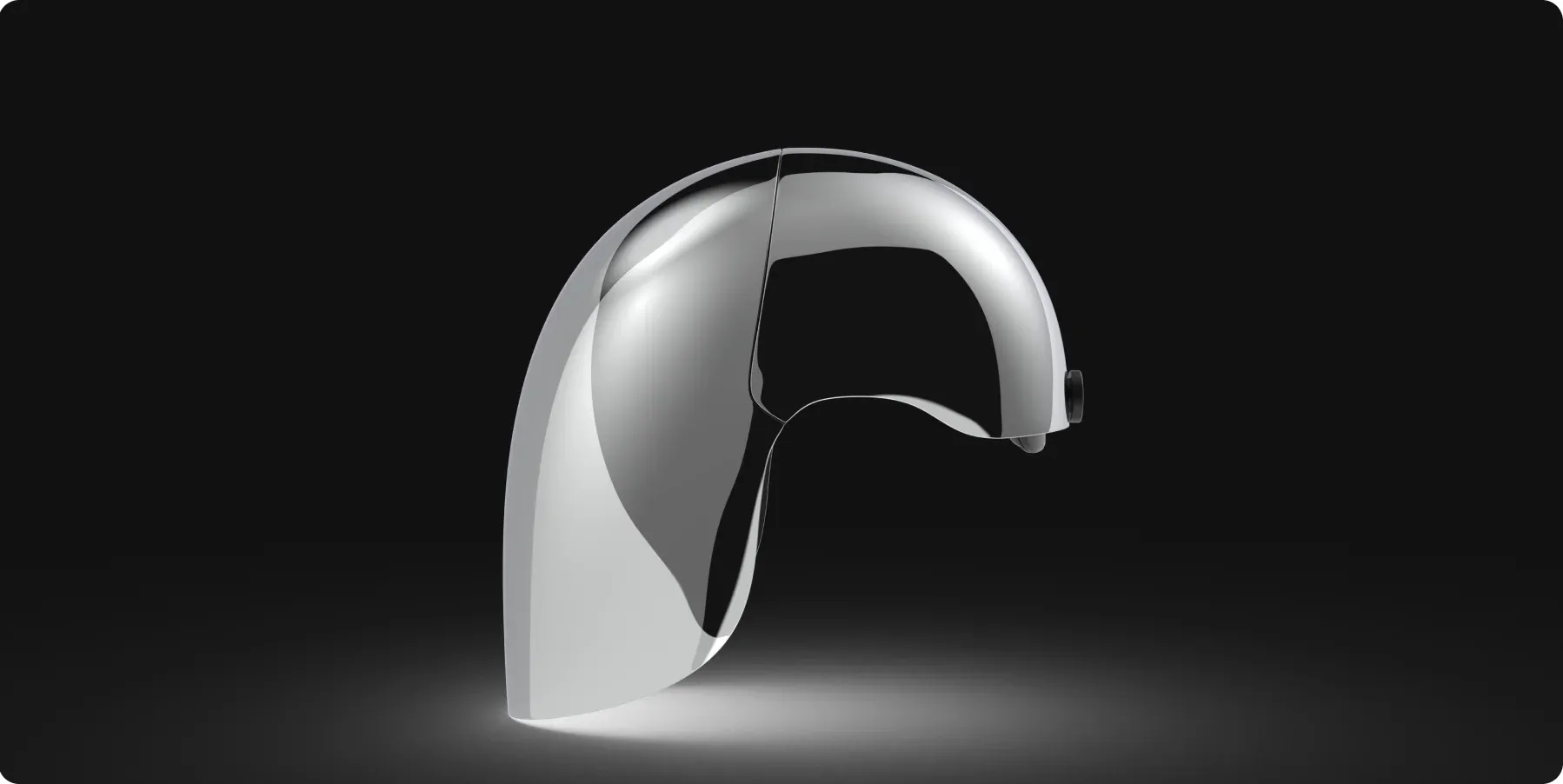
    Figure 1

    An at-home LED face mask.

    How light is supposed to change skin

    The leading explanation starts inside your cells. An enzyme in the mitochondria called cytochrome c oxidase absorbs red and near-infrared light (Avci et al., 2013)(4).

    Its absorption is strongest in four bands, around 614 to 624nm, 668 to 684nm, 751 to 772nm and 813 to 846nm (Karu and Kolyakov, 2005)(5). The 830nm light used in many masks sits in the last band, and the common 630nm red sits just above the first.

    Absorbing the light is thought to free the enzyme from nitric oxide, which blocks it. The cell then makes more ATP, its energy supply, and switches on genes linked to repair, with more collagen and less inflammation as the result (Avci et al., 2013)(4).

    Avci and colleagues call that mechanism a hypothesis, and the therapy "somewhat controversial", partly because it is still unclear how the light produces its effects.

    How light is thought to act on a skin cell

    1

    Light reaches the cell

    Red or near-infrared light passes into the skin.

    2

    An enzyme absorbs it

    Cytochrome c oxidase absorbs it, most strongly near 620, 680, 760 and 830nm.

    3

    Nitric oxide lets go

    The light frees the enzyme from nitric oxide, which was blocking it.

    4

    Energy flow resumes

    Electrons move more freely along the mitochondria's energy chain.

    5

    ATP rises

    The cell makes more of its energy supply.

    6

    Signals shift

    Reactive oxygen species, which act as signals, rise.

    7

    Genes switch on

    Transcription factors turn on genes linked to repair.

    8

    Repair

    In lab studies, collagen production rises and inflammation falls.

    Figure 2-How light is thought to act on a skin cell

    The leading explanation, worked out mostly in cell and animal studies. Source: Avci et al. (2013); absorption bands from Karu and Kolyakov (2005).

    What the trials show for wrinkles

    A mechanism worked out in cells is not proof that a mask changes a face. For that you need a trial where some people get a dummy device and nobody knows who has which.

    In the strongest one we found, Park and colleagues (2025)(1) gave 60 adults with crow's feet either a home mask with 630nm red and 850nm near-infrared light, or a sham, a dummy mask that gave off only red light at a tenth of the strength. Both groups used it for 9 minutes, five times a week, for 12 weeks.

    An independent rater scored photos of each face. Crow's feet improved by at least one grade in 25 of 29 mask users (86.2%) and in 5 of 30 sham users (16.7%), and the gap was already clear by week 8.

    The participants' own ratings, though, did not differ clearly between the groups, and the mask's maker, Y&J Bio, paid for the trial.

    Crow's feet improved at week 12

    Home mask, 630nm and 850nmLow-power sham
    86.2%
    16.7%
    0255075100

    % of participants who improved

    Figure 3

    Share of people whose crow's feet improved by at least one grade at rest, scored from photos by an independent rater: 25 of 29 on the mask (630nm and 850nm) and 5 of 30 on a sham that gave off low-power red light. The participants' own ratings did not differ significantly. The mask's maker paid for the trial. Source: Park et al. (2025).

    An older trial measured the skin directly. Lee and colleagues (2007)(2) treated the right side of the face in 76 people twice a week for four weeks, with 633nm red, 830nm near-infrared, both, or a sham light, and followed them for three months.

    All three active lights improved wrinkles and elasticity, measured against each person's starting point, and the sham light did not. The biggest gains were 36% for wrinkles with the combination and 19% for elasticity with 830nm alone (Jagdeo et al., 2018)(6). Skin samples showed more collagen and elastic fibers in every treated group (Lee et al., 2007)(2).

    Improvement by type of light

    Wrinkles
    Elasticity
    403020100
    633nm redred alone
    830nmnear-infrared alone
    Both633nm and 830nm
    Figure 4

    Improvement in wrinkles and skin elasticity against each person's own starting point, 76 people treated twice a week for four weeks and followed for three months. The sham light made no difference. Group figures as tabulated by Jagdeo et al. (2018) from Lee et al. (2007).

    Two more studies point the same way, but neither had a comparison group, so there is nothing to measure them against. Russell and colleagues (2005)(7) gave 31 people nine sessions of 633nm and 830nm light. By week 12, 52% had improved by 25 to 50% on a photo-based aging score, and 81% said their eye wrinkles had improved.

    A 2023 study of a red-only home mask made by Dior and Lucibel reported crow's feet 38% shallower after three months of twice-weekly use. It had 20 people, and its authors came from both companies (Couturaud et al., 2023)(8).

    Results with no comparison group

    Improved 25 to 50% on a photo aging scoreSaid their eye wrinkles improved
    52%
    81%
    0255075100

    % of participants

    Figure 5

    31 people, nine sessions of 633nm and 830nm light, results at week 12. The first figure is a clinical score from photos and the second is the participants' own report. With no comparison group, neither can be put down to the light alone. Source: Russell et al. (2005).

    You will also see masks sold for a brighter skin tone. The evidence for that is a side note from an acne trial by Lee's group, in which 14 of 24 patients said, unprompted, that their skin looked brighter, and their melanin readings fell (Lee, You and Park, 2007)(9). That trial alternated blue and red light, so it says little about red light alone.

    A mask treats your skin without telling you where it stands. Skin quality is one of the more than 160 facial markers a QOVES facial analysis measures from your photos, and it reads each one against norms for your own background.

    Where the evidence is thinner

    Fine lines are the strongest case. Masks are also sold for acne, redness and healing, where the trials are fewer and smaller.

    Acne

    Red light on its own has only small trials behind it. In one, Na and Suh (2007)(10) treated one side of the face in 28 people and found fewer spots on that side, but by a 16-week follow-up, 21 of 22 patients said their acne had come back (as cited in Jagdeo et al., 2018)(6).

    The larger acne trials we found used blue and red light together, probably because blue light works against the bacteria and red light against the inflammation. In a 2000 trial of 107 people, blue and red light reduced inflamed spots by 76% over 12 weeks, more than white light did and, by weeks 8 and 12, more than benzoyl peroxide cream (Papageorgiou et al., 2000)(11).

    At home, a blue and red device cut inflamed spots by 77% at 12 weeks in a 2013 trial of 35 people, while a sham device made no difference (Kwon et al., 2013)(12). A 2025 review pooled six trials of home devices with 216 people in all. Inflamed spots improved about 45% more than in the control groups, though the devices and doses varied so much that the authors warn the results may not apply to devices on sale now (Ershadi and Barbieri, 2025)(13).

    Blue light alone looks weaker. A 2019 review of 14 trials found the evidence too limited to draw conclusions (Scott et al., 2019)(14).

    Rosacea and eczema

    For rosacea, the evidence for red and blue light is two case reports (Sorbellini et al., 2020)(15). For eczema, a 2023 review found the studies too inconsistent to give a reliable answer (Ngoc et al., 2023)(16).

    Healing after procedures

    NASA funded early work on LED light and wound healing. In an early paper from that program, Whelan and colleagues (2001)(17) reported that cuts healed faster in crew aboard a US Navy submarine.

    Closer to skincare, a pilot study of 10 people found that redness faded faster after laser resurfacing on the side of the face treated with 635nm LED light (Oh et al., 2013)(18). A 2015 review argues that 830nm light also speeds recovery after other cosmetic procedures (Calderhead et al., 2015)(19).

    In a 2024 trial, red and infrared LED light showed a trend toward faster healing of diabetic foot ulcers (Borges et al., 2024)(20), which is a long way from a face mask.
    What to check if you use one

    If you do want to try a mask, a few details decide whether it resembles what was tested.

    Start with the wavelength. The trials above used red light around 630 to 660nm and near-infrared around 830 to 850nm, so a mask that lists those numbers is close to what was studied.

    The wavelengths the trials used

    630 to 660nm
    830 to 850nm
    600650700750800850

    Wavelength (nm)

    630 to 660nm, visible red

    Seen as
    Red light
    Studied for
    Fine lines with near-infrared, acne with blue light, redness after laser resurfacing

    830 to 850nm, near-infrared

    Seen as
    Invisible
    Studied for
    Fine lines and skin elasticity, recovery after cosmetic procedures
    Figure 6

    Wavelength ranges used in the trials in this article. Visible light, red included, can reach the full thickness of the skin (Austin et al., 2021).

    More light is not better. Lab and animal studies of this kind of light show a biphasic response: low doses work better than high ones, and too much light blunts the effect or even reverses it (Huang et al., 2009)(21). One likely reason is that reactive oxygen species help cells as signals at low levels and harm them at high ones (Huang et al., 2011)(22).

    How dose changes the effect

    Schematic, axes unscaled

    Biological effect

    Too little: small effect

    Useful range

    Too much: blunted or reversed

    Lower doseHigher dose
    Figure 7

    A sketch of the biphasic response, not data. The studies behind it are mostly cell and animal work and give no dose for a face mask, so the axes carry no numbers. Sources: Huang et al. (2009); Huang et al. (2011).

    Frequency seems to matter less. The trials in this article ran from twice a week to twice a day, and a 2025 trial that compared schedules in 95 women using a 660nm mask found three sessions a week no better than two (Bragato et al., 2025)(23). Follow the instructions that come with your device.

    Last, check the clearance. In the US, masks sold to reduce wrinkles or treat acne are Class II medical devices. A home mask cleared in 2023, for example, is listed under the FDA's codes for over-the-counter wrinkle and acne devices (FDA, 2023)(24). Devices like this reach the market through a 510(k), which shows the FDA that a device is substantially equivalent to one already sold. The FDA calls that "clearing" the device, which is not the same as approving it (FDA, 2024)(25).

    Who should be careful

    Clearance does not mean a mask suits everyone, though problems have been rare. In trials of home devices, side effects were mild, such as dryness, redness or discomfort (Ershadi and Barbieri, 2025)(13). A 2023 review found no sign that this kind of light raises cancer risk, and only mild, passing redness in 4 patients across its clinical trials (Glass, 2023)(26).

    Your eyes are the main concern. In 2019 Neutrogena recalled its Light Therapy Acne Mask, saying that for people with certain eye conditions, or taking medicines that make the eyes more sensitive to light, there was "a theoretical risk of eye injury" (Association of Optometrists, 2019)(27).

    A 2026 case report describes a woman who developed acute angle closure, a sudden build-up of pressure, in both eyes after two weeks of using a red light mask. She recovered with treatment. Its authors say it is the first case of its kind described with an at-home mask, and one case cannot show the mask caused it (Labkovich et al., 2026)(28).

    If you have an eye condition, take a medicine that makes you sensitive to light, or are being treated for a skin condition, talk to a doctor before you start.

    References

    1. 1

      Park et al. (2025). Clinical study to evaluate the efficacy and safety of home-used LED and IRED mask for crow's feet: a multi-center, randomized, double-blind, sham-controlled study. Medicine (Baltimore) 104(7), e41596.

    2. 2

      Lee et al. (2007). A prospective, randomized, placebo-controlled, double-blinded, and split-face clinical study on LED phototherapy for skin rejuvenation. J Photochem Photobiol B 88(1), 51-67.

    3. 3

      Austin et al. (2021). Visible light. Part I: properties and cutaneous effects of visible light. J Am Acad Dermatol 84(5), 1219-1231.

    4. 4

      Avci et al. (2013). Low-level laser (light) therapy (LLLT) in skin: stimulating, healing, restoring. Semin Cutan Med Surg 32(1), 41-52.

    5. 5

      Karu and Kolyakov (2005). Exact action spectra for cellular responses relevant to phototherapy. Photomed Laser Surg 23(4), 355-361.

    6. 6

      Jagdeo et al. (2018). Light-emitting diodes in dermatology: a systematic review of randomized controlled trials. Lasers Surg Med 50(6), 613-628.

    7. 7

      Russell et al. (2005). A study to determine the efficacy of combination LED light therapy (633 nm and 830 nm) in facial skin rejuvenation. J Cosmet Laser Ther 7(3-4), 196-200.

    8. 8

      Couturaud et al. (2023). Reverse skin aging signs by red light photobiomodulation. Skin Res Technol 29(7), e13391.

    9. 9

      Lee, You and Park (2007). Blue and red light combination LED phototherapy for acne vulgaris in patients with skin phototype IV. Lasers Surg Med 39(2), 180-188.

    10. 10

      Na and Suh (2007). Red light phototherapy alone is effective for acne vulgaris: randomized, single-blinded clinical trial. Dermatol Surg 33(10), 1228-1233.

    11. 11

      Papageorgiou et al. (2000). Phototherapy with blue (415 nm) and red (660 nm) light in the treatment of acne vulgaris. Br J Dermatol 142(5), 973-978.

    12. 12

      Kwon et al. (2013). The clinical and histological effect of home-use, combination blue-red LED phototherapy for mild-to-moderate acne vulgaris in Korean patients: a double-blind, randomized controlled trial. Br J Dermatol 168(5), 1088-1094.

    13. 13

      Ershadi and Barbieri (2025). At-home LED devices for the treatment of acne vulgaris: a systematic review and meta-analysis. JAMA Dermatol 161(5), 552-555.

    14. 14

      Scott et al. (2019). Blue-light therapy for acne vulgaris: a systematic review and meta-analysis. Ann Fam Med 17(6), 545-553.

    15. 15

      Sorbellini et al. (2020). Coupled blue and red light-emitting diodes therapy efficacy in patients with rosacea: two case reports. J Med Case Rep 14(1), 22.

    16. 16

      Ngoc et al. (2023). Utilization of light-emitting diodes for skin therapy: systematic review and meta-analysis. Photodermatol Photoimmunol Photomed 39(4), 303-317.

    17. 17

      Whelan et al. (2001). Effect of NASA light-emitting diode irradiation on wound healing. J Clin Laser Med Surg 19(6), 305-314.

    18. 18

      Oh et al. (2013). Efficacy of light-emitting diode photomodulation in reducing erythema after fractional carbon dioxide laser resurfacing: a pilot study. Dermatol Surg 39(8), 1171-1176.

    19. 19

      Calderhead et al. (2015). Adjunctive 830 nm light-emitting diode therapy can improve the results following aesthetic procedures. Laser Ther 24(4), 277-289.

    20. 20

      Borges et al. (2024). Photobiomodulation using red and infrared spectrum light emitting-diode (LED) for the healing of diabetic foot ulcers: a controlled randomized clinical trial. Lasers Med Sci 39(1), 253.

    21. 21

      Huang et al. (2009). Biphasic dose response in low level light therapy. Dose-Response 7(4), 358-383.

    22. 22

      Huang et al. (2011). Biphasic dose response in low level light therapy: an update. Dose-Response 9(4), 602-618.

    23. 23

      Bragato et al. (2025). Role of photobiomodulation application frequency in facial rejuvenation: randomized, sham-controlled, double-blind, clinical trial. Lasers Med Sci 40(1), 170.

    24. 24

      U.S. Food and Drug Administration (2023). 510(k) K230042, Q-Rejuvalight Pro Facewear: Class II, product codes OHS and OLP, 21 CFR 878.4810, over-the-counter treatment of wrinkles and mild to moderate inflammatory acne.

    25. 25

      U.S. Food and Drug Administration (2024). Premarket notification 510(k).

    26. 26

      Glass (2023). Photobiomodulation: a systematic review of the oncologic safety of low-level light therapy for aesthetic skin rejuvenation. Aesthet Surg J 43(5), NP357-NP371.

    27. 27

      Association of Optometrists (2019). Eye injury risk prompts recall of Neutrogena light therapy acne mask. Optometry Today, 22 July 2019.

    28. 28

      Labkovich et al. (2026). A rare acute presentation of simultaneous bilateral angle closure in a patient using a red light therapy mask. Am J Ophthalmol Case Rep 43, 102645.

    How it works

    How it works

    Get your personalized facial analysis from the comfort of your home in three simple steps.

    1

    Upload Your Photos

    Upload 6 clear photos of your face securely and privately through our online portal.

    Drag and drop file To upload

    POSES REQUIRED

    • Front Face
    • Right Side Profile
    • Left Side Profile
    • Right Quarter Profile
    2

    Facial Assessments

    We measure 160+ facial markers, including skin quality, symmetry, eye shape, brow density, and more.

    • Ear protrusion
    • Chin projection (receding vs balanced)
    • Eyebrow density
    • Nose symmetry
    • Smile line detection
    • Nose symmetry
    3

    Personalized Report

    You’ll receive a plan highlighting your strengths, areas for improvement, and best ways to improve your appearance.

    Emma’s Report

    January 16, 2026

    20μm60μmAVERAGE WRINKLE DEPTH25.00μm
    OUTER CORNERMIDINNER CORNER-25-20-15-10-50510152025

    Explanation

    Your forehead wrinkle depth aligns with expectations for your age and demographic, falling on the lower end of our predicted range.

    Your Questions

    Frequently asked questions

    For fine lines around the eyes, modestly. In a 2025 trial, 25 of 29 people who used a red and near-infrared home mask for 12 weeks had visibly better crow's feet, against 5 of 30 on a low-power sham (Park et al., 2025). The users' own ratings did not differ clearly, and most other trials are small.

    The effects are modest and take weeks of regular use, and the trials behind them are small. Some were paid for by the companies that make the masks (Park et al., 2025; Couturaud et al., 2023). Masks are also not right for everyone: Neutrogena recalled its acne mask in 2019 over a theoretical risk of eye injury for people with certain eye conditions or on medicines that make the eyes sensitive to light (Association of Optometrists, 2019).

    It takes weeks of regular use. In Park and colleagues' 2025 trial, the mask group pulled clearly ahead of the sham group by week 8 (Park et al., 2025). For acne, a 2025 review found that improvement usually showed after 4 to 12 weeks (Ershadi and Barbieri, 2025).

    Possibly a little. In Lee and colleagues' 2007 trial, skin elasticity improved by up to 19% with 830nm light (Lee et al., 2007). A 2023 study of a red-only mask also reported less sagging of the face's outline, but it had no comparison group (Couturaud et al., 2023).

    Blue and red light together has the best evidence. A 2000 trial found 76% fewer inflamed spots after 12 weeks (Papageorgiou et al., 2000), and a 2025 review of six home-device trials found clear improvement over control groups (Ershadi and Barbieri, 2025). Red light alone has only small trials, and in one of them most patients' acne had come back by a 16-week follow-up (Na and Suh, 2007, as cited in Jagdeo et al., 2018).

    Red light, around 630 to 660nm, is visible, and near-infrared, around 830 to 850nm, is not. The enzyme thought to respond to both absorbs most strongly in bands that include 830nm and sit just below 630nm (Karu and Kolyakov, 2005). In Lee and colleagues' 2007 trial, 830nm gave the biggest gain in elasticity and the two together the biggest gain on wrinkles (Lee et al., 2007).

    For most people, side effects in trials have been mild, such as dryness or redness (Ershadi and Barbieri, 2025), and a 2023 review found no sign of cancer risk (Glass, 2023). If you have an eye condition or take a medicine that makes your eyes sensitive to light, check with a doctor first. A 2026 case report describes acute angle closure in both eyes after two weeks of mask use (Labkovich et al., 2026).

    Personalized Analysis

    Get your ownpersonalised plan

    Understand your facial features and start your glow-up todaywith a proven action plan, no plastic surgery needed.

    The QOVES report showing a personalised facial analysis protocol