What Is Laser Skin Resurfacing?
March 1, 2026
If you are dealing with acne, wrinkles, fine lines, scars, or other signs of aging, laser skin resurfacing is one of the strongest tools for the job. At home, facial masks, scrubs, and retinol products can slough off dead cells. Other in-clinic options, like chemical peels, dermabrasion, and microneedling, go further, though they can cause minor injury to the skin.
Lasers tend to outdo all of those. Laser resurfacing removes the skin layer by layer, and as it heals new cells form, leaving a tighter, younger-looking surface. Modern lasers give the surgeon fine control, which matters most in the small, delicate areas around the eyes and mouth.
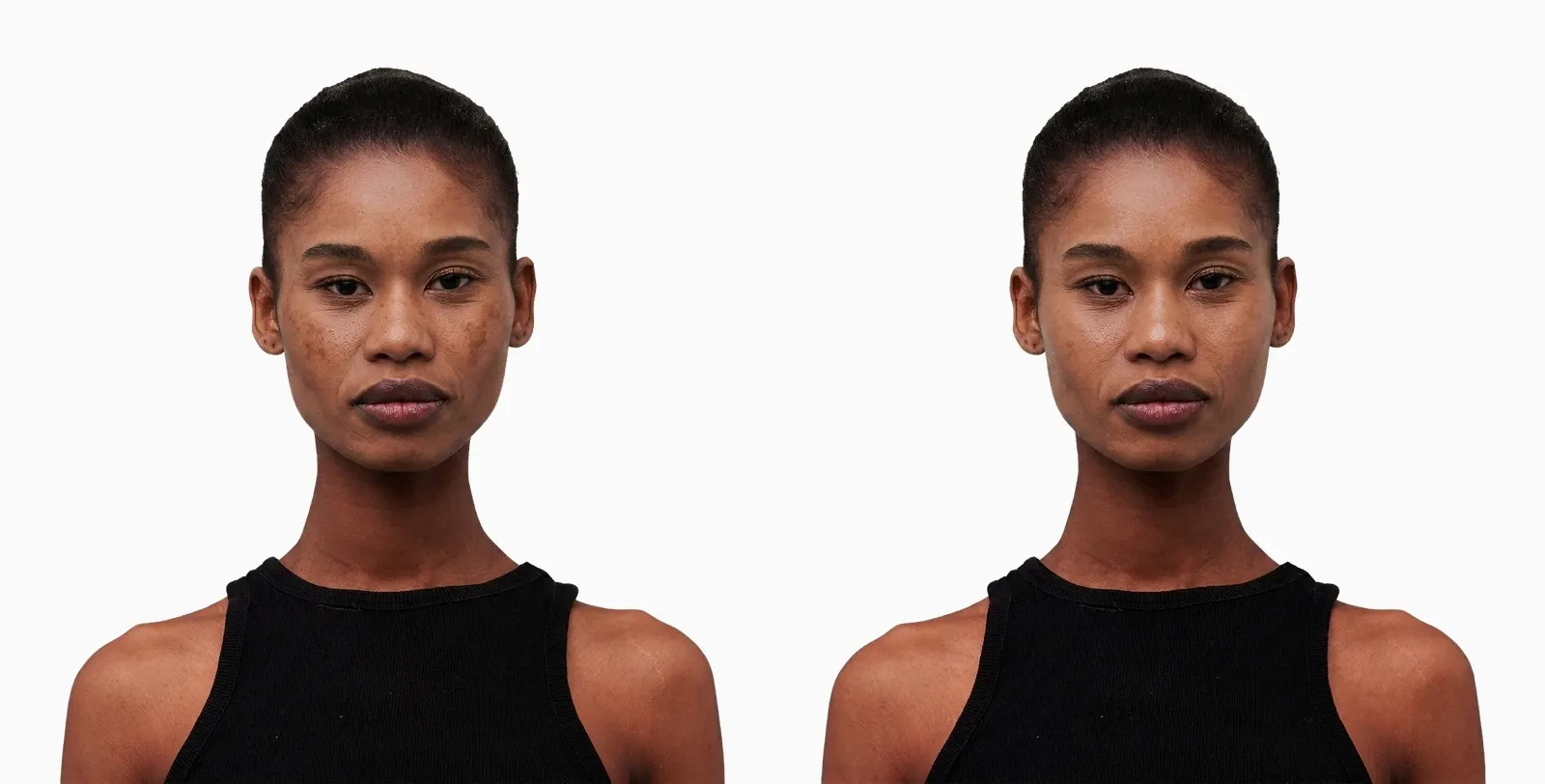
Simulated demonstration of fractional laser resurfacing on photodamaged skin. Pigmentation faded, fine lines softened, pore appearance refined — overall texture more even.
What is laser skin resurfacing?
Laser skin resurfacing, also called a laser peel, laser vaporization, or lasabrasion, is one of the most popular skincare procedures. It uses lasers to smooth out wrinkles, clear up skin problems, and improve the skin's texture and appearance.
The word laser stands for light amplification by stimulated emission of radiation. For cosmetic use, the laser sends direct, short, concentrated pulses of light at the target area to vaporize the skin, layer by layer, with a lot of precision.
The laser takes off the outer layer, the epidermis, while heating the dermis underneath. That heat prompts new collagen, which firms and smooths the skin. Since the skin makes less collagen as we age, which is part of why fine lines and wrinkles show up, building it back is what makes the skin look younger.
In effect, the laser creates a controlled injury so the skin heals itself back to a better state.
According to a 2018 report from the American Society of Plastic Surgeons, laser resurfacing procedures jumped by about 248%. There were 170,951 done in 2000, and by 2018 there were more than 600,000 in the United States alone 1.
Types of lasers and what you can expect from each
There are a lot of lasers on the market now, and if this is your first time looking into resurfacing, it is easy to feel overwhelmed about which one is right for you 2, 3, 4, 5, 6.
First, it helps to know a few laser terms.
Ablative lasers
Ablative lasers work by wounding the outer layer, the epidermis, while sending heat into the dermis underneath. The aim is to stimulate new collagen. As the epidermal cells regrow, the wrinkles and fine lines in the area smooth out and the skin looks younger and better.
Because ablative procedures are more invasive, they need more recovery time, and the trade-off is stronger, more dramatic results.
Non-ablative lasers
Non-ablative lasers do not wound the epidermis, but they still stimulate new collagen in the dermis.
Being non-invasive, they need less recovery time, though the results take longer to show. They are also safer across skin types than ablative lasers.
Fractionated or fractional lasers
These leave tiny columns of skin untreated, which shortens recovery time while still giving the skin strong results.
Here are some of the best and most recommended lasers available, and what each can do for you.
IPL or intense pulsed light
IPL is a strong choice for clearing up pigmentation to even out skin tone. So if your main goal is to fade things like age spots, dark scars, and sun discoloration, IPL may be right for you. It is a non-ablative laser that can be used on various areas, including the face and arms.
Fractional laser
Fractional lasers are a strong choice for improving skin texture, which makes them great for wrinkles, fine lines, and depressed acne scars. They rely on selective photothermolysis and can treat scars and discoloration without harming the surrounding skin.
Clear + Brilliant
This laser is non-ablative. It is gentle on the skin and safe for all skin types, and the procedure is milder than other lasers. The sessions need no recovery time, and results show up after a few of them. It is a good pick for mild scars, superficial wrinkles and fine lines, and sunspots. It can also make the skin more permeable, which helps skincare products work better by reaching deeper layers.
Picosure
This laser is non-ablative too. It is mild but well suited to pigmentation issues like sunspots, wrinkles, and acne scars. It does not cause pain or discomfort and needs no recovery time.
Erbium YAG laser
This laser is effective on superficial wrinkles, fine lines, acne scars, and pigmentation problems such as age spots and sunspots. Since it is an ablative laser, you may feel some pain during the procedure, but the results are strong and show up after the first session.
Laser skin resurfacing uses
If you have acne problems, signs of aging, sunspots, or other skin issues that over-the-counter products cannot fix, laser skin resurfacing may help.
The procedure is used to treat one or more of these:
- Age spots.
- Mild to moderate scars and acne scars.
- Wrinkles and fine lines.
- Crow's feet wrinkles.
- Uneven skin tone or texture.
- Sagging skin.
- Enlarged oil glands.
- Sun-damaged skin.
Your natural skin tone plays a part in whether laser resurfacing is a good fit.
It is usually recommended for lighter skin tones, where the risk of hyperpigmentation is lower. That said, the American Board of Cosmetic Surgeons (ABCS) notes it is not only for lighter skin. It can work for any skin tone, as long as the dermatologist or physician has enough experience and can choose the right laser for that tone 7.
The ABCS also recommends getting resurfacing in winter or fall to limit sun exposure, which can damage your delicate, healing skin. Finally, it is not recommended for people with active acne breakouts or a lot of sagging skin.

Recovery scales directly with treatment depth. CO2 fractional at medium settings — the most common 'real result' option — needs 5-7 days of social downtime; ablative CO2 and erbium go to 10-14 days for the strongest results.
The risks and side effects of laser skin resurfacing
Ablative lasers
Ablative laser resurfacing can cause several side effects:
- Itching and swelling. The treated skin can get itchy, swollen, and red. The redness can be severe and last for months, and a prior condition like rosacea can make it worse.
- Acne. If you put thick creams, lotions, or bandages on your face afterward, your acne may flare. Tiny white bumps called milia can also appear temporarily on the treated areas.
- Infection. A viral, bacterial, or fungal infection can develop after ablative resurfacing. The most common is a flare-up of the herpes virus, the one that causes cold sores. In these cases the virus is already in the skin but dormant.
- Skin discoloration. Ablative resurfacing can darken the skin (hyperpigmentation) or lighten it (hypopigmentation). It can start weeks after the procedure, and people with darker skin tones are at risk of permanent discoloration.
- Scarring. In some cases ablative resurfacing can cause permanent scarring.
- Ectropion, or turning of the eyelid. In rare cases, ablative procedures near the lower eyelid can cause ectropion, where the eyelid turns outward and exposes its inner surface.
Non-ablative lasers
Non-ablative laser resurfacing can cause several side effects too:
- Infection. It can trigger a herpes virus flare-up. Bacterial and fungal infections are not common with non-ablative resurfacing.
- Skin discoloration. People with darker skin tones are at risk of temporary hyperpigmentation after the procedure.
- Mild redness and swelling. These last anywhere from several hours to a few days afterward.
Talk to your doctor about the possible risks and side effects and the best ways to manage or prevent them 8, 9, 10.
Who should not undergo laser skin resurfacing?
Laser resurfacing is not right for everyone. Your doctor may advise against it in these cases:
- If you have taken the acne medication isotretinoin (sold as Claravis, Myorisan, and Zenatane) in the past year, since it can raise the risk of scarring.
- People with weak immune systems or an autoimmune disease.
- People who tend to scar, are prone to cold sores, or have had a recent cold sore outbreak or herpes infection.
- People with darker skin tones.
- Pregnant or breastfeeding women.
- People who have had facial radiation therapy.
You can lower the risks and side effects by following your doctor's pre-care and post-care instructions. Depending on your history, your doctor may prescribe antibiotics or antiviral medication as a precaution before the procedure.
Tell your doctor about any conditions you have and any medications you take, including over-the-counter ones. Even aspirin is worth mentioning, since it can lengthen recovery and raise the risk of bleeding.
It is recommended to quit smoking for at least 2 weeks before the procedure and 2 weeks after, since smoking afterward can increase the risk of side effects.
How to prepare for laser skin resurfacing
Before the procedure, your doctor will do the following:
- Take a full medical history. Your doctor will ask about your current and past conditions, any medications you take or have taken, and any procedures you have had, including dental and cosmetic ones.
- Do a physical exam. Your doctor will check your skin overall and the treated area to plan how to do the procedure, what changes to make, and how features like your skin tone and thickness will affect the results.
- Discuss your needs and expectations. Your doctor will go over your goals, the potential risks and side effects, how long healing will take, and what results to expect. Make sure you understand it all.
On top of that, before the procedure you may need to:
- Take certain medications to prevent complications. Whether it is ablative or non-ablative, and depending on your history with the herpes virus and cold sores, your doctor may prescribe an antiviral before and after to prevent viral infections.
- Avoid sun exposure beforehand. Too much unprotected sun for up to 2 months before the procedure can damage your skin and cause permanent irregular pigmentation, especially in the areas being treated. It can also reactivate the herpes virus in some people, so talk to your doctor about how much sun is acceptable and the best protection.
- Quit smoking for a while. Smoking before and after the procedure slows healing. Stop for at least 2 weeks before and after to avoid side effects and help your body heal properly.
- Arrange a ride home. You may need a ride if you will be sedated during the procedure.

Light photodamage and texture issues respond to IPL or non-ablative fractional with minimal downtime. Acne scars and deeper wrinkles need ablative CO2 or erbium — bigger results, longer recovery.
The laser skin resurfacing procedure
The main goal of laser resurfacing is to boost collagen by targeting the outer layer, the epidermis, while heating the dermis underneath.
Done well, the procedure builds new collagen fibers, which build new skin cells, so your skin should feel smoother and firmer afterward 11.
The procedure is easier than you might expect, and it goes like this:
- Before the procedure, your skin has to be prepped. Your doctor will give you several treatments to use in the weeks beforehand to help your skin tolerate the laser and lower the risk of side effects.
- On the day, your face is washed to remove makeup and pollutants. Some doctors use a mild antiseptic on the area to make sure it is free of irritants.
- Your doctor may apply a numbing cream if the laser causes mild to moderate pain. For lasers that do not hurt much, like Clear + Brilliant or Picosure, this step may be skipped. While you wait, a plastic wrap may go over the cream so the area goes fully numb. The topical anesthetic keeps you comfortable during the procedure.
- If a large area is being treated, your doctor may recommend a sedative or painkiller.
- The wait is usually 30 to 45 minutes while the cream fully numbs the area. It helps to have a friend or family member to talk to during this time.
- Once the area is numb, your doctor starts the laser treatment. Whatever the laser, you should be given opaque eye protection, such as silver or black goggles.
- The laser is moved slowly across the target area. Depending on your needs, it can focus on one spot or cover a whole stretch of skin.
- When it is done, the treated area is dressed in wraps to protect it.
- Ablative resurfacing can take up to 2 hours, depending on the laser, the technique, and the size of the area.
Non-ablative resurfacing usually needs a series of sessions, scheduled over the following weeks or months depending on your condition.
Laser skin resurfacing aftercare and recovery
Even though some cosmetic and dermatologic surgeons perform laser resurfacing, these are not surgeries. Once the procedure is done, you can leave right away and get back to your routine 12, 13.
Still, the recovery period matters, since it lets the treated area heal properly.
How long side effects last
Healing after laser resurfacing takes 3 to 10 days. As a rule, the larger the area and the deeper the treatment, the longer recovery takes. After an ablative laser, it can take up to 3 weeks.
During healing, your skin may be red and peel a little. If there is swelling, ice packs can help bring it down.
You do not have to stay home until your skin fully heals. Just follow your doctor's instructions and stay away from places like the gym, where the risk of infection is higher.
Cleansing the treated area
You will need to adjust your daily skincare to help healing. Clean the treated area 2 to 5 times a day, and avoid regular cleansers no matter how good the brand. Your doctor will recommend a saline or vinegar-based solution instead.
Airtight, watertight dressings should also be used regularly to keep the area clean and protected.
Moisturizers can help healing too, but get your doctor's approval before using them.
Protection
After the procedure, your skin may stay sensitive to the sun for up to a year. Wear sunscreen all the time, with an SPF of at least 30, to prevent sunburn and sun damage.
Apply it every morning, even when it is cloudy, to protect your skin and the treated area, and reapply throughout the day as needed.
Other precautions
Avoid activities that raise the risk of infection, like going to the gym or swimming. If there is discomfort, redness, or swelling after non-ablative resurfacing, you can use cool compresses as needed. Non-ablative procedures need no recovery time and you can return to your normal activities and skincare right away, but it is always best to check with your doctor first.
Laser skin resurfacing results
Non-ablative resurfacing has fewer risks and side effects, but it may take a series of treatments to get the best result. The change is gradual, and you will notice improvements in skin texture, tone, pigmentation, and wrinkles over time.
Ablative resurfacing shows results right after the session, at the cost of a higher risk of side effects. Your skin may stay red and swollen for months, but once it heals the change in texture and appearance is big.
Results vary from person to person, depending on the concern being treated and the type of procedure. Once your sessions are done, the results can last for years, but they are not permanent. As you age, your face keeps forming fine lines and wrinkles from squinting, frowning, smiling, and sun exposure, so you may need to repeat the treatment at some point 14, 15, 16, 17.
Laser skin resurfacing cost
According to the American Society of Plastic Surgeons, the average cost of laser resurfacing in 2020 was about $2500 for ablative procedures and $1440 for non-ablative ones. The price can vary, though, based on factors like how severe your condition is and where you live.
Most laser resurfacing is not covered by medical insurance, since it is usually cosmetic. Some cases are covered, though, such as scars and the removal of precancerous skin growths.
Before the procedure, talk through the costs with your doctor and your insurance company. Find out whether insurance might cover it, and ask about the financing options your doctor offers.
FAQ about laser skin resurfacing
Can laser skin resurfacing be combined with other procedures?
Yes. You can combine laser resurfacing with other cosmetic procedures to reach your skin goals faster. Topical retinoids are often recommended afterward to maintain the results. Botox and dermal fillers can also be paired with resurfacing when the goal is to soften wrinkles and restore facial volume. Depending on your goals, your doctor will design a plan for your needs.
How long does the healing process take?
After the treatment, your skin will be red and swollen for a while, and you may feel some tightness in the treated areas. Right after the procedure, put ice on the area for 30 minutes. For the next 2 to 3 days, avoid glycolic acid, salicylic acid, and vitamin A creams and lotions. After 3 days your skin may get dry, so use a hydrating moisturizer that will not irritate it. Within 1 to 2 weeks, the treated areas heal completely.
Is the laser skin resurfacing procedure painful?
Most patients say it is well tolerated and feels like warm pinpricks on the treated areas. Your face gets warm during the procedure.
Am I a good candidate for laser skin resurfacing?
Before you book it, make sure you are a good candidate.
Here are some criteria you should meet:
- Not pregnant.
- Not recently tanned.
- No history of seizures, especially light-induced seizures.
- No recent cold sores or skin infections.
- No medical implants in your skin.
- No photosensitivity.
Laser resurfacing is not just for aging signs and wrinkles. It also treats acne scars, surgical scars, and other lesions such as enlarged pores. It can be a good option for patients who are not good candidates for other treatments.
How is laser skin resurfacing different from similar treatments like chemical peels?
Laser resurfacing has a few advantages over treatments like chemical peels. The procedure is precise, with little to no bleeding, and the discomfort afterward tends to be less than with other treatments.