1
Upload Your Photos
Upload 6 clear photos of your face securely and privately through our online portal.
Drag and drop file To upload
POSES REQUIRED


We were interested in whether AI models (GPT, Claude, Gemini and Grok) rate facial attractiveness similarly to humans, depending on three characteristics of the face: age, sex and ethnicity. Age was the only one that carried over. The models barely registered the sex of a face, and on ethnicity they produced patterns human raters did not show. That does not make them fairer judges. A possible explanation is that these models have been trained not to let a face's sex or ethnicity change the score, while letting its apparent age do so is not treated as a problem.
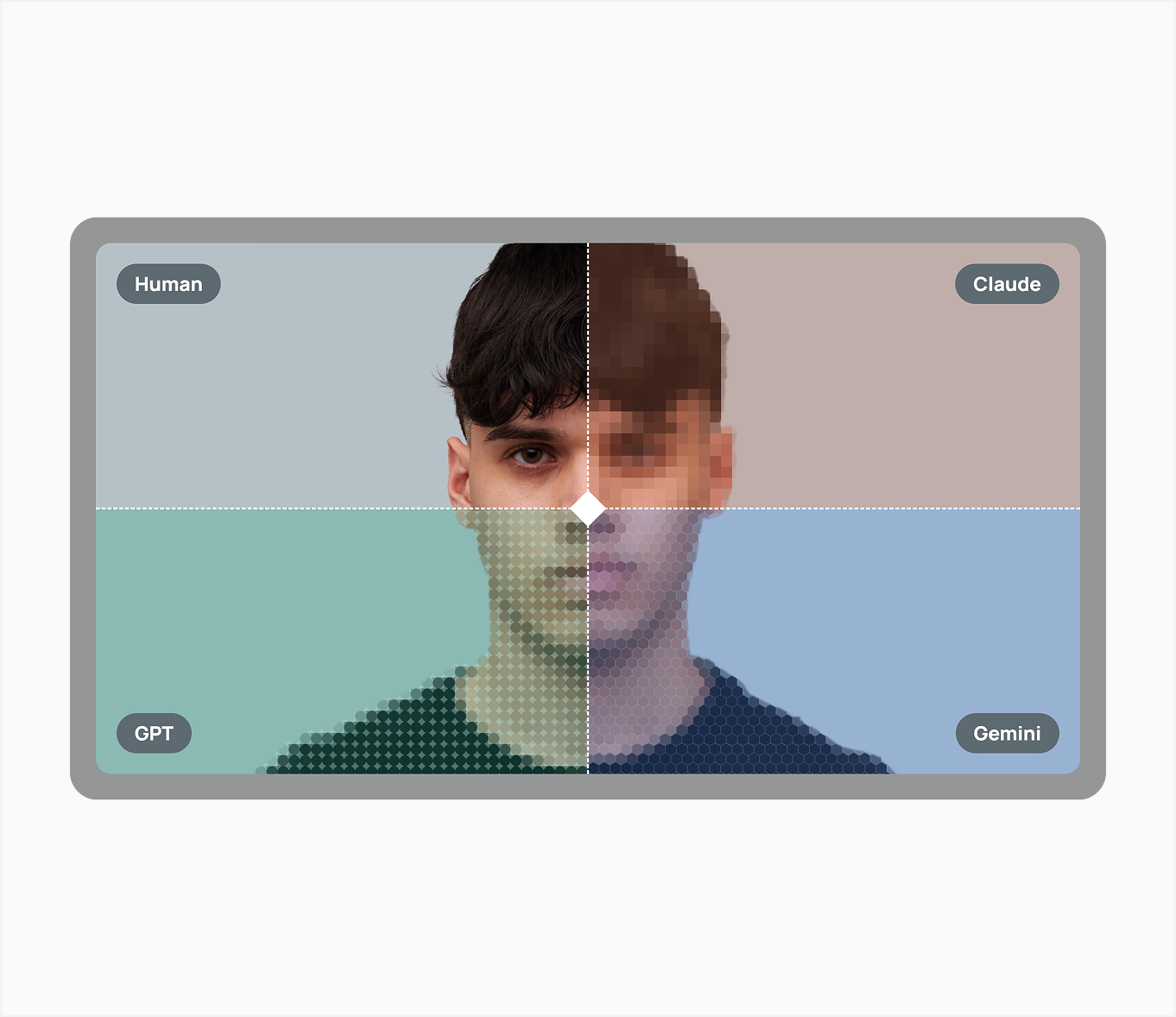
We asked four AI models (GPT, Claude, Gemini and Grok) to rate the facial attractiveness of 102 faces using a scale from 1 to 7, where 1 meant much less attractive than average and 7 meant much more attractive than average1; a group of 2,513 people had previously rated the same faces using the same scale. What we wanted to explore was not simply whether AI models agree with people overall, but whether the same facial characteristics drive their judgments. We looked at three of them: the sex, the age and the ethnicity of the face.
Only one of the three carried over. Both the models and human raters gave lower attractiveness scores as the apparent age of a face increased, and by roughly the same amount. Sex mattered far less to the models than it did to people. Ethnicity was where they diverged most, and one model produced a pattern human raters did not show at all.
This is puzzling. AI models learn from enormous quantities of text and images produced by people. Whatever preferences are encoded in that material should, in principle, be inherited by the models. However, on two of the three characteristics we tested, that is not what happened. It is possible that the material they have been trained on is not really representative of the diversity in the human population, as some researchers have pointed out2,3, that they might have been explicitly built to consider certain things and ignore others, or both.

Painting: Master of the Annunciation to the Shepherds, The Sense of Sight, ca. 1620–40, public domain, digitally modified.
To see why this matters, it helps to notice something implicit in the question we started with. Normally, when we ask what makes a face attractive, it is implicit that we are asking specifically what makes a face attractive to people. Even though it would be interesting to ask what makes a face attractive to a dog, a cat, or even a fish, that is a bit less relevant to our daily lives. However, as our interactions with machines become commonplace, what makes a face attractive to ChatGPT stops being a curiosity. The more people turn to AI models to judge their own appearance, the more relevant that question becomes. Thus, when we consider facial attractiveness, the question attractive to whom? is crucial.
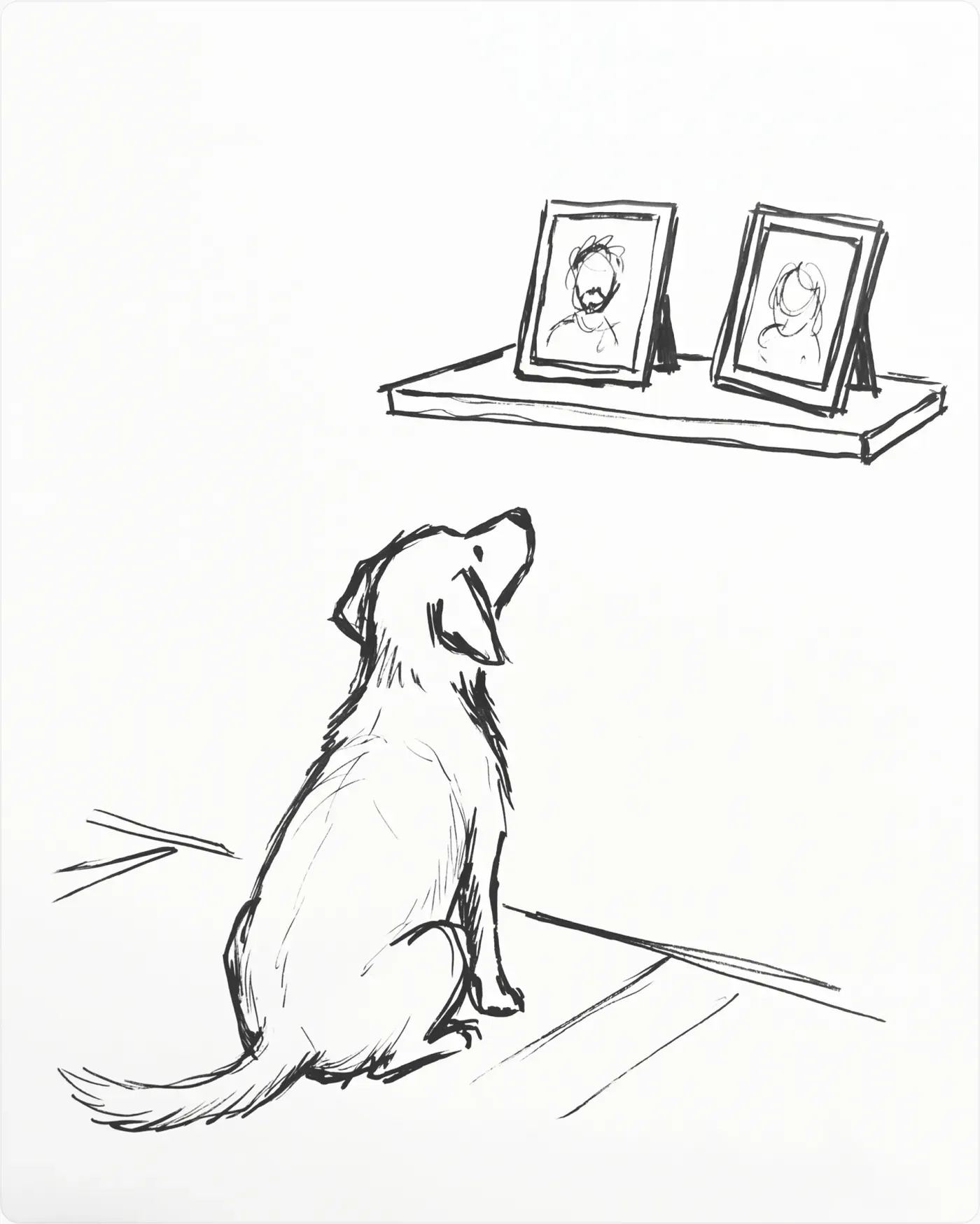
What makes a face attractive to a dog is a different question, and probably has a different answer.
When it comes to what facial characteristics make a face attractive to humans, scientists have observed a few relatively stable patterns. Averageness, meaning mathematically average trait values, is one of them4,5, and symmetry is another6,7. Humans also respond to cues to health, such as moderate facial adiposity8,9, and to cues to youth, that is, the apparent age of a face, when these are paired with cues to sexual maturity10–12. In women, juvenile-like traits such as large eyes13 and facial femininity14,15 both contribute, while in men the pattern is closer to a "Goldilocks dimorphism", neither too feminine nor too masculine16,17. Relevant to what follows, both men and women seem to perceive female faces as more attractive than male faces, a finding recently formalised as the "gender attractiveness gap"18.
Many of these come as no surprise. What is more interesting is why they should be attractive at all, and the answer is usually evolutionary19–21. Symmetry, for example, has been associated with successful gene expression, and youthfulness with fertility22. Therefore, it is easy to imagine that those ancestral humans who valued such cues when choosing a partner were more likely to reproduce, until the preference had spread through most of the population.
We should be careful with that story, though, because what counts as attractive varies across cultures to a degree that would surprise many Westerners. In the United States, straight square teeth are prized, and one might assume this reflects an innate preference for functional dentition. Among the Aka, where shaving the teeth into points is common, square teeth are not preferred at all23,24
Whatever the mix of evolution and culture, an AI model went through none of it. AI models were never exposed to the selective pressures that make members of a species attracted to certain signals in others of their own kind, nor do they share the kind of nervous system that so many species have in common. Whatever they are doing when they read a face, it arises from very different processes and mechanisms. Which makes the results of our study difficult to explain.
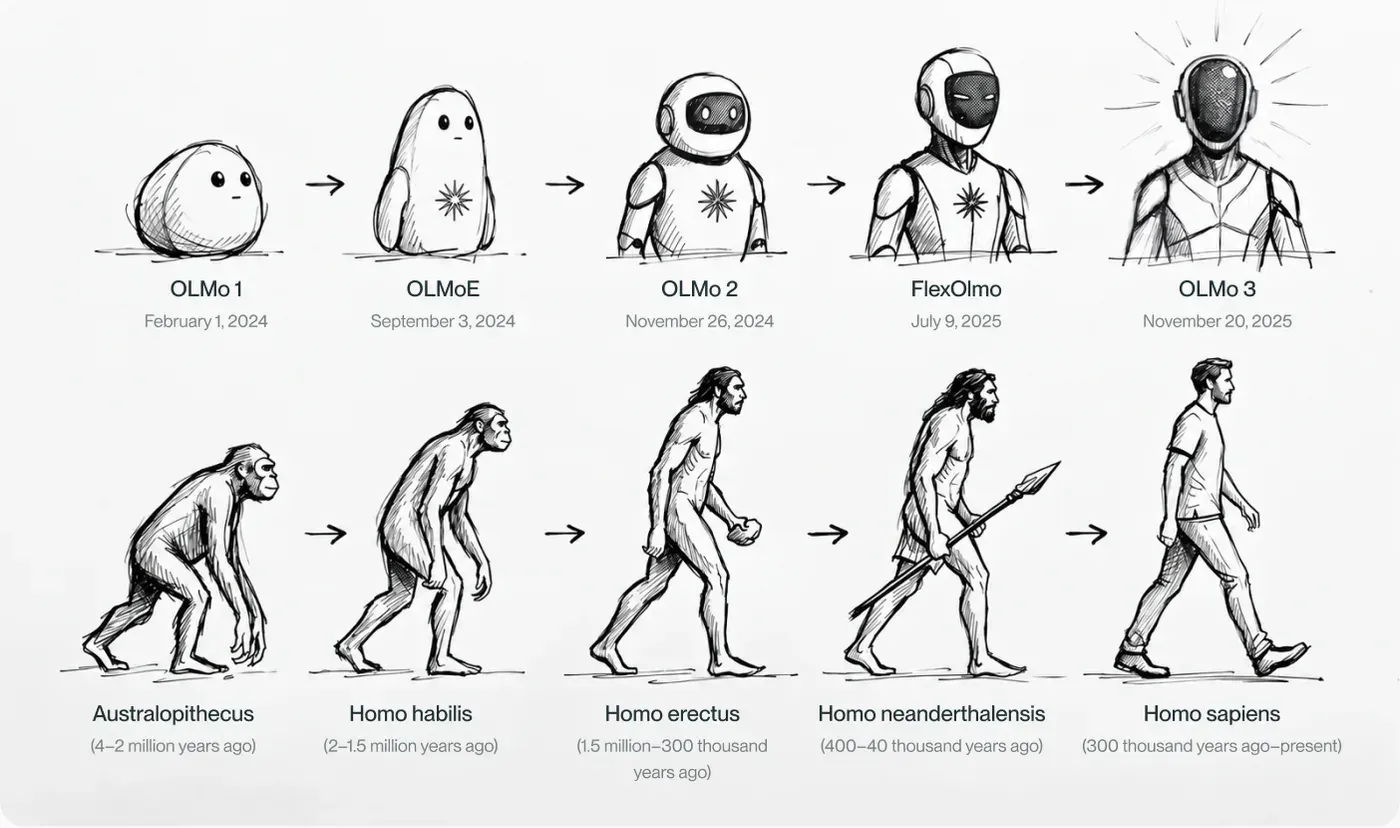
Unlike the species around us, AI models did not evolve. Each version was designed and released.
We found that AI models show the same human pattern of giving lower attractiveness scores as the age of the face increases. Across human raters, attractiveness declined by about 0.04 points for every additional year of apparent facial age, and every one of the four models showed the same decline; in three of them it was statistically indistinguishable from the human slope, and only Grok showed a slight softening (Figure 1). Age was, in fact, the only characteristic that predicted attractiveness significantly for every rater, human or machine, which is consistent with a large literature on apparent age in human judgments12. In humans the usual explanation is again evolutionary, framed in terms of cues associated with better chances of having healthy offspring. That explanation cannot apply to AI models. They can certainly learn to identify cues to youth, but it is not clear whether they respond to the same cues humans evolved to respond to, or to different ones that happen to travel with them.

Predicted attractiveness by the apparent age of the face, for human raters and each AI model, on a 1 to 7 scale. Shaded bands are 95% confidence intervals. All five sources decline at a similar rate, but the models sit well above the human line throughout.
We also found that AI models, on average, provided lower scores to male faces compared to female faces, something human raters showed as well, and which previous studies have reported18. However, the difference is far weaker in AI models. Human raters scored male faces 0.65 points below female faces, whereas in the models the gap was about 0.1 to 0.2 points (Figure 2). In other words, they do not rate the facial attractiveness of males as low as humans do. When we tested each model on its own, only GPT and Claude showed a statistically significant female advantage at all; Gemini and Grok did not.

Predicted attractiveness by the sex of the face. Bars are 95% confidence intervals. Human raters scored male faces 0.65 points below female faces, while in the models the gap was about 0.1 to 0.2 points.
Lastly, we found that AI models show some ethnic patterns not found in humans while softening others that are. Human raters gave their highest scores to White faces and their lowest to West-Asian faces, a gap of 0.61 points and the only ethnicity difference among human raters to reach statistical significance. All four models reversed the top of that order, scoring Black faces above White faces, and in every model this departure from the human pattern was statistically significant. Beyond that, the models separated Black, East-Asian and White faces by less than 0.2 points, and none of those differences was significant. West-Asian faces received the lowest scores from every rater, human or AI, but the size of the drop differed: human raters placed them 0.61 points below White faces, whereas GPT, Claude and Grok dropped them only about 0.2 to 0.3 points. Gemini was the exception, dropping them 0.70 points, as far as human raters did, and it was the only rater of any kind that also scored West-Asian faces significantly below Black and East-Asian faces.
Why should the three characteristics come apart like this? We cannot say with certainty, since our study was not designed to test mechanisms, but there are a few plausible explanations, and none of them involves the models perceiving faces more fairly than we do.
The first is sycophancy, a well-documented tendency for AI models to give agreeable, non-confrontational answers that match what a user wants to hear, acquired through reinforcement learning from human feedback during their fine-tuning25. The same tendency appears elsewhere: models skew their personality scores toward the socially desirable ends of each trait26 and never award the lowest grade when asked to evaluate research quality27.
Consistent with this, none of our four models ever gave a face the lowest rating, and only one ever gave the highest (Figure 4).

Distribution of attractiveness ratings given by each source across the 102 faces. The human raters used the full range of the scale. The models concentrated their ratings between 3 and 6, never gave a face the lowest rating, and only Grok ever gave the highest.
A second explanation is the safety filtering that commercial AI products apply to their outputs28, which is designed to block responses that could cause harm. In our pilot tests some models refused outright to rate faces, explaining that judgments of physical appearance can be harmful. Careful prompting works around those refusals, but the underlying disposition does not disappear29, and it may push scores away from the unflattering end of the scale more than the flattering one.
A third explanation is the most specific to our results: judgments along socially sensitive dimensions such as sex and ethnicity are precisely the ones developers work hardest to suppress30, whereas age might not be treated in the same way.
These findings deserve some caution. The set of 102 faces we used was heavily skewed toward White faces, at 67.6%, which leaves the ethnicity comparisons resting on relatively few images, and the specific patterns we observed may say as much about this particular set of faces as about faces in general. The results also describe four specific model versions at a single point in time, and these systems change frequently and without announcement. Earlier work has reported broad agreement between AI and human attractiveness judgments31,32, so the interesting question is not whether the models track us, but where exactly they stop doing so.
Nonetheless, as suggested at the beginning of this article, it is important to keep in mind that even if we found in one or many studies that AI can give responses matching exactly those a human would, the underlying mechanisms responsible for what we see are different: the interactions of biological systems with a physical environment, on one hand, and a computer program applying algorithms, on the other. This distinction almost guarantees that under particular circumstances, probably not explored so far, one will get different responses even for a specific task such as rating human faces using an attractiveness scale.
Which brings us back to where we started. When someone asks an AI how attractive they are, what comes back does not truly reflect the way humans perceive faces. The response they get depends less on the face than on which of its characteristics the model has been allowed to take into account.
How it works
Get your personalized facial analysis from the comfort of your home in three simple steps.
Upload 6 clear photos of your face securely and privately through our online portal.
Drag and drop file To upload
POSES REQUIRED
We measure 160+ facial markers, including skin quality, symmetry, eye shape, brow density, and more.


You’ll receive a plan highlighting your strengths, areas for improvement, and best ways to improve your appearance.
Emma’s Report
January 16, 2026
Explanation
Your forehead wrinkle depth aligns with expectations for your age and demographic, falling on the lower end of our predicted range.