1
Upload Your Photos
Upload 6 clear photos of your face securely and privately through our online portal.
Drag and drop file To upload
POSES REQUIRED


Most advice blames face fat. On the faces we measured, the wider ones did not have more babyish proportions. Here is what drives it instead, and how to add definition.
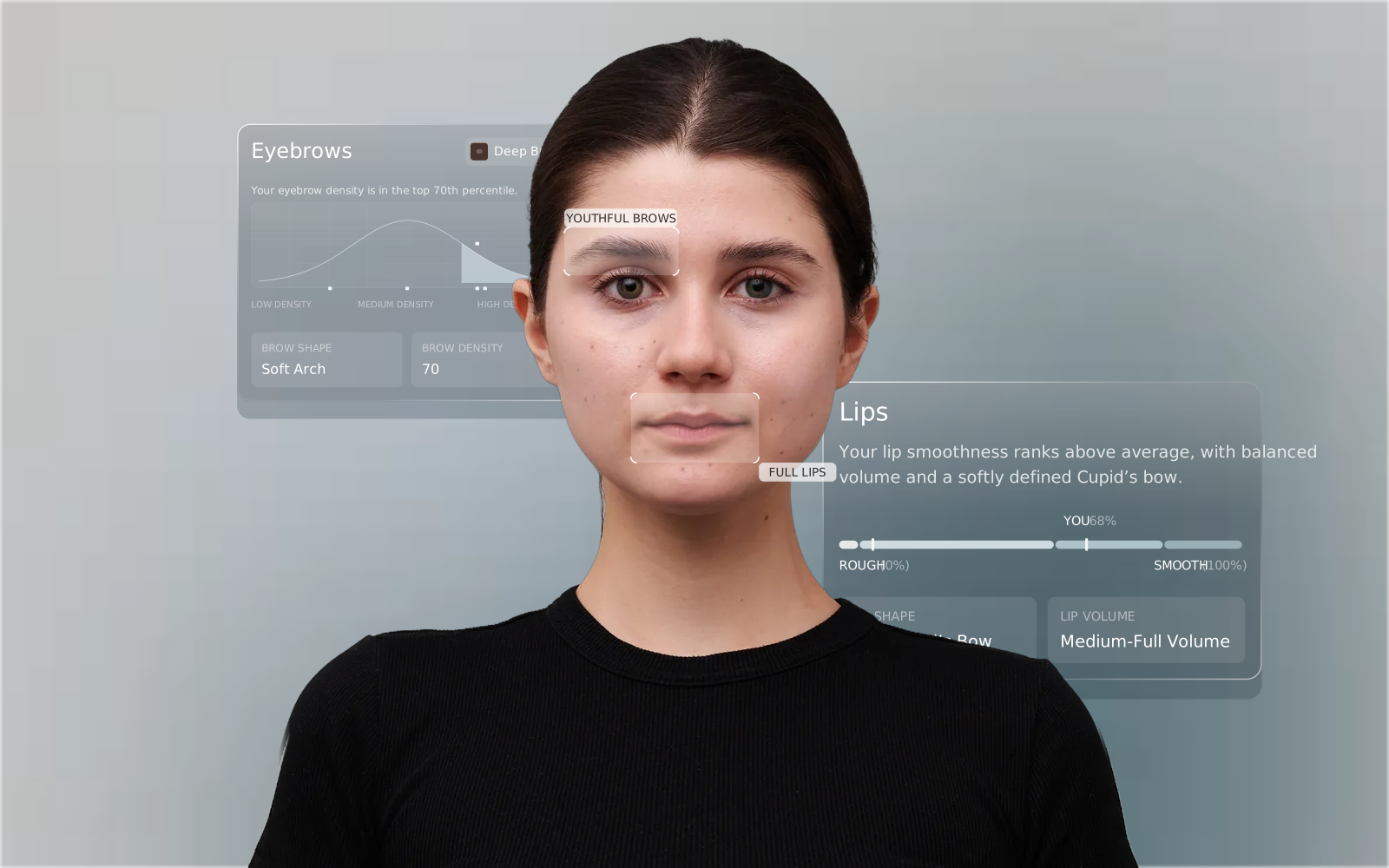
You were not looking for a compliment when you searched this. You want to know why people guess your age wrong, and how to look more grown-up without losing what already works about your face.
In 1984, McArthur and Apatow1 built faces that varied one babyish feature at a time and asked people to rate them. Larger eyes, features set lower on the face, and shorter features each made a person look physically weaker and less socially dominant. The effect held even after they controlled for how old and how attractive each face was rated. That is the judgment people are describing when they say nobody takes them seriously, and it shows up outside the lab: when people rated the faces of Finnish election candidates, the more babyish the face, the less competent they judged it, though it did not cost the candidates votes (Poutvaara et al., 2009)2.
The same features get you more help, though. In a field experiment in the US and Kenya (Keating et al., 2003)3, researchers left 584 stamped, addressed envelopes lying around, each holding a fictional CV with a face photo edited to look either babyish or mature, and counted how many strangers posted them back. For three of the four groups of faces they tested, the babyish version came back more often. The same edits made faces look more honest, naive and compassionate.
The third effect is the one that complicates the fix. Across five populations, from Brazil, the US and Russia to two Indigenous groups in South America, men were drawn to women's faces with large eyes, small noses and full lips, even once the women's age was accounted for (Jones, 1995)4. For men's faces the picture is mixed, and work by Cunningham and colleagues (1990)5 suggests the most attractive ones combine babyish features with mature ones. So the aim is to add definition and keep what works, which starts with knowing which features are giving you the babyish look.
Three features come from that 1984 study, where each one was changed on its own and the effect measured: eyes that are large for the face; features set low, which means a high forehead and a short chin; and short features, especially a short nose. Porcheron and colleagues (2013)6 report the same pattern in real photographs, where large round eyes and shorter noses both lower people's age estimates. Berry and McArthur's 1985 measurement study7 added higher-set eyebrows, a larger and rounder iris, and a narrower chin.
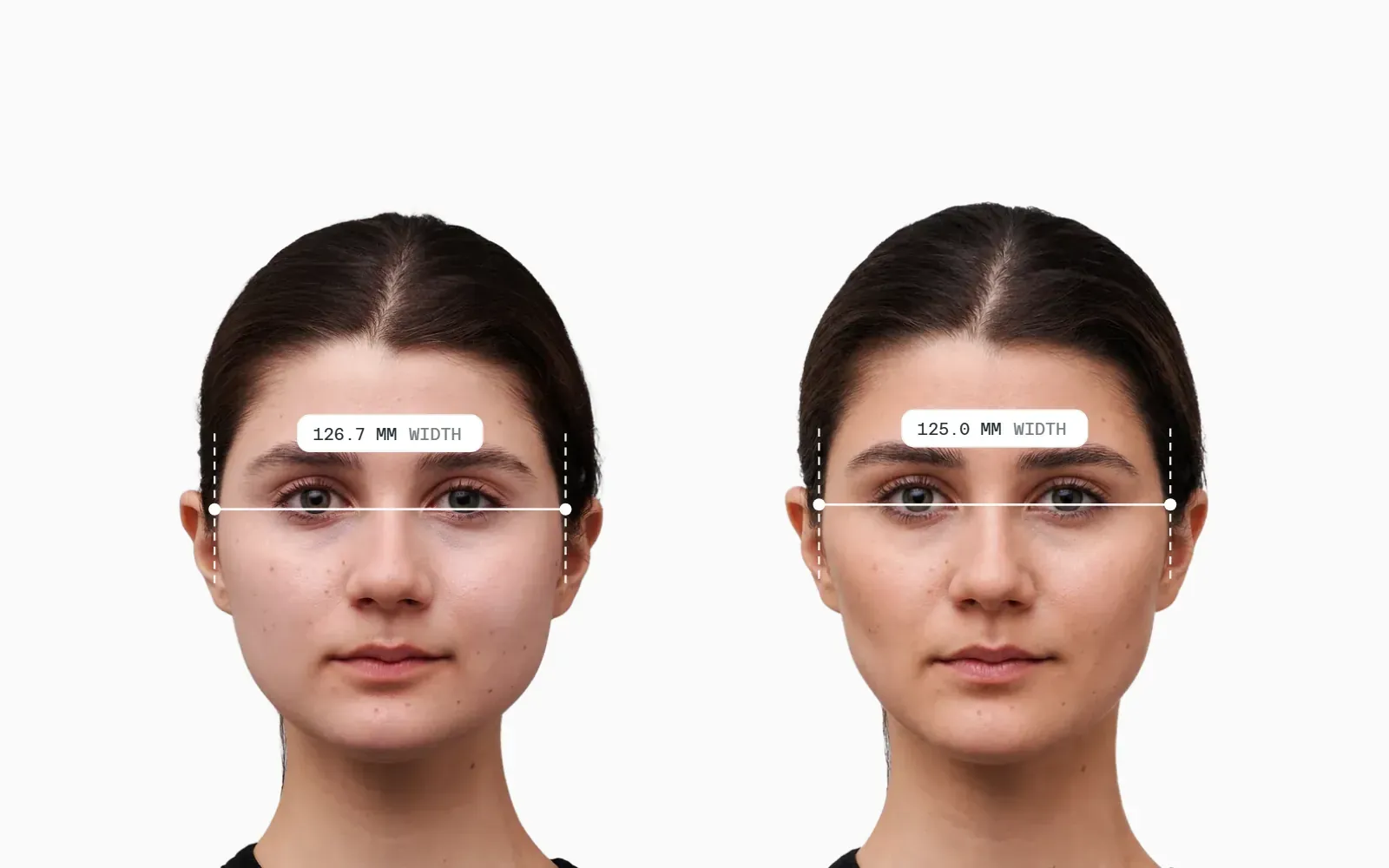
These two faces measure almost the same across the cheekbones, 126.7 and 125.0 mm, yet the one on the right looks older. Width does not decide how young a face reads. Structure does: here, a longer lower face, a firmer jaw and fuller brows.
The replication is messier than that list makes it look. When Cunningham and colleagues (1990)5 measured the same features on a different set of faces, forehead height and nose size turned out to be uncorrelated with a babyish appearance, and large eyes and a narrow chin did not come through either, possibly because several men in his sample had both large eyes and a large chin at once.
So treat the list as suspects. You might have one of them or several, and the one that stands out decides which fix will help. Most advice skips working out which one you have and hands everyone the same fix: lose the fat.
That fix tends to arrive as a list: cut salt, do cardio, drink water, lose weight. The same 1990 study5 undercuts that advice in two ways. First, babyish and mature are not two ends of one scale. Plenty of faces carry both at once, so looking less babyish and looking more mature are separate jobs. Second, and more important for the diet advice: babyishness showed up on the round, heavy face and on the narrow, thin one. Both read as immature, for different reasons, which is why the thinnest person you know can still get asked for ID.
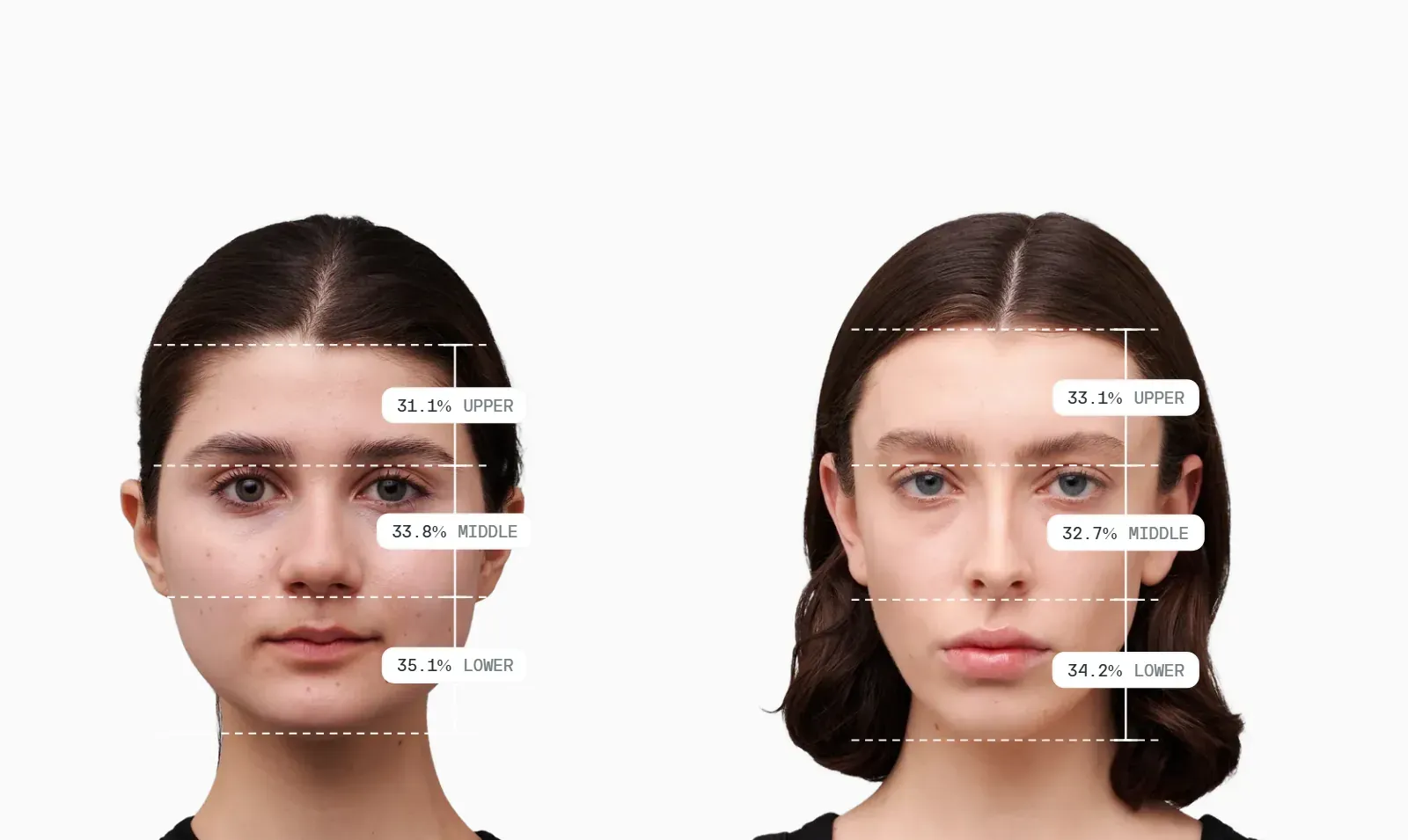
A taller, narrower face looks older because it resembles a leaner face with less fat, which is the direction ageing takes a face.
We checked this on our own photography: 24 women from one studio session, measured on the three ratios the literature ties to a babyish appearance. Then we asked how much of the difference between them lined up with how wide the lower face was, which is the nearest thing to fullness a photo can measure. The answer was about a fifth, and it leaned the wrong way for the diet argument: the wider faces tended to have less babyish proportions. Twenty-four faces is a small sample, so call it a lean, but the lean runs against the advice.
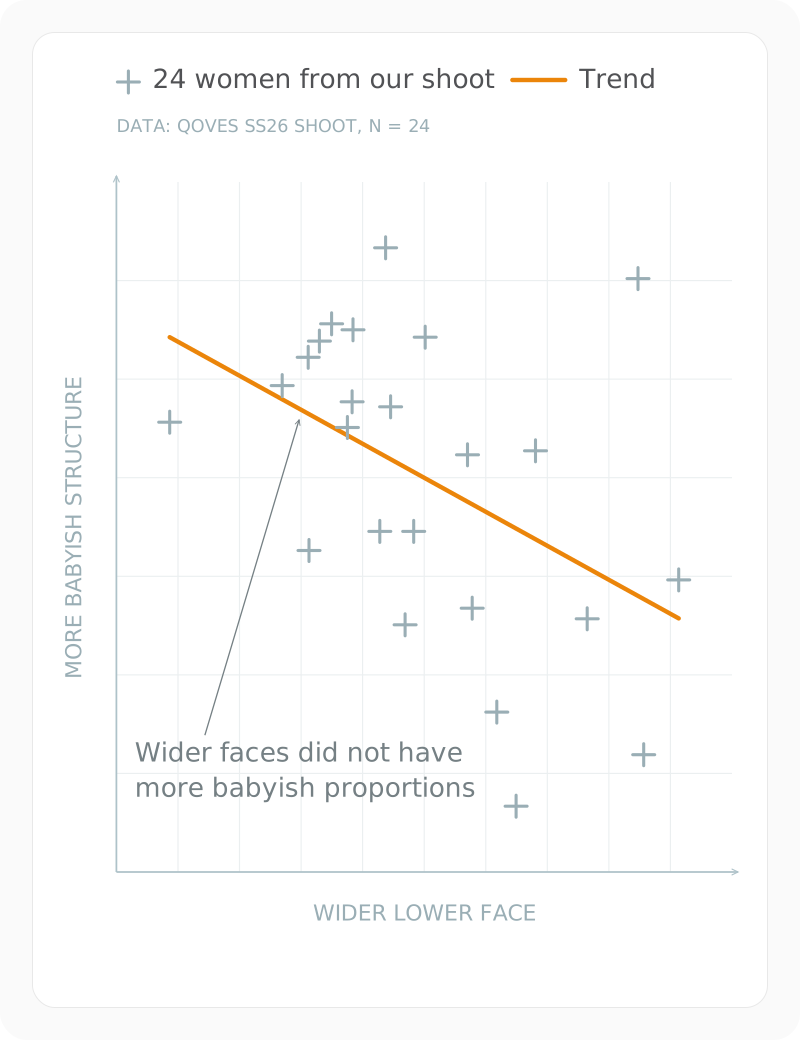
Each cross is one woman and one frontal photo. Width stands in for fullness, because a photo cannot separate fat from bone. The score combines the three ratios the research ties to a babyish look.
Where fat is part of it, losing some helps. On a face that is already narrow, losing more only makes it narrower, and narrow faces read babyish too. So before you change anything, find out which kind of baby face you have.
You can get most of the way with a phone. Take a front-on photo in even light, neutral expression, hair off your forehead, camera at eye level and as far back as you can manage, then zoom in, so the lens does not stretch your nose.
For structure, measure four ratios. The first three are the definitions Cunningham and colleagues (1990)5 used, and the fourth is the lower third, the bottom band marked on the second pair of faces above:
Eye height. The distance from the upper to the lower edge of the visible eye at the pupil, divided by the length of your face from hairline to the base of your chin.
Vertical eye placement. The distance from your pupil up to your hairline, divided by that same face length. The lower your eyes sit on the face, the more babyish the face reads.
Eyebrow height. From pupil center to the lower edge of the eyebrow, divided by face length.
Lower third. From the base of your nose to the base of your chin, divided by face length.
If one of the four stands out and the other three look ordinary, that one is probably what you have been noticing in photos without being able to name it.
What you cannot do at home is score it. A ratio only means something against a reference sample of faces like yours, and an eye height that is unremarkable in one population is high in another. Even the features that count differ between groups: a study of Chinese faces (Zheng et al., 2016)8 found that a lower forehead and closer-set pupils also read babyish there, neither of which American studies had linked to a baby face. So the self-check tells you which feature to look at. Putting a number on it is what a QOVES facial analysis does. It measures your face from your photos and reads the results against norms for your own background, so you know which feature is yours before you spend six months, or a surgeon's fee, on the wrong one.
For fullness, find a photo from a time you were at least ten pounds lighter. If your face looked clearly more defined then, fullness is likely part of it. If it looked much the same, it is mostly structure. Fullness and structure call for different fixes, so take them one at a time.
If fullness is part of it, the goal is a healthy weight and a lean look, not a number on the scale. Your face does reflect your body: in a meta-analysis, people's guesses of BMI from a face alone lined up with the real figure at a correlation of about 0.71, which is strong for this kind of judgment (de Jager et al., 2018)9.
Small changes do not show, either. Re and Rule (2015)10 found that the smallest difference people could see in a face was about 1.33 BMI points, and a change in how attractive the face was rated took nearly twice that. So a few pounds either way will not change how your face reads, and if you are already at a healthy weight, losing more is not the fix: a face that is already narrow reads babyish too.
Weight also changes slowly, which is why two shortcuts keep coming up: facial exercises and lymphatic drainage massage. Neither has been tested for this, and the one trial of facial exercise that does exist points the other way (Alam et al., 2018)11. Sixteen middle-aged women did thirty minutes of facial exercises a day for eight weeks, then every other day up to twenty. Dermatologists rating their photos without knowing which was before and after found fuller upper and lower cheeks, and guessed them nearly three years younger than at the start. It was a small study with no control group, eleven dropouts, and the regimen's creator among the authors, but the direction is clear: exercises sold for slimming a face made these faces fuller, probably by building the cheek muscles. So if your baby face is fullness, neither shortcut is worth six months.
You cannot direct fat loss to one part of your body, so an exercise aimed at your cheeks will not take fat off your cheeks. Drainage techniques move fluid rather than fat, so whatever they do is temporary by design. If you are puffy in the morning and sharper by the afternoon, that is the same mechanism, working for free.
One part of cheek fullness resists weight loss. The buccal fat pad, which fills the cheek hollow, is one reason a thin person can still have full cheeks: its volume does not follow body weight, so dieting leaves it largely alone (Jafar et al., 2024)12. And weight only reaches fat, while much of a baby face is bone.
Some of it may still change on its own, if you are young enough. The skull and the face grow on different schedules. The top of the skull, which holds the brain, is finished by about seven or eight years old, while the facial skeleton keeps growing well into your teens (Naini, 2011)13. That is why a child's head is mostly forehead and an adult's is mostly face, and it is the same shift that facial neoteny describes in the research literature.
The lower third arrives last and changes most, particularly in men at puberty (Weston et al., 2007)14. If you are seventeen and reading this, part of that growth is still ahead of you, and the best advice is to wait before buying anything. If you are twenty-six, the growth you were waiting for has already happened. From then on, the question is what you can add to the structure you have.
For men, the main lever is facial hair. Neave and Shields (2008)15 found that masculinity and dominance ratings climb steadily as facial hair increases. Attractiveness behaved differently in the same study, where stubble beat both a clean shave and a full beard. If you want to be read as an adult, more hair helps. If you want to look good, stubble is the sweet spot.
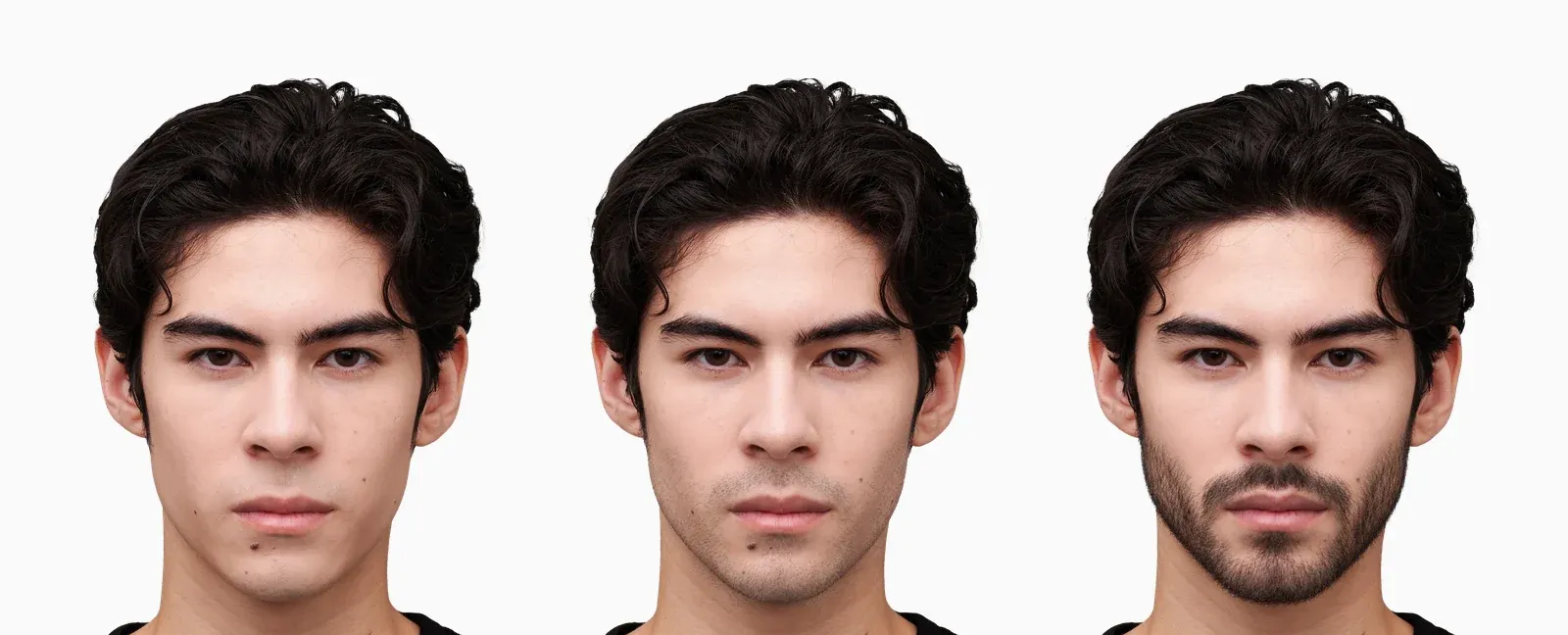
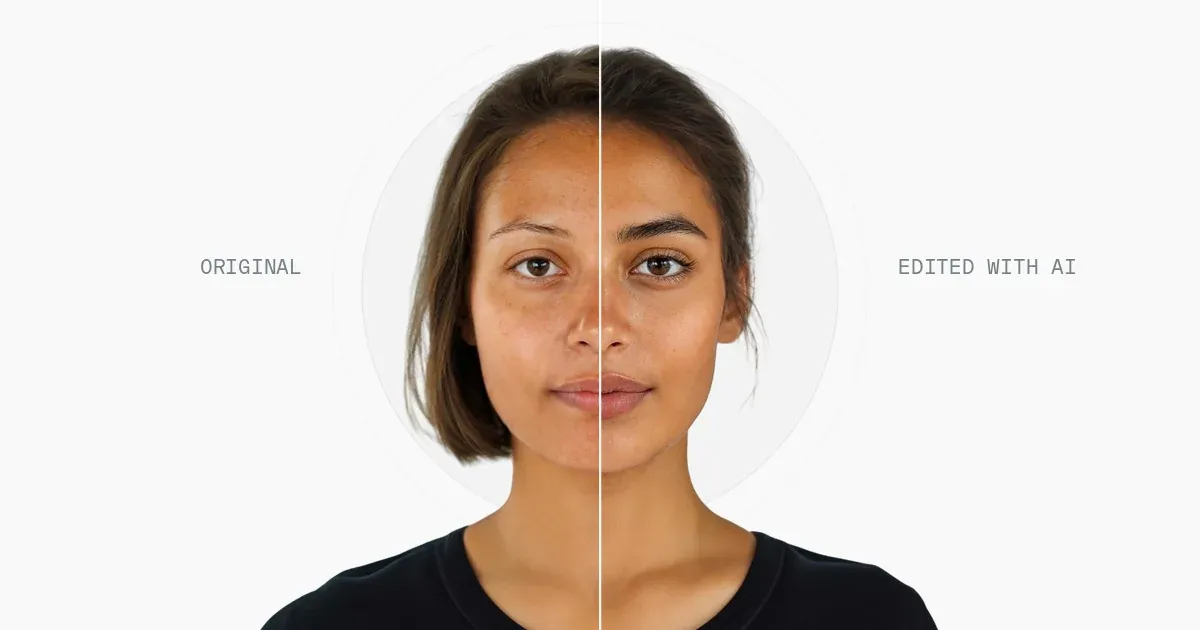
One of our models as photographed, then with stubble and a short beard added by an AI image edit. Only the new hair comes from the edit. His eyes, nose, forehead and hairstyle are the original photo.
Cunningham's 1990 measurements5 point the same way: across two studies, the only features that tended to separate a mature face from a babyish one were facial hair and thicker eyebrows. Thicker, which is a different thing from darker. Brow density is one of the markers a QOVES report scores, so you can find out whether that lever is yours before you start growing them out.
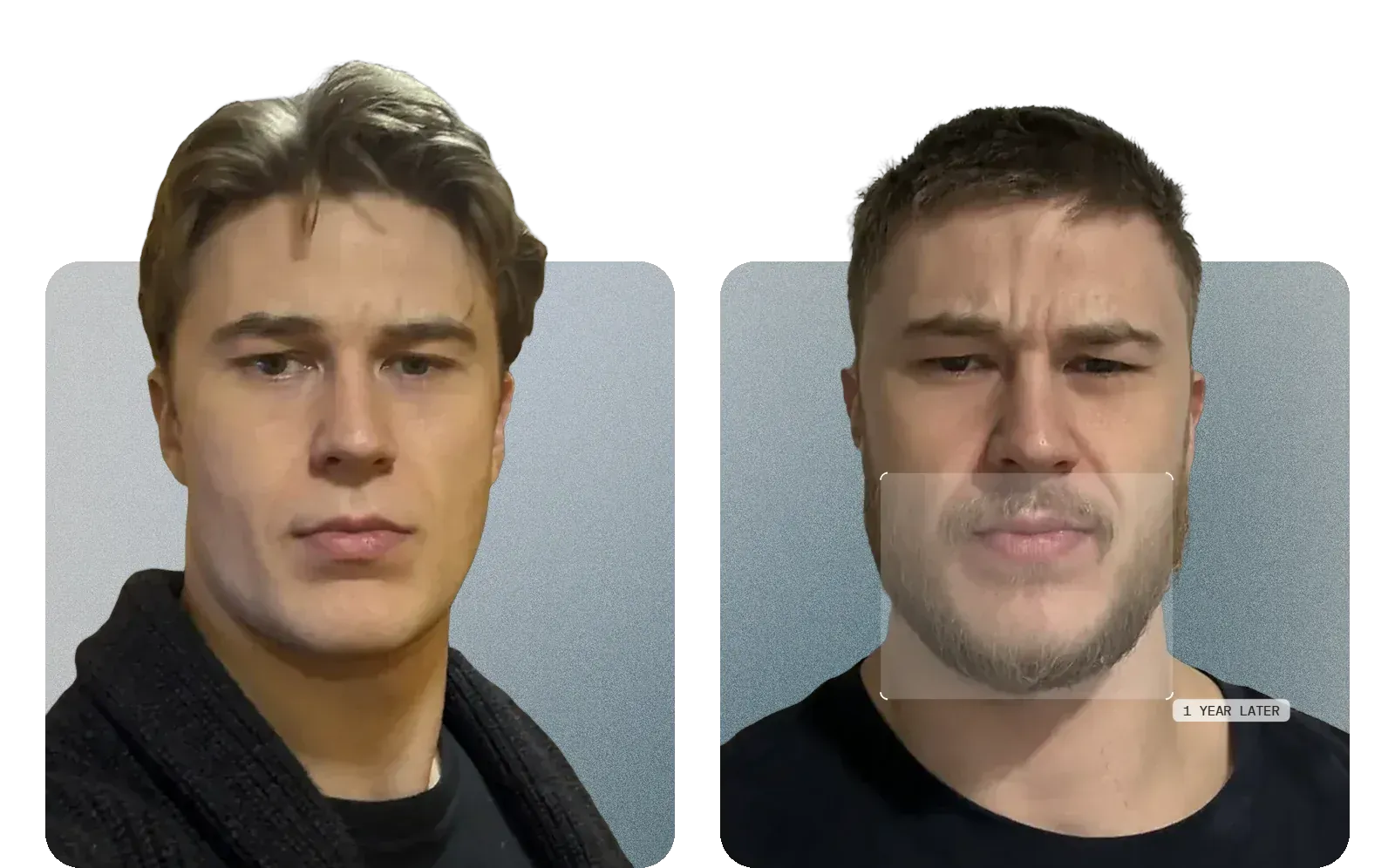
A QOVES team member without and with a beard, a year apart, both real photos. His hair, the lighting and his expression differ too, so treat it as an illustration.
For women, the main lever is facial contrast, meaning how much your eyes, eyebrows and lips stand out against the surrounding skin. It falls as people age, and in Porcheron's 2013 experiments6 raising it artificially made the same faces look younger, while lowering it made them look older. One of the clearest changes with age was in how much the eyebrows stand out from the skin around them, so soft, light brows read older and dark, defined brows read younger. For a woman, darkening and sharpening the brows to look older pushes the wrong way.
That puts women in a bind that men are not in. Lowering contrast does add years, the same day, and Porcheron and colleagues (2017)16 found the effect in French Caucasian, Chinese, Latin American and Black South African women alike, and report work finding the same fade with age in men. But low contrast is also what a face looks like with no makeup and lighter brows, which is the opposite of the defined look most women are after. Stubble adds maturity and keeps the appeal; softer brows add maturity and spend it. So for women the grooming route is narrower, and most of it is hair.
The hair on your head moves the reading for everyone. Muscarella and Cunningham (1996)17 found that going from full hair and a clean shave to a bald head with a beard and mustache added 7.25 years to perceived age. You do not want all 7.25, but it shows how much of the judgment comes from hair. Height on top with shorter sides lengthens a round face, and a heavy fringe shortens it. None of this changes the skeleton, which is why clinics sell surgery for it.
Nobody books surgery to look older. They book it to look less babyish: more defined, a sharper jaw, less round cheeks, and for men often more masculine.
Cosmetic clinics that write about baby faces tend to recommend buccal fat removal, which takes out that cheek fat pad. The operation is quick and effectively permanent, and the permanence is the problem: the pad shrinks with age on its own (Jafar et al., 2024)12, so the face you buy at twenty-five keeps traveling in that direction for the next thirty years.
Full cheeks are also on Lorenz's classic 1943 list of what makes a face babyish (as cited in Kuraguchi et al., 2015)18, and that list overlaps with what makes a face attractive, so taking the fat out for good can take some of the appeal with the roundness.
Chin and jaw work aims at the structure itself, since a short or set-back lower third is the part of a baby face that bone accounts for. The measurements are chin projection, chin height and the gonial angle, and jaw recession is the name for it when it is pronounced. All three are measured in a QOVES report, which is a cheaper way to learn whether your lower third is the problem than a consultation that ends in a quote. Fullness under the jaw is a different complaint, and double chin surgery a different operation.
We are not recommending any of them. Each is aimed at a specific measurement, and buying the wrong one is how people end up further from what they wanted, so find out which feature is yours before you pay for any of them.
Get Yours Measured
Six photos, measured and compared with faces from your own group. You get the numbers, and a plan for the one that stands out.
Upload 6 clear photos of your face securely and privately through our online portal.
Drag and drop file To upload
POSES REQUIRED
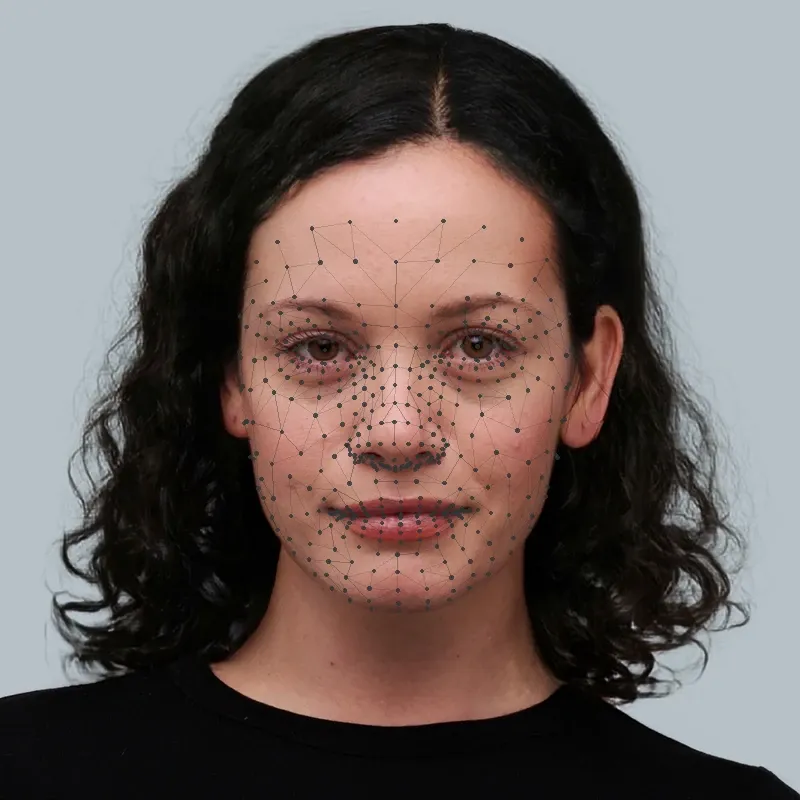
We measure 160+ facial markers, including skin quality, symmetry, eye shape, brow density, and more.


You’ll receive a plan highlighting your strengths, areas for improvement, and best ways to improve your appearance.
Emma’s Report
January 16, 2026
Explanation
Your forehead wrinkle depth aligns with expectations for your age and demographic, falling on the lower end of our predicted range.
Your Questions
Partly, and mostly before your twenties. The facial skeleton keeps growing well into your teens and the lower third arrives last, so faces do mature on their own. After that the structure is settled, and what still changes is fat, skin and hair.
Three levers need no surgery: facial hair, the hair and hairline, and facial contrast. Facial hair raises rated masculinity and dominance (Neave & Shields, 2008)15. In one study, a bald head and a beard together read over seven years older than full hair and a clean shave (Muscarella & Cunningham, 1996)17. Lowering the contrast between your eyes, eyebrows, lips and skin makes a face read older the same day (Porcheron et al., 2013)6, at the cost of the definition most people are trying to add.
Work out which feature is driving it before you change anything. If it is fullness, aim for a healthy weight; small changes do not show in a face (Re & Rule, 2015)10. If it is the placement or size of your features, weight will not touch it, and the levers are facial hair, hair and contrast.
A lot of it sits in the features themselves. When George and Hole (1995)19 swapped the features of one person photographed at two different ages, putting the older features into the younger face raised age estimates by about 40 percent, and the reverse cut about 33 percent off the older face. Contrast between the features and the surrounding skin is the other strong cue (Porcheron et al., 2013)6.
Mostly by waiting. Your facial skeleton is still growing and the lower third has the most left to do. Grooming and hair work now. Nothing irreversible is a good idea at 17.
Often, which is what makes this frustrating. Berry and McArthur (1985)7 found a correlation of .38 between how babyish a man's face was rated and how attractive it was rated. Cunningham and colleagues (1990)5 found only a weak hint that faces in between, neither very babyish nor very mature, were preferred. What babyish features reduce is perceived strength and dominance, and that holds even after controlling for age and attractiveness ratings (McArthur & Apatow, 1984)1. Those are two separate judgments, and you can sit high on one and low on the other.
No. Babyishness has been measured on round faces and on narrow ones (Cunningham et al., 1990)5. Facial fullness is one route to it and bone structure is the other, and the second matters more than most advice suggests.
If you are above a healthy weight, reaching it is likely to show in your face, slowly: people only notice a change of around 1.33 BMI points or more (Re & Rule, 2015)10. If you are already at a healthy weight, losing more is not the answer. Fat loss cannot be directed to your cheeks, and part of cheek fullness is a fat pad that dieting barely touches (Jafar et al., 2024)12.
Not in any published test, and the one trial that exists found the opposite (Alam et al., 2018)11: after twenty weeks of facial exercises, sixteen middle-aged women had fuller cheeks and were guessed nearly three years younger, probably because the cheek muscles grew. It was small and had no control group, but it is the only trial there is. Fat loss cannot be aimed at one area either, so an exercise targeting your cheeks will not take fat off your cheeks.
Often it is not the fat that dieting removes. The buccal fat pad in the cheek largely keeps its size when you lose weight (Jafar et al., 2024)12, and a rounded face outline, a short lower third, or features set low on the face all read as fullness at a glance. Fluid retention and a wide underlying bone structure can do it too, and losing weight does little for any of them.