Why You Look Different in the Mirror, in Photos, and to Other People
September 1, 2026
What is your first reaction when you accidentally open your camera, or when your friend takes a candid picture of you and insists you see it? You are not alone in feeling uncomfortable at seeing your face ‘as it truly is’. It has long been a phenomenon where we prefer our mirror reflection to our own selfies. Unlike Narcissus, who fell in love with his reflection without ever realizing it was his own face, most of us know the face in the mirror is ours. However, the strange part is realizing it is not the face everyone else is seeing. This article explains the mirror image effect, why every way we have of checking our own face is covertly unreliable, and how observing your face the way it is actually measured can close this mirror-selfie gap.
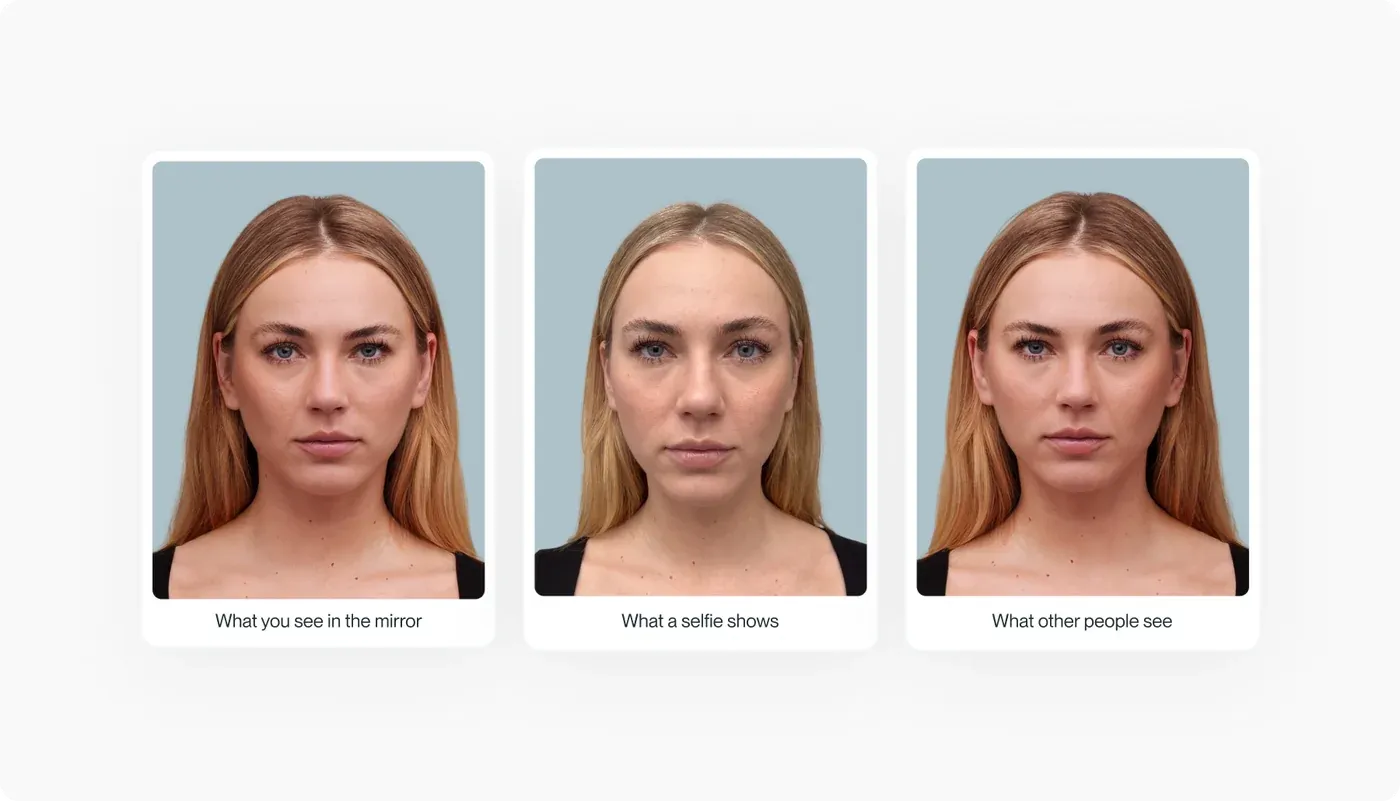
Left, the reversed face your mirror shows and you have memorized. Center, the same face at selfie distance, where a short lens widens the nose and midface. Right, the unflipped face everyone else sees.
Is the mirror effect how people actually see you?
In 1977, researchers Theodore Mita and Marshall Dermer (1) photographed a group of women, then printed each photo in two ways: the true image and a mirror-flipped version, reversed left to right, the way it would appear in a bathroom mirror. Each woman was shown both versions of her own face and asked which she preferred. Her partner or close friend would be asked the same question separately.
There was a consistent pattern: women consistently preferred their own mirror-reversed image, while their friends and partners preferred the genuine, unreversed picture. There is a well-documented reason for this split, covered in the next section. While the original 1977 samples were biased toward female subjects and small in size, a 2024 follow-up (2) tested men and women together and found the same pattern. Irrespective of gender, everyone preferred their own mirror-reversed reflection. That newer study did not repeat the friend-comparison part of the experiment, so we cannot say whether friends’ preference for the true image holds up in the same way.
The actual test was more strict than either preference in isolation. Both halves of the pair had to choose as predicted simultaneously, with the woman picking her mirror print and her partner picking her true one, which occurred in 45% of pairs in the first study and 50% across the five-trial replication, against the 25% expected by chance (1).
This mismatch is not purely psychological. In fact, it has been wired into your phone by design. Every iPhone’s front camera viewfinder shows a mirrored preview, the same reversed orientation as a bathroom mirror to make framing intuitive. However, up to 2020, the photo saved to your camera roll was the true, unmirrored image, meaning your picture never matched the preview you saw. Finally, iOS 14 added a “Mirror Front Camera”, but this only applies to the Camera app’s photos and videos, thus excluding video calls. For example, Zoom mirrors your self-view by default but has always transmitted the true, unmirrored orientation to everyone else on the call; FaceTime does the same.
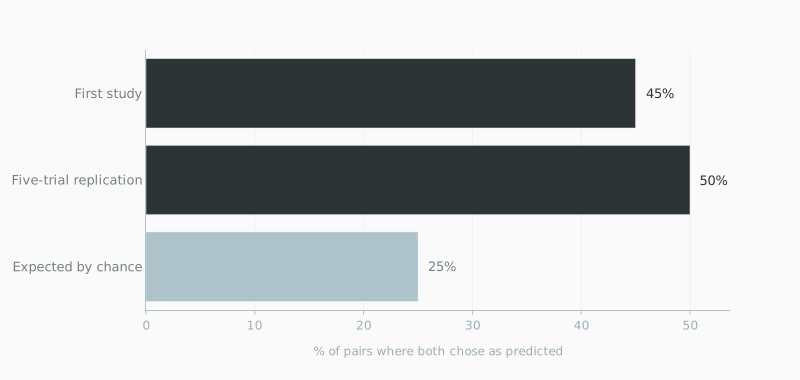
Mita and Dermer (1977). Both halves of the pair had to choose as predicted for a pair to count.
What is the mere exposure effect?
The core reason behind this phenomenon can be chalked up to the mere-exposure effect, which states that the more times you are exposed to something, the more you tend to like it, even if you never consciously notice that exposure. The ‘mere’ in the name implies you do not have to interact with the thing in question; you need exposure to it for effects to sink in. This concept originated with the 1960s social psychologist Robert Zajonc (3), whose work included a landmark paper titled “Attitudinal Effects of Mere Exposure,” published as a monograph supplement to the Journal of Personality and Social Psychology. He ran experiments exposing participants to specific stimuli, such as Chinese characters and unfamiliar faces, and found that the more times someone had seen an item, the more favorably they would rate it. This even applied to meaningless stimuli like nonsense syllables.
Later researchers went even further by using stimuli flashed so briefly that participants could not consciously recognize them, finding that the liking boost still occurred. Kunst-Wilson and Zajonc (4) showed subjects a series of irregular shapes for one millisecond each, revealing that subjects guessed correctly only 48% of the time (no better than chance) when asked to pick out which shapes they had seen before. However, when asked which shapes they preferred, 60% of the time they preferred the previously shown ones, suggesting their brains registered and favoured the familiar shape without ever knowing they had seen it.
Zajonc’s explanation is evolutionary; a never-before-seen stimulus could easily be a threat, so our brains treat novelty cautiously. However, as the novelty wears off through exposure, our guard slowly drops. Researchers coined this concept ‘perceptual fluency’: your brain finds it easier to process something it has seen before, and this ease of processing is misinterpreted as likeability. We can measure this physiological guardedness directly too: when researchers showed people the same pictures while recording how aroused their nervous system was (via skin conductance response), the response dropped most sharply within the first several viewings, and the difference between pleasant and unpleasant pictures disappeared completely after that same short window (5).
This is not a one-off study either. In 1989, psychologist Robert Bornstein (6) set out to test whether Zajonc’s findings genuinely held up. His paper “Exposure and Affect: Overview and Meta-Analysis of Research, 1968-1987,” published in Psychological Bulletin, compiled 134 studies, testing 208 separate effects, conducted over the 20 years since Zajonc’s original paper. This spanned diverse labs, participant groups, and types of stimuli, such as words, sounds, images, faces, and others. Across the body of research, people preferred items to which they were more frequently exposed, positioning the mere-exposure effect as one of the most consistently replicated findings in all of psychology. This applied to faces too: identical faces were rated more likeable by groups who saw them more often.
This was even further supported in a 2017 re-examination of the same journal, statistically modelling 268 separate effects drawn from 81 articles spanning the decades post Bornstein’s review. There was still a rise in liking with exposure overall, but this plateaued at around 35 exposures on average across the reviewed studies (7).
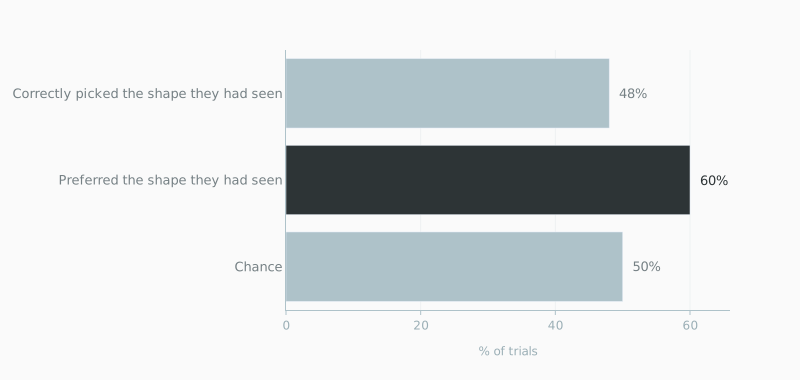
Kunst-Wilson and Zajonc (1980). Shapes were flashed for one millisecond each.
Why am I pretty but not photogenic?
This discrepancy is not exclusive to mirror-reversal. How close someone is to the camera also plays a vital role in self-perceived attractiveness. A 2018 study by researchers at Rutgers and Stanford (8) modelled differences in reactions between a typical selfie distance (around 12 inches) and a conventional 5-foot portrait distance. Interestingly, when standing 12 inches away, they found the base of the nose appeared roughly 30% wider and the tip around 7% wider than in the same face shot from 5 feet away, as anything closer to a camera lens projects larger in the frame than anything farther away. This results in two problems stacked on top of each other: incorrect orientations and warped proportions.
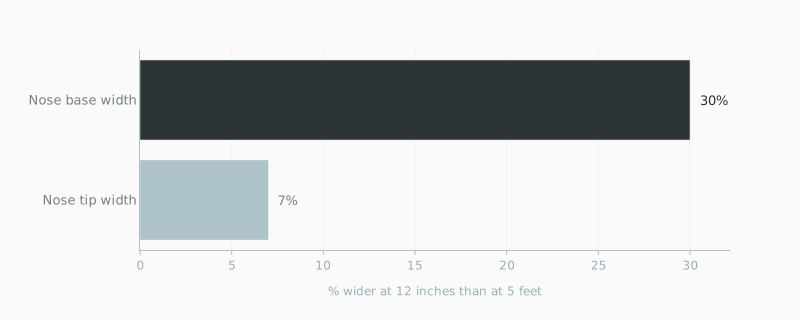
Ward and colleagues (2018), modelling a typical selfie distance against a 5-foot portrait distance.
Do you look better in real life, in the mirror, or on camera?
If this is the case, how do other people truly see us? Is it a flattering confirmation? Or an unflattering reality check? A 2012 study by Bryan and co-authors (9), published in PLoS ONE, found that photographing distance on its own dictates perceived trustworthiness, dominance or how attractive the same face is rated, irrespective of the actual facial features. Another layer is added when factoring in motion; a 2012 study by Post and co-authors (10) found videos of people talking were consistently rated as more flattering than any freeze-frame from the same video, a pattern named “frozen face effect”. In reality, people see you in motion, which mirrors and selfies cannot capture.
How to actually see the face other people see
To conclude, there is no everyday way to see the face other people experience, as each is missing something different, and looking harder won’t make it appear. This also explains why face-scanning apps and even Large Language Models cannot give you the full picture; they inherit the same distance and orientation issues described above, and a chatbot has no way to correct for this. This is the gap a landmark-based facial analysis aims to overcome: measuring your real facial symmetry and how your features map across the facial thirds, correctly orienting them and without distortion from lens distance.
References
- 1
Mita TH, Dermer M, Knight J. Reversed facial images and the mere-exposure hypothesis. Journal of Personality and Social Psychology. 1977;35(8):597–601.
- 2
Suchow J, McDowell M, Huang J, Haberman J. A reflection on faces seen under mirror reversal. Perception. 2024 Nov;53(11-12):763–74.
- 3
Zajonc RB. Attitudinal effects of mere exposure. Journal of Personality and Social Psychology. 1968;9(2, Pt 2 Suppl):1–27.
- 4
Kunst-Wilson WR, Zajonc RB. Affective discrimination of stimuli that cannot be recognized. Science. 1980;207(4430):557–8.
- 6
Bornstein RF. Exposure and affect: overview and meta-analysis of research, 1968–1987. Psychological Bulletin. 1989;106(2):265–89.
- 9
Bryan R, Perona P, Adolphs R. Perspective distortion from interpersonal distance is an implicit visual cue for social judgments of faces. PLoS ONE. 2012;7(9):e45301.
- 10
Post RB, Haberman J, Iwaki L, Whitney D. The frozen face effect: why static photographs may not do you justice. Frontiers in Psychology. 2012;3:22.