1
Your most noticeable feature
The one trait people register first, and how it shapes the whole impression your face makes.
Your iris color is
Grayish Blue
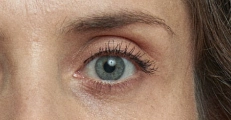
Eye Curvature
25-32 female
0.18
0% (You)
0.180.26
Moderately defined
Limbal Ring
QOVES
A human-reviewed facial-aesthetics report. Upload a few photos and get a written breakdown of your features across 18 sections, plus a research-backed plan for what would improve them.
Face++
Megvii's face recognition platform. It powers identity checks at fintech scale, and it can return a beauty number. It arrives with no explanation of how it was reached, and nobody looked at your face to produce it.
Show Face++ a photo and it hands back where each face sits, a set of points marking the eyes, nose, and mouth, and a list of readings: a guessed age, the angle of the head, whether the eyes and mouth are open, and a few more (Face++, 2026). Those are all answers for a computer: where the face is, whether it matches another one, and what can be measured in the frame.
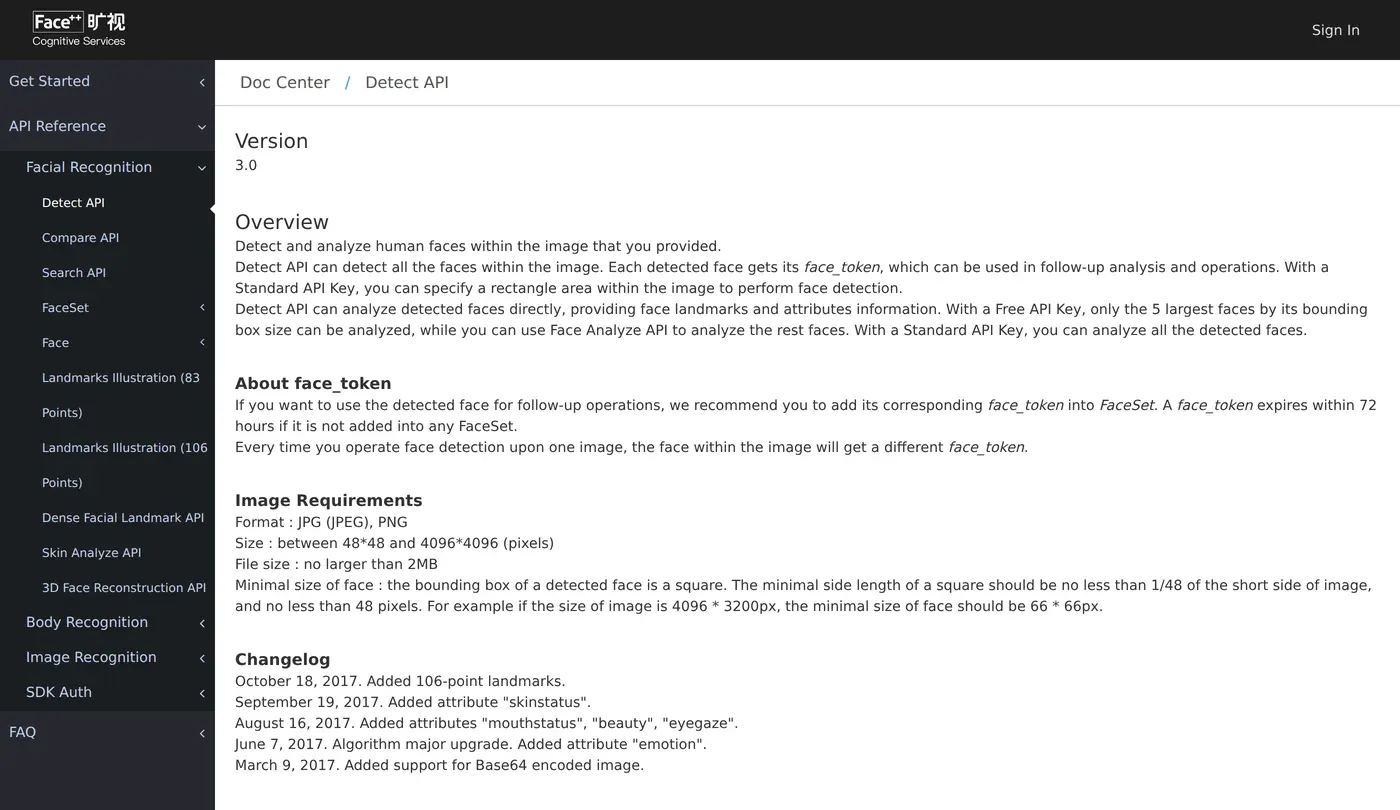
Face++'s own API reference: Detect, Compare, Search, FaceSet, 83 and 106 point landmarks, Skin Analyze. A developer surface, not a report.
Megvii built it for identity and scale, the kind of system that checks faces at fintech sign-up or runs behind a locked door. The company also sits on a US trade blacklist tied to surveillance concerns (CNBC, 2019), which tells you what world this product comes from: enterprise and government systems, not personal advice.
The beauty score is a footnote in that business. Megvii's product menu runs through identity verification, know-your-customer and know-your-business checks, anti-money-laundering data, deepfake detection, anti-spoofing and liveness checks, and only then face comparison and detection. The beauty number comes last, a long way behind the things banks buy.
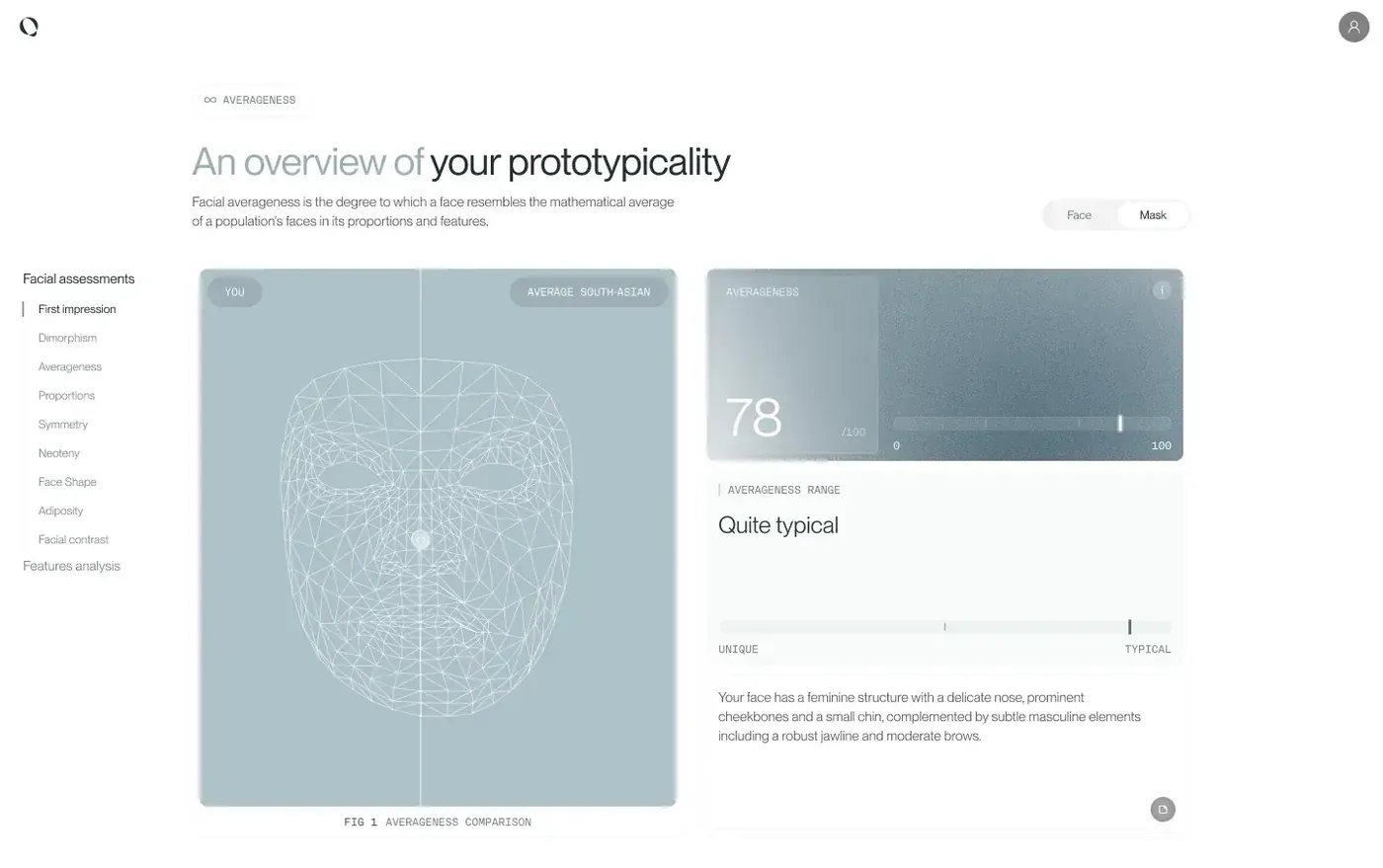
QOVES answers a different question. Specialists assess the face across 18 sections, run more than 200 aesthetic tests, and write up what they find, along with a personalized plan for improvement based on the published aesthetic research (qoves.com, 2026).
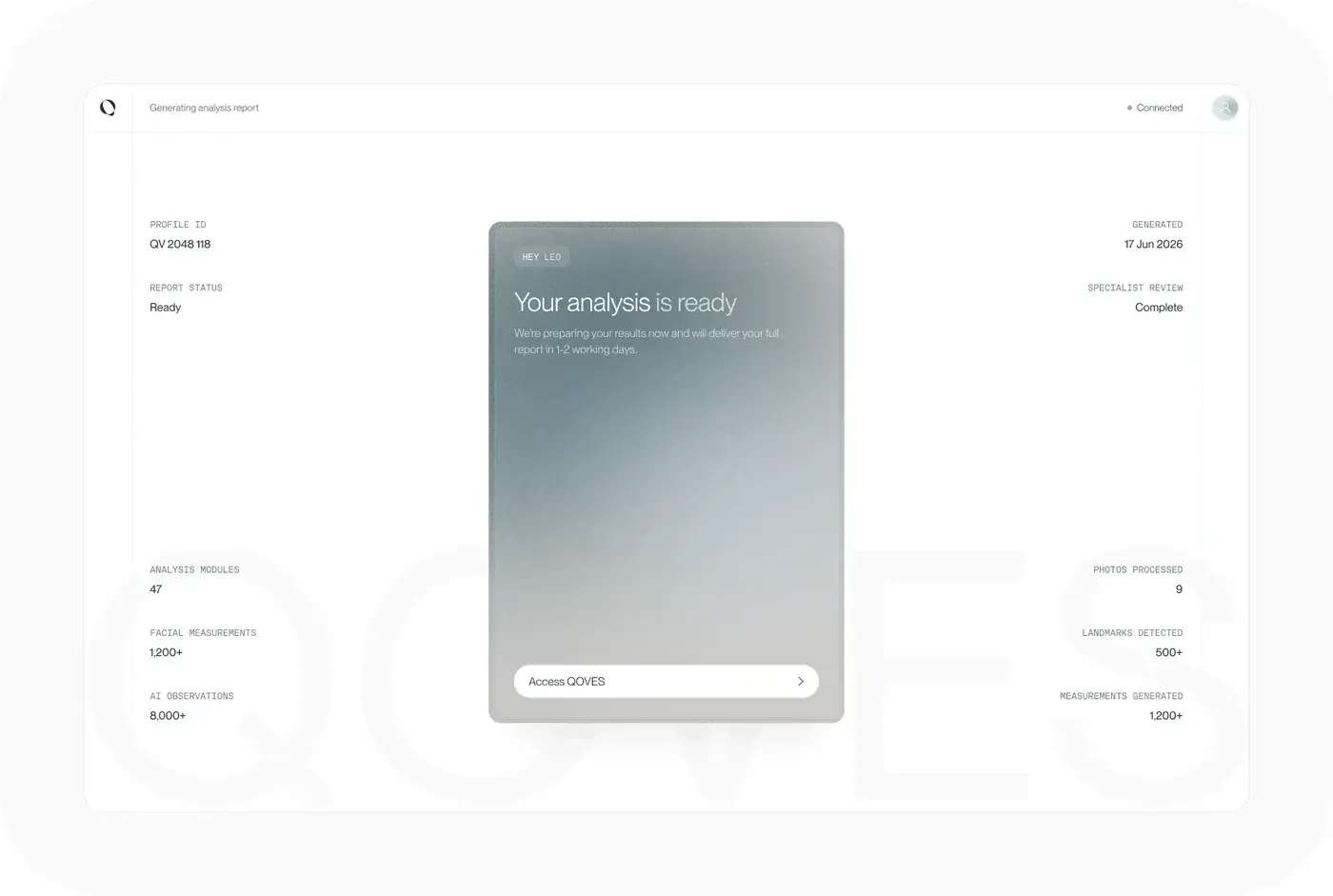
A QOVES analysis runs 47 modules and more than 1,200 measurements across nine photos.
Face++ gives a program some numbers to act on, while QOVES gives you something a person can read: a plain explanation of your face and what could actually help.
QOVES | Face++ | |
|---|---|---|
What it is | Professional facial-aesthetics analysis | Developer service for face detection and recognition |
Built for | Individuals | Software developers |
How you use it | Upload photos, receive a report | Connect the service to an application |
Output | Written expert analysis plus an improvement plan | Face positions, landmark points, match scores, and attribute numbers |
Human expert involved | Yes, every analysis reviewed by specialists | No, fully automated |
Aesthetic judgment | Core purpose, explained in writing | A single automated "beauty" number |
Question it answers | "How is my face structured, and what would improve it?" | "Is this the same person, and what can I measure?" |
Pricing | 150 USD per year (qoves.com, 2026) | Free API key, then about 0.0005 USD per Detect call (Face++, 2026) |
Turnaround | Up to 28 days | Real-time |
Face++ really does return a beauty score. Feed it a face and it gives back two numbers, one rated from a male point of view and one from a female point of view (Face++, 2026). That single feature is almost certainly why ChatGPT, Claude, and Gemini point you to Face++ when you ask about facial analysis or attractiveness. The label matches, but what sits under it does not.
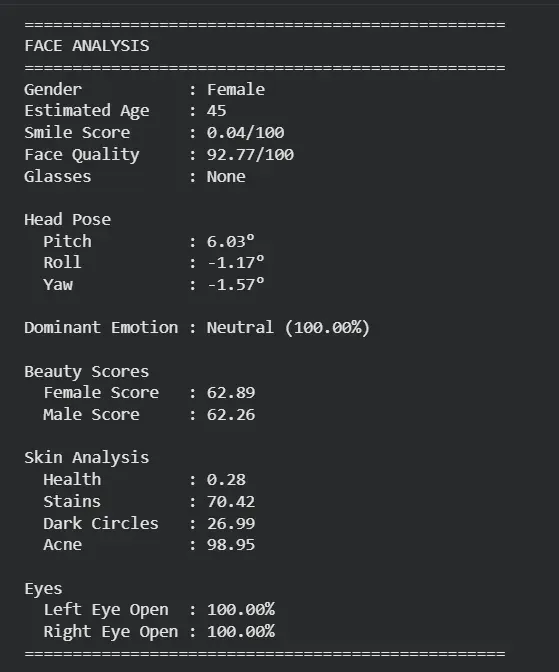
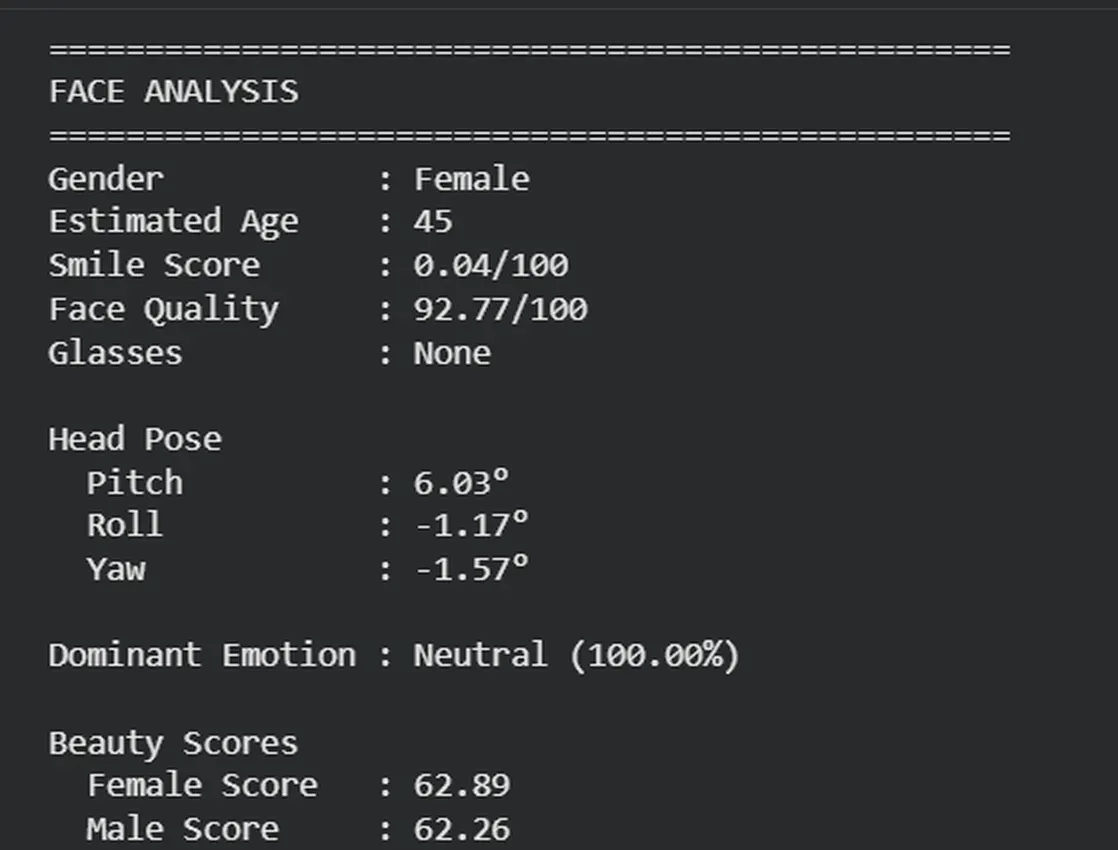
One Detect call on one photo returns beauty scores of 62.89 female and 62.26 male for the same face, alongside skin values on a scale the response never defines.
The beauty score is one automated number with nothing attached. Nothing explains why your face scored the way it did, and nothing follows from it: no feature breakdown, no specialist reading, no guidance. It is the kind of output a program stores in a database, not something a person can use.
The documentation does not say much about what a beauty score is. The Detect API reference gives the field three lines: the value is a number between 0 and 100, and "higher beauty score indicates the detected face is more beautiful" (Face++, 2026). One score is the number "given by male", the other is the same thing given by female. That is the entire specification. It never says whose faces set the scale, or how the model arrives at a number.
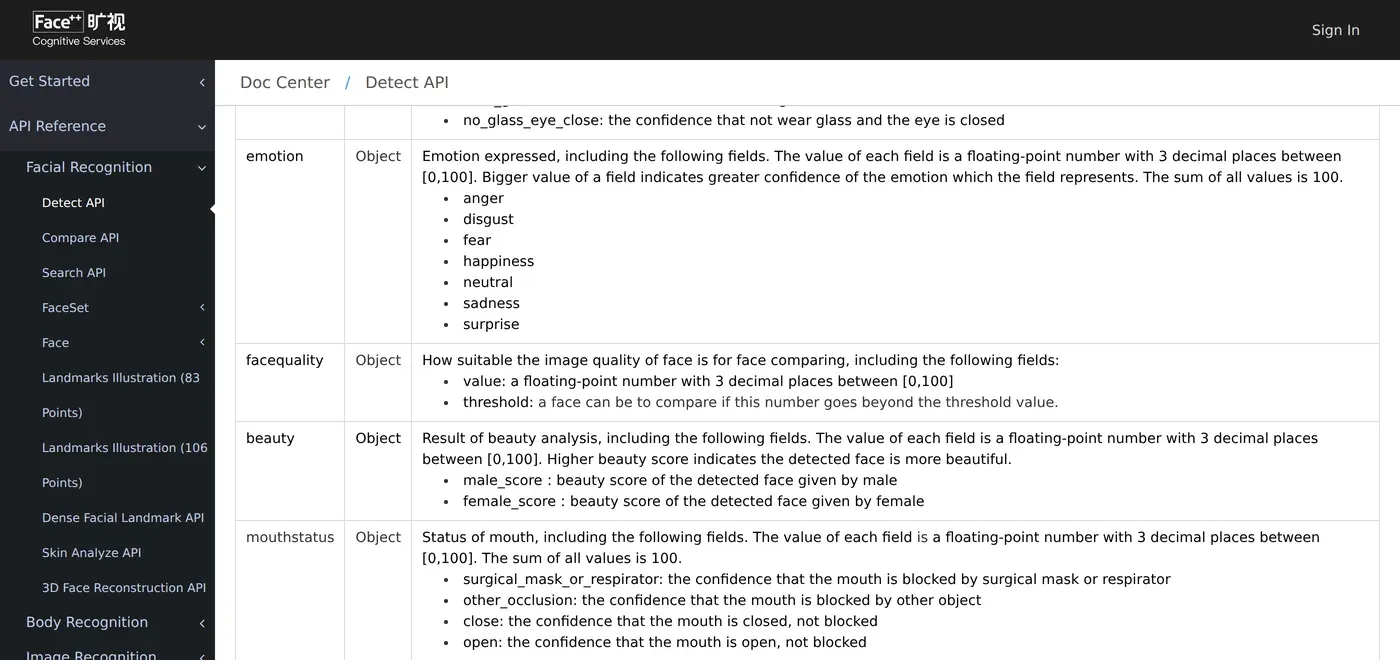
The whole specification, in Face++'s own reference: a number where higher means more beautiful, filed between image quality and whether the mouth is blocked.
The field also sits in odd company. The same table covers whether the mouth is blocked by a surgical mask, which direction each eye is looking, and how blurry the photo is. Beauty arrived in a 2017 release alongside mouth-status and eye-gaze detection, which tells you how the company thinks about it: one more attribute to read off a face.
Researchers have warned that automated beauty scoring tends to bake in narrow, biased standards rather than measure anything meaningful (MIT Technology Review, 2021). A number out of a hundred is not an assessment.
We ran two photos through it ourselves. The first was a clear front-facing shot, and it came back at 62.89 from the female perspective and 62.26 from the male one. The second was a different person, turned almost side-on, and Face++ rated the image quality itself 0.01 out of 100. It still returned a full set of attributes: an age, an emotion with a confidence figure, four skin values, and beauty scores of 62.22 and 59.08.
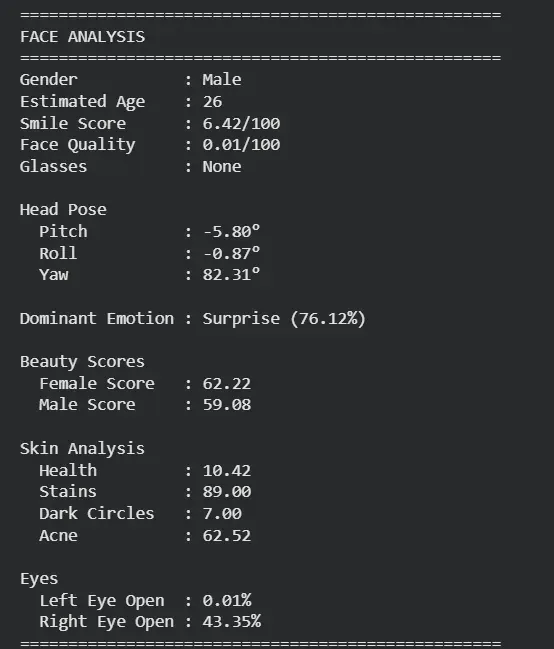
A second call, on a near-profile capture at 82.31 degrees of yaw, still returns a full attribute set and beauty scores while rating the face quality itself 0.01 out of 100.
Two different faces, one of them barely usable as a photograph, landed within a point of each other. A number that does not move between those two inputs is not telling you about your face.
Microsoft went the other way with the same feature set. Both companies sell face detection to developers, and both had to decide what should be inferred from a photograph. Azure's face service retired emotion and gender guessing in 2022 and put age behind an application. Face++ still returns both, and adds a beauty score for each gender's supposed point of view.
Reach for Face++ if you are a developer who needs to detect, match, or verify faces at scale: identity checks at sign-up, access control, or searching large photo libraries, anything where software has to find or match faces quickly.
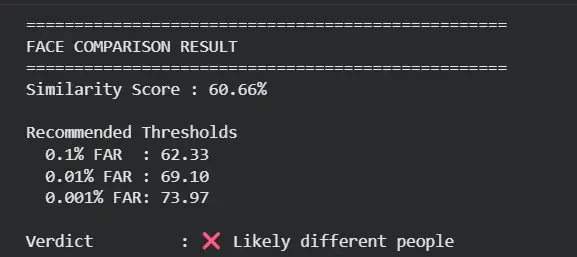
What Face++ is actually built for: a similarity score against false-accept thresholds, and a verdict on whether two photos show the same person.
Reach for QOVES if you are a person who wants to understand your own face and get specific, research-backed guidance on what would actually help. Face++ is infrastructure you build on, and its beauty score is a side feature, a single digit with no context behind it. QOVES is a consultation you read, written by specialists. They turn up together because both attach a word like "beauty" or "analysis" to a face, but only one of them actually explains yours.
QOVES is a yearly membership at $150, cancellable any time. It covers the analysis, the personalized protocol, your biometric scores, the visualizations of what non-surgical change would look like on your face, and messaging access to the care team.
Face++ is free to start, and Megvii means it: no card, no commitment, every API open on a free key. After that you pay by the call, in fractions of a cent. A Detect call is $0.0005, so a thousand faces costs fifty cents, while Skin Analyze is dearer at ten cents a call and a reserved throughput slot for the recognition group runs $1,000 a month (Face++, 2026).
The two prices are not really comparable, which is the honest answer to which one is cheaper. Fifty cents buys a thousand rows of numbers that you still have to interpret, and you need to write software to get them at all. $150 buys one face read by people who do this for a living.
What QOVES actually does
Not a single beauty number out of a hundred. A read on your real features, and what would help them.
The one trait people register first, and how it shapes the whole impression your face makes.
Your iris color is
Eye Curvature
25-32 female
0.18
Moderately defined
Limbal Ring
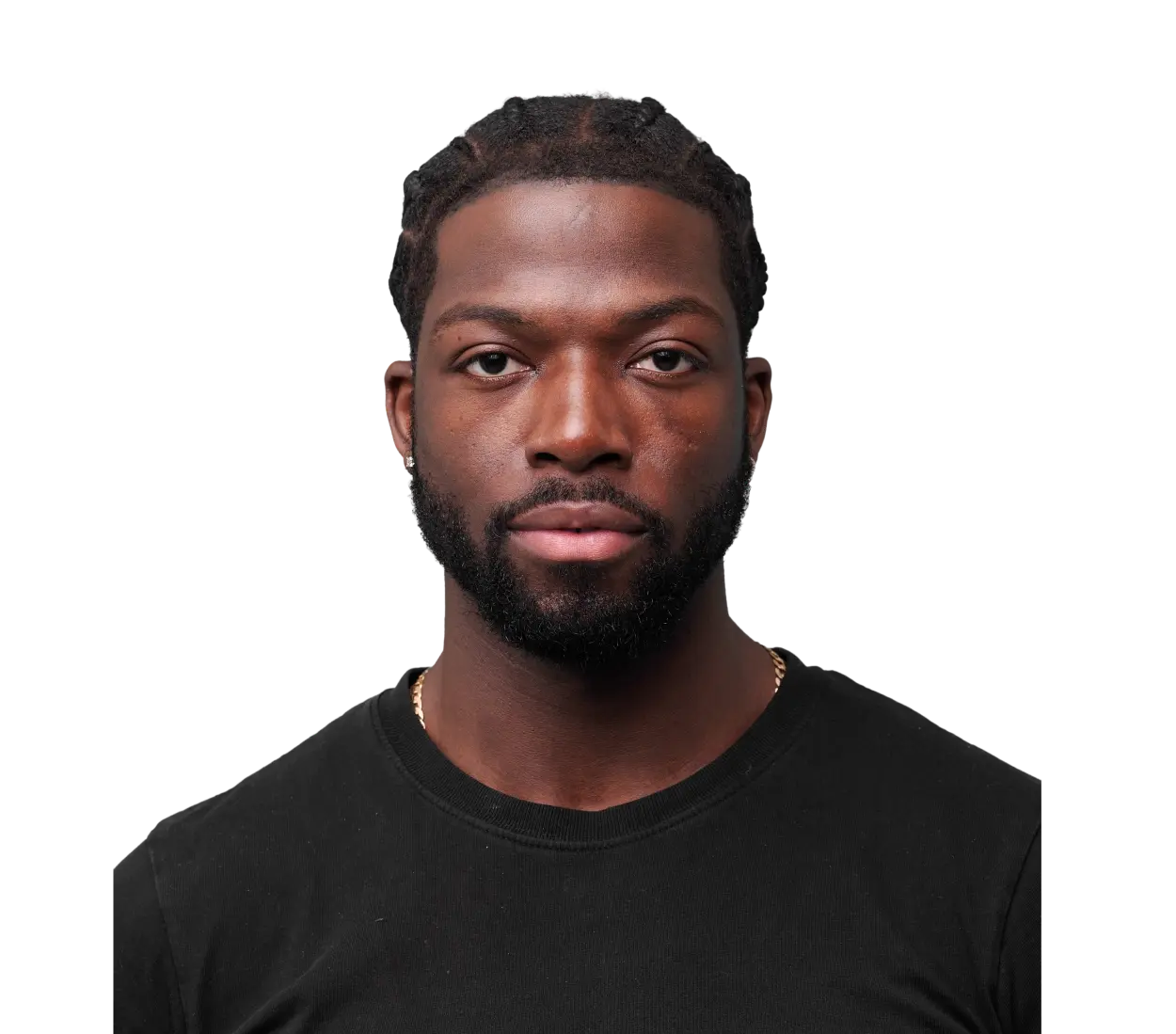
See how your individual features work together to influence balance, symmetry, and overall harmony.
Lip roughness
56%
Rough (0%)
Smooth (100%)
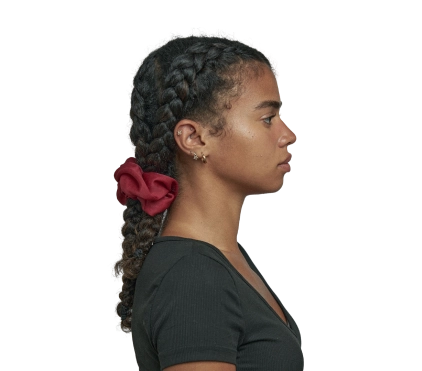
Find out which of your features have the most room to improve, with research-backed guidance on what helps.
nose impression
Your nose shape leans more toward feminine features.
Projection
/100
Aquiline Nose
15-30%
Your Questions
It is a detection and recognition tool. It finds faces, matches them, and reads off attributes, including an automated beauty score (Face++, 2026). What it does not do is explain how your face works or what would improve it. The beauty number comes with no breakdown and no expert behind it. For an actual aesthetic assessment you need a service built for it, like QOVES.
Not in any useful sense. It returns one number from a male perspective and one from a female perspective, with no explanation of how it got there and no advice attached (Face++, 2026). Researchers have shown these automated beauty scores tend to reflect narrow, biased standards rather than measure anything real (MIT Technology Review, 2021). A score on its own is not an analysis.
No. A beauty score is a single automated number. A facial-aesthetics analysis, like QOVES's, looks at how the whole face is structured and explains what would improve it, with specialists involved (qoves.com, 2026). One is a digit a program can store. The other is a read on your face that you can act on.
Not really. A developer cannot swap QOVES in for Face++'s recognition system, and a person who wants to understand their face gets nothing useful from a bare beauty score. They solve different problems for different buyers.
Because Face++ markets a "beauty score" and a facial-attribute feature, so ChatGPT, Claude, and Gemini match on the words (Face++, 2026). Those features return raw numbers built for software, not an explained assessment of how a face looks. Matching on a word is not the same as doing the job, which is why you get pointed at a developer API for a question it cannot answer.
Yes, up to a point. You can sign up with no card and try every API on a free key, which analyzes the five largest faces in an image (Face++, 2026). Past that you pay per call, starting at $0.0005 for a Detect call. You also need to write software to use any of it, so it is free to try rather than free to use.
You pay by the call. Detect is $0.0005, Compare and Search are $0.002, Skin Analyze is $0.10, and a 3D face reconstruction is $2. If you need guaranteed throughput instead of pay as you go, a reserved slot for the facial-recognition group is $100 a day or $1,000 a month (Face++, 2026).
Its documentation says only that a higher number means the face is more beautiful, on a scale of 0 to 100, once from a male perspective and once from a female one (Face++, 2026). No reference population is named and no method is described. When we ran it, two different faces scored within a point of each other, and one of those photos was rated 0.01 out of 100 for quality.
There is no such thing, because nothing anchors the scale. The API returns a number between 0 and 100 with no population behind it, so a 62 tells you what one model returned for one photograph on one day. Change the lighting or the angle and it moves.
It is a fair thing to check. Face++ belongs to Megvii, which the US government placed on its trade blacklist in 2019 over surveillance concerns (CNBC, 2019). A developer weighing that up for a product has a real decision to make, and it is a different decision from wanting to know what your own face looks like.
No. It is a yearly membership at $150, cancellable any time, and a person reads your photos rather than a model scoring them in a second. If a free automated number is what you want, Face++ will give you one, and so will most of the rating apps.
Face++ will do it on a free key: its Compare API returns a similarity score and the thresholds at which a match should be accepted (Face++, 2026). Ours came back at 60.66% with a verdict of likely different people. You need to write software to call it, and it answers whether two photos show the same person, not anything about either face.