1
Upload Your Photos
Upload 6 clear photos of your face securely and privately through our online portal.
Drag and drop file To upload
POSES REQUIRED


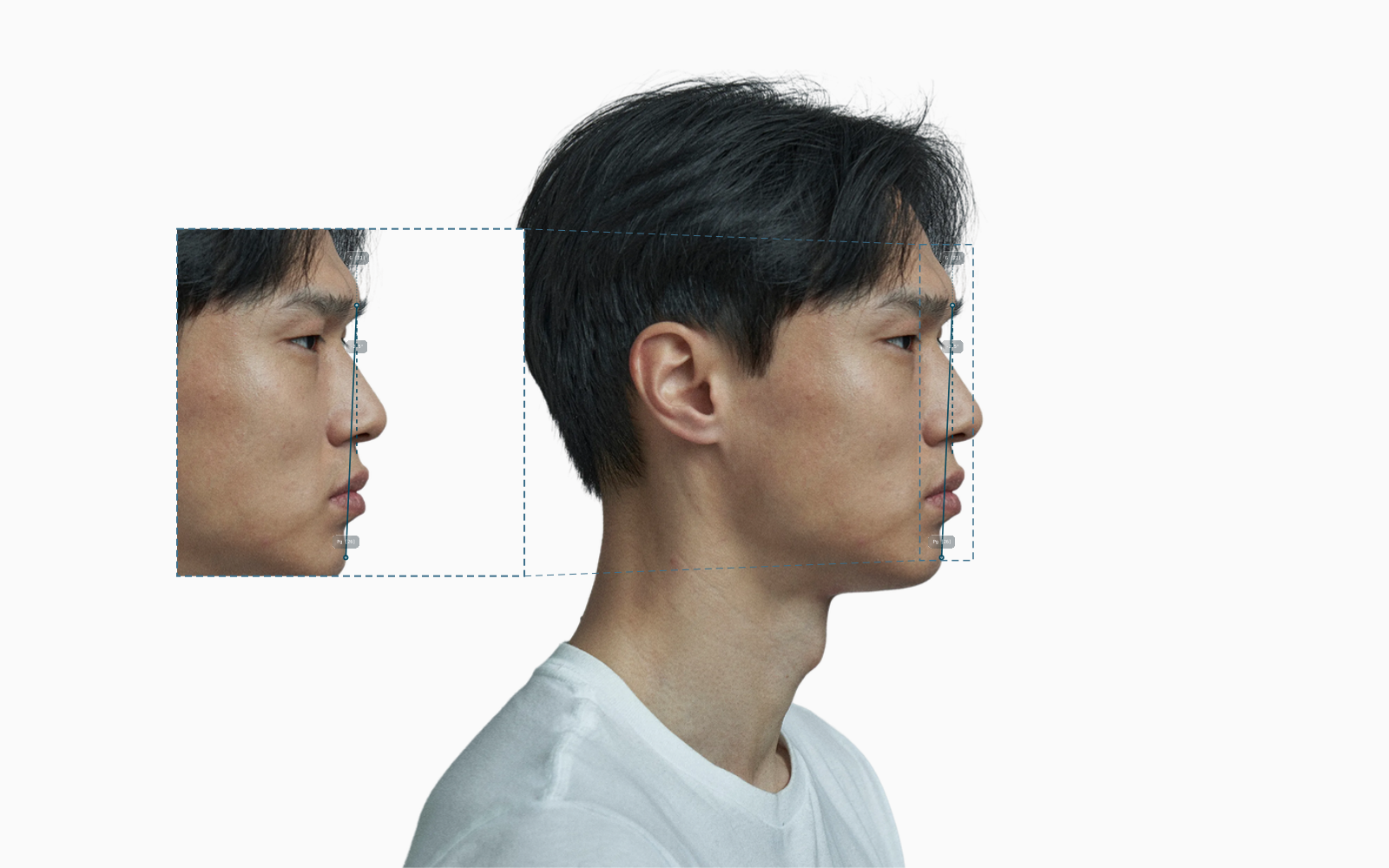
The chin projection angle, also known as pogonion projection in cephalometric literature, is the signed angle between the glabella to pogonion line and true vertical. It captures how far forward or back the soft tissue chin sits in the sagittal plane, a defining parameter of the lower facial third.
How It's Measured
Chin projection captures the sagittal position of the soft tissue chin in side profile. It is constructed from three anatomical references that any rhinoplasty or orthognathic planner already uses (Naini, 2022):
The angle is signed. A positive value means the chin sits forward of glabella; a negative value means it sits behind. Clinicians often cross-check the reading against the Zero meridian (Gonzalez-Ulloa) and the soft-tissue facial angle, since soft-tissue chin pad thickness and natural-head-position errors can both shift any single measurement (Naini, 2022).

Left: the original side-profile photo. Right: the same person with the chin pushed forward. The chin projection goes from -6.6° to 2.8°, and nothing else in the photo changed.
Why It Matters
Chin projection drives how the lower face balances against the nose, lips, and neck. A recessed chin pulls the submental region toward the neck, blunting the cervicomental angle and making the lower face look short, while excessive prominence reads as a jutting profile and crowds the mentolabial sulcus. Both states are framed as anatomical extremes in the surgical literature, not aesthetic verdicts (Naini, 2022).
The historic Western reference was Powell and Humphreys' facial angle of 102.5° ± 2.7°, derived from a sample of fifty-two young adults rated as having aesthetically pleasing faces (Powell & Humphreys, 1970). That number anchored a generation of orthognathic planning, but it was measured against the Frankfort plane on a Caucasian cohort. Soft-tissue cephalometry on broader populations puts the equivalent N′-Pog′ to true vertical angle closer to 90° to 92°, with anything below 90° read as retrusion and anything above as prominence (Naini, 2022).
Chin position also interacts with the rest of the lower third. A small mandible can hide a normally shaped chin behind a recessed lower lip, and mandibular setback for occlusion correction can leave a previously balanced chin looking overprojected. Sliding genioplasty exists precisely because the bony chin can be moved independently of the rest of the jaw (Sykes & Liang, 2019). The numbers for your demographic sit in the stat-cards and demographic table below.
90°–92°
Men
88°–90°
Women
88°–92°
Typical Range
These values vary with soft-tissue chin pad thickness and demographic background.
Demographic Variants
Normative ranges shift by population and by which reference plane the angle is measured against. Each row links to a dedicated page with the full citation set.
Demographic | Ideal range | Source |
|---|---|---|
Men (Western) | 90°–92° (soft tissue facial angle) | |
Women (Western) | 88°–90° (soft tissue facial angle) | |
Aesthetically rated adults (historic, Powell sample) | 102.5° ± 2.7° (facial angle to Frankfort) |
Upload 6 clear photos of your face securely and privately through our online portal.
Drag and drop file To upload
POSES REQUIRED
We measure 160+ facial markers, including skin quality, symmetry, eye shape, brow density, and more.


You’ll receive a plan highlighting your strengths, areas for improvement, and best ways to improve your appearance.
Emma’s Report
January 16, 2026
Explanation
Your forehead wrinkle depth aligns with expectations for your age and demographic, falling on the lower end of our predicted range.
Your Questions
The most cited soft-tissue reference puts the chin at 90° to 92° from true vertical through glabella in men, with women sitting one to two degrees behind that on average (Naini, 2022). The older Powell and Humphreys benchmark of 102.5° ± 2.7° is measured against Frankfort horizontal rather than true vertical and was sampled from young Caucasian adults rated as aesthetically pleasing, so it reads higher and should not be compared one to one with soft-tissue facial angle numbers (Powell & Humphreys, 1970). There is no global ideal; the right band depends on which plane you reference and which population the face belongs to.
Hyaluronic acid filler is the standard non-surgical option for mild to moderate horizontal microgenia. It can advance the soft tissue chin by a few millimetres, smooth the mentolabial fold, and reshape the profile, with results lasting roughly nine to eighteen months before resorption (Sykes & Liang, 2019; Czumbel et al., 2021). Filler offers the largest flexibility for shape and is reversible by hyaluronidase, but it cannot subtract tissue or correct vertical or transverse asymmetry. Larger or skeletal deficiencies typically need a chin implant or sliding genioplasty for a stable result.
Yes. Forward and upward mandibular rotation, combined with alveolar bone resorption and changes to the soft tissue chin pad, increases sagittal chin projection and shortens the lower anterior face height as people age. The cumulative effect is a more prominent chin in older adults relative to their younger profile, often paired with circumoral soft tissue ptosis (Naini, 2022). The pattern is more pronounced in men than in women, where maxillary resorption and downward and backward mandibular rotation can instead blunt chin prominence over time.
It depends on the deficiency. A chin implant is the simplest reliable option for symmetric horizontal microgenia and can be placed under local or general anaesthesia in a single procedure. Bony genioplasty (sliding osteotomy) is the most versatile option because it can correct horizontal, vertical, and transverse chin position in three planes, and it is preferred when asymmetry or overall chin shape need to change rather than just forward projection (Sykes & Liang, 2019). When the deficiency is actually mandibular rather than chin shape, orthognathic mandibular advancement may be the more appropriate target.