Hair Loss in Men: Causes, Prevention, and Treatment
March 1, 2026
Why hair loss matters
Hair loss is one of the most common things men deal with. It shows up more often with age, but it can hit anyone, even young boys. More than half of men over 50 see signs of it, and 4 out of 5 men over 70 lose some hair.
Some shedding is completely normal. The American Academy of Dermatology says it is normal to lose 50 to 100 strands a day, and if you have more than 100,000 strands up top, that daily loss is not even noticeable (1).
Normally new strands grow in to replace the ones you lose. It only becomes a real problem when that replacement stops keeping up.
Depending on the cause, it can arrive suddenly or creep up over years. Most men cannot tell whether they are actually losing hair or just shedding normally, and they rarely know when it is time to see a doctor. This guide walks you through what you need to know.
Hair is a big part of how a man is seen, and a large body of research ties losing it to a lower quality of life. It chips away at confidence, brings more romantic rejection, and shrinks the dating pool (49-51).
Pattern baldness is the most common cause, and watching your hairline slowly recede can leave you feeling helpless, like your looks are draining away a bit at a time.
Bald men are seen as more masculine and strong
There is some truth to the idea that bald men read as more masculine (55).
Even so, balding is an unpleasant experience for most men, and younger men especially tend to refuse to just accept it.
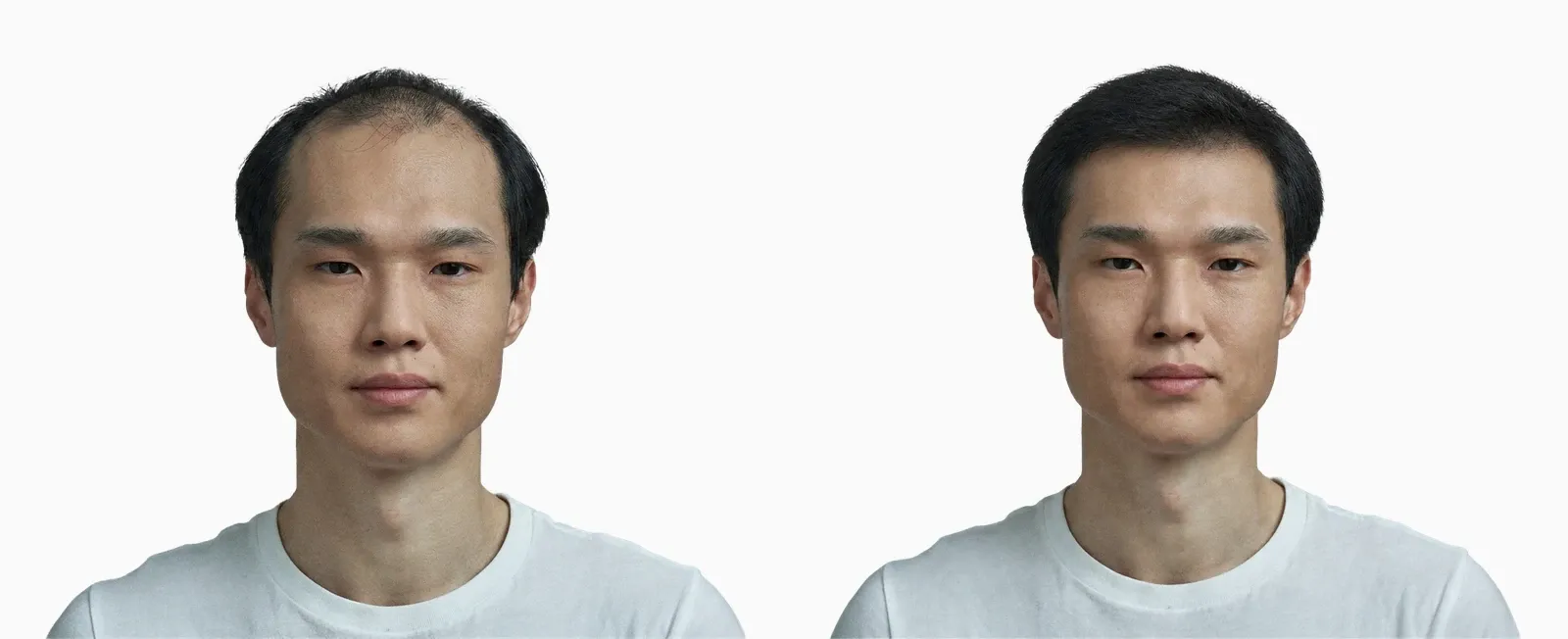
Simulated 12-month result of consistent finasteride and minoxidil treatment on Norwood 3-4 hair loss. Density restored at the crown, frontal hairline partially refilled — typical of well-responding patients.
The difference hair makes
As men lose their hair their confidence tends to drop, and most will admit how much it matters to how attractive they feel (52). When it starts early, it can even tip into Body Dysmorphic Disorder. By our own estimate, hair loss can knock a full 2 points off a man's attractiveness on a 10-point scale.
There are a lot of possible causes, and yours is hard to pin down without a dermatologist, so once you notice a problem it is worth finding one who can diagnose it properly (19). QOVES cannot truly diagnose the cause of your hair loss. We can only make an educated guess.
Before you get that far, it helps to compare your hairline against a few free resources:
- QOVES Studio (articles on hairloss aesthetics)
- r/tressless (user submitted images of hairloss)
- Hairloss Talk (discussions of hairloss medication)
- QOVES Discord (post your hairline for realtime feedback)
To diagnose it properly your doctor will examine you and ask about your diet, hair care routine, medical conditions, medications and supplements, and family history (20). They may also run some of these tests:
- Blood Test: Blood tests may reveal any medical conditions or nutrient deficiencies you may have that cause hair loss.
- Pull Test: To determine the shedding stage, your doctor may pull your hair to examine their strength and see if they come out easily or not.
- Scalp Biopsy: Scalp biopsies are gathered by scraping skin samples or pulling a few hairs from the scalp. Your doctor will then examine your hair roots microscopically to determine whether the cause of the hair loss is an infection or not.
- Light Microscopy: This is an instrument used mainly to examine hair shafts in order to discover any hair shaft disorders.
One word of warning: do not ask friends or family for hair loss advice. Most are not equipped to give a good answer, and the ones who are will soften the truth to spare your feelings.
- Full-Body Hair Loss: Certain health conditions and treatments can lead to full-body hair loss such as cancers and chemotherapy.
- Scaling Patches: Ringworm infections can lead to scaling patches spreading over the scalp.
- Visual Evaluation: In more severe cases of hairline recession or thinning, it's quite clear to see how the hairline is moving.
- Diffuse Thinning: This type of hair loss is the most common and natural. Hair thickness will reduce with age, even with a full head of hair.
- Bald Spots: Hair loss can develop in circular or patchy bald spots on different body parts including the scalp, beard, or even eyebrows.
- Hair Loosening: Sudden hair loosening usually occurs due to emotional or physical shock.
Androgenic alopecia (male pattern baldness)
This is the most common type of hair loss in men. You will also hear it called male pattern hair loss or androgenic alopecia (3).
It is genetic. You inherit genes that make your follicles sensitive to dihydrotestosterone (DHT), and as your testosterone converts into DHT, the DHT binds to those follicles and shrinks them. The hair does not really fall out for good, it just gets too small to see.
- 80% of predisposition to baldness is inherited (35).
- Increased risk of baldness with increasing affected family members (36).
- If your father suffers from pattern baldness there is an ~81% chance you will too (37).
- Some regions are less sensitive to DHT than others, like the base of the head. Hair transplanted from here to the front will not miniaturize as quickly (38).
Alopecia areata (autoimmune hair loss)
Alopecia areata is an autoimmune disease where the immune system attacks the hair follicles. It can hit hair anywhere on the body, including the scalp, eyebrows, eyelashes, and even inside the nose and ears.
It is the second most common kind of non-scarring hair loss after pattern baldness, but it affects only about 2% of people in their lifetime (39). It often shows up alongside depression or autoimmune diseases like rheumatoid arthritis, vitiligo, and psoriasis. If you have this form, you are probably already aware of it.
- Characterized by patchy baldspots
- No notable sex or ethnic differences in prevalence
- Treated with steroidal creams and is moderately reversible (40)
Tractional alopecia (friction hair loss)
Tractional alopecia is hair loss from physically pulling the hair out of its follicles, usually from tight hairstyles or headwear. It is most common in African women who braid tightly, but it affects men too, whether through Sikh practices or just a regular hat (41).
For a lot of men, tight headphones are the culprit, creating a band of thinning along the vertex where the headphone rests. If that is you, switch to earphones where you can.
- Characterized by temporal recession, horseshoe or band-like thinning
- African hair is most at risk due to the asymmetrical shape of the hair follicles
- Cornrows, weaves, dreadlocks, turbans, ponytails, buns and hats mechanically pull on the hair.
Telogen effluvium
Extreme stress can trigger hair loss by pushing the hair cycle into its shedding phase too early. When stress is the cause, the condition is called telogen effluvium.
It can come from stress, hormonal changes, or certain medications. Most of the time it is temporary and the hair grows back, though in some cases the loss is permanent.
Minoxidil (Rogaine)
Minoxidil started life as a blood pressure drug and is now used off-label for hair loss. It comes as a liquid or a foam, and we lean toward the liquid if your skin can handle it, applied to the scalp twice a day, ideally at 5%.
The short version is that it really works, but you have to be consistent, and you should expect at least 6 months before you see results.
- Clinical trials in androgenic patients treated with 2% or 5% concentrations of Minoxidil showed a remarkable increase in hair growth (42)
- Minoxidil-induced growth peaked at 1 year in a 5 year period (43)
Finasteride (Propecia)
Finasteride is an enzyme inhibitor that blocks testosterone from converting into DHT, the metabolite that shrinks sensitive follicles. You can take it as a topical or an oral, and 1mg a day turns out to be the sweet spot, nearly as effective as 5mg but with fewer side effects (45).
- Once started, Finasteride must be taken for life or the hair will continue falling out
- No significant difference between oral (1-5mg/day) vs topical (1% solution) (46)
- Finasteride is prescription only, but can be bought through an online-prescription
Platelet rich plasma (PRP)
Platelet rich plasma is an injectable procedure. The platelets, which act as growth factors, are separated from your own drawn blood and injected back into the scalp to encourage hair growth. It has to be done in a licensed clinic, which makes it less convenient, but it works, with strong results for boosting hair counts on a typical protocol of 4 monthly visits followed by quarterly maintenance (4748).
- Works like Minoxidil to encourage hair growth
- Needs ongoing maintenance
- Does not slow down hairloss (like finasteride)
Build your routine

Most patients see initial regrowth around month 3, with peak density gain near month 12-18. After two years the gain plateaus — continuing treatment maintains the result, stopping reverses it.
Get your hairline assessed
Whether it is us, your local practitioner, or the best dermatologist in the country, get a second opinion now if you have any concern about pattern baldness.
Prevention works far better than any treatment we have today.

Early-stage hair loss responds well to minoxidil alone or finasteride alone. Mid-stage typically needs both — and consideration of transplant for the frontal hairline. Advanced loss is mostly a surgical conversation.
Read these
Additional hair loss resources.
FAQs
Things you should probably know
To prevent or slow down hair loss, try these:
- Avoid Excessive Touching: Pulling, twisting, and rubbing your hair make it loose. Try to avoid touching your hair as possible.
- Use a Loose Hairstyle: Braids, buns, ponytails, and other hairstyles put a lot of pressure on your hair. Try to use a loose hairstyle.
- Dry Your Hair Gently: When your hair is wet, gently pat it dry. Rubbing or twisting your hair with a towel may make it weaker over time.
- Consume Nutrient-Rich Foods: Nutrient-rich, balanced diets will prevent hair loss due to nutrient deficiencies. Consume foods that contain iron and protein regularly.
- Avoid Styling Tools and Products: Blow dryers, heated combs, hair strengtheners, coloring products, bleaching agents, relaxers, perms, and other hair styling products and tools may weaken your hair over time and accelerate hair loss. Many men use heated tools to style their hair. These tools should be used when the hair is dry and with the lowest settings.
If you are losing hair, a baby shampoo is a gentle way to wash it. And if your hair runs oily, washing it a few times a week is usually enough.
- Frontal hairline and crown
- If they prescribe Finasteride, am I ready to start it...for life?
- Hairloss Evaluation Report
- Take a look at your family members closely before you go... many people forget!
If your hair loss has no obvious explanation, see a dermatologist. They can find the underlying cause and map out the best treatment for your situation.
When they take your history and examine you, mention any unusual symptoms you have noticed, such as:
- Fever
- Weight loss
- Fatigue
- Limb problems such as swelling or pain
- Bowel movement changes
- Skin changes such as rashes
Share your full medical history at the appointment too, including past conditions, surgeries, medications, and family history. Any detail can help point to the real cause.
Minoxidil is the active ingredient in a lot of hair loss treatments. Used topically, it stimulates hair growth in men, though it is still not entirely clear how it works (26).
Use minoxidil exactly as directed. It is a direct vasodilator, so it acts on the heart and blood vessels and can cause unwanted effects.
Timing matters with minoxidil. A few rules worth following:
- Applying other skin and hair products on the same area where minoxidil is applied must be avoided.
- Wash your scalp before using relaxer, or hair coloring products and make sure that minoxidil no longer exists on your scalp.
- Do not use minoxidil for at least 24 hours before or after hair treatment procedures.
- Avoid using a double dose of minoxidil to make up for missed doses.
- The hair and scalp must be completely dry before applying minoxidil.
- After applying minoxidil, you should not shampoo your hair for at least 4 hours.
- After applying, you should leave it to dry completely for 2 to 4 hours.
Ask your doctor how and when to apply it so you can stay ahead of the side effects, and call them right away if you notice anything unusual.
PRP therapy means drawing your blood, processing it, and injecting it back into the scalp.
Several studies suggest PRP can support natural hair growth and help you hold onto the hair you have, since it raises the blood supply to the follicles and can thicken and strengthen the shaft. It can also be paired with other procedures or medications to push regrowth further (27, 28).
The evidence is still thin, though, and more research is needed to confirm how well PRP works for men. It has been around since the 1980s but is not well proven as a hair treatment, so ask your doctor whether it makes sense for your case.
Scalp micropigmentation makes the scalp look fuller even though it is not. It is done with a tattoo device that penetrates the thick skin of the scalp (29).
The small, layered dots read like a shadow on the scalp and create a natural-looking fullness. Done well, they look like real hair follicles.
It works for nearly every kind of hair loss, including:
- Cancer patients
- Hair thinning
- Alopecia
- Male pattern baldness
Hair cloning, or hair multiplication, is one of the more talked-about treatments for androgenic alopecia. It works by multiplying hair follicle stem cells and re-implanting them into the scalp.
It is promising, but not yet available for clinical use (30).
Less common causes of hair loss
Cancer treatments
Chemotherapy and radiation usually cause you to lose almost all of your body hair within the first few weeks. It typically grows back once treatment ends, and there are treatments that can help it along. You can also reduce hair loss during chemotherapy by wearing a cooling cap (6).
Stress
Stress is one of the main triggers of hair loss in men. Under heavy pressure or a rough stretch, you may notice a lot of hair coming out while brushing or on your pillow.
Once the stress eases, the loss usually stops, and your hair tends to return to its normal fullness within 7 to 9 months (7).
Excessive hair care
Coloring, perming, or relaxing your hair does serious damage over time, and that can lead to hair loss. Once a follicle is damaged the hair cannot grow from it anymore, so heavy styling can leave permanent bald spots.
Regrowth is still possible, so change your routine as soon as you notice a problem (8).
Scalp infections
Scalp infections tend to create inflamed, scaly patches, often with hair stubs and bald spots. Treating the infection stops the loss, and the hair grows back once it clears completely (10).
Medications
Hair loss is a side effect of many medications. If you notice it after starting something new, talk to your doctor about your options. Do not stop a medication on your own, since suddenly quitting can cause serious problems. Regrowth usually happens once you come off the drug (11).
Scalp psoriasis
Plaque psoriasis is a common, chronic autoimmune condition that leaves the scalp itchy and inflamed. Left alone it can turn into scalp psoriasis, which in turn leads to hair loss.
Once it is treated, the hair grows back, though it usually takes time (12).
Scarring alopecia
Severe scalp inflammation can badly damage the follicles, leading to scarring alopecia. Hair cannot grow from destroyed follicles, and the whole sequence is called cicatricial alopecia.
In most cases regrowth is not possible, so catching and treating it early is the best way to prevent major loss (13).
Sexually transmitted diseases (STDs)
Untreated STDs can cause severe hair loss. Untreated syphilis, for example, can lead to losing hair on the scalp, beard, eyebrows, and elsewhere. Once it is treated, the hair grows back on its own (14).
Thyroid diseases
Thyroid problems can thin the hair. People with thyroid disease often notice clumps coming out while brushing. Treating the condition usually reverses the loss (15).
Nutrient deficiencies
If you are short on zinc, biotin, protein, or iron, hair loss is often one of the first signs. Once you figure out what is missing and get enough of it, the hair grows back (16).
Poison
Some poisons cause hair loss, including mercury, arsenic, and lithium. So can long-term use of certain medications and supplements like warfarin, vitamin A, and selenium. Once the exposure stops, the hair grows back.
Most causes of hair loss respond well to treatment. The hard part is finding the real reason behind it, because an accurate diagnosis is what makes the treatment work (18).
References
- 11
[7] Peters EMJ, Müller Y, Snaga W, Fliege H, Reißhauer A, Schmidt-Rose T, et al. Hair and stress: A pilot study of hair and cytokine balance alteration in healthy young women under major exam stress. PLoS One. 2017;12(4):e0175904. doi:10.1371/journal.pone.0175904. PMID: 28423056. PMCID: PMC5397031.