What Is Botox?
March 1, 2026
If you have looked into smoothing out forehead lines or frown lines, you have probably run into Botox. It has been a go to anti-aging treatment for years. In plain terms, it is a drug that relaxes or weakens muscles, and in small doses it softens skin wrinkles so the face looks a little younger and smoother.
The name comes from where it starts. Botox is made from botulinum toxin, which is produced by a bacterium called Clostridium botulinum. That bacterium lives all around us, in soil, lakes, some fish, and the intestines of mammals. On its own, the bacterium and its spores are harmless. Under the right conditions, though, the spores can transform and multiply, and at that point the bacteria can produce botulinum toxin.
This is the same toxin behind botulism, the illness people get from eating contaminated food.
So how is it safe to inject? The toxin is also a protein, and used correctly it has real cosmetic and medical benefits. It is generally safe and does not tend to cause serious side effects 1. The injections are manufactured carefully and contain only tiny doses of the toxin. Relaxing a muscle for a while turns out to help with a long list of muscle and nerve conditions, plus the cosmetic effects most people come here for.
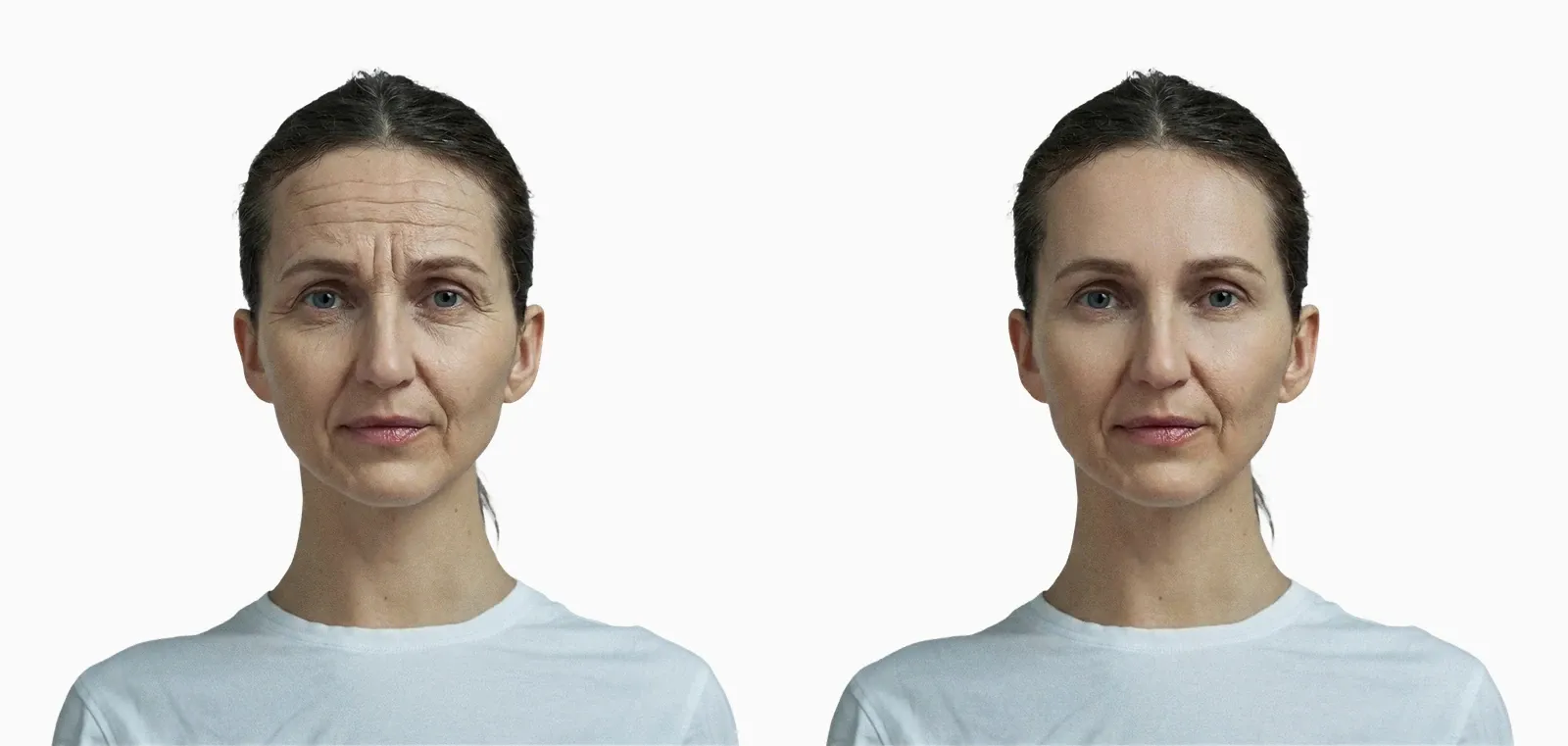
Simulated demonstration of botulinum toxin effect on dynamic upper-face wrinkles. Forehead lines, glabellar 11s and crow's feet smoothed; lower-face nasolabial folds unchanged (Botox doesn't treat those).
What are cosmetic Botox injections?
Cosmetic Botox uses botulinum toxin type A, specifically OnabotulinumtoxinA, to relax the muscles that create wrinkles. By calming those muscles for a while, it softens the look of wrinkles, fine lines, and other signs of aging.
It is minimally invasive, and the FDA has cleared it as safe and effective for facial wrinkles and fine lines. That clearance came in stages: first in 1989 for eye muscle problems like blepharospasm, then in 2002 for the frown lines between the eyebrows, and in 2013 for crow's feet at the outer corners of the eyes.
A 2016 clinical study rated Botox among the safest and most effective treatments for forehead wrinkles. That same year more than 4.5 million Botox procedures were performed in the United States, according to the American Board of Cosmetic Surgery, which makes it the most popular non-surgical option Americans reach for to soften wrinkles and aging signs 2, 3, 4.
How does cosmetic Botox work?
Botox works by relaxing muscles for a while. It is a neurotoxin that acts on the nervous system, blocking the nerve signals that tell a muscle to contract. With the signal blocked, the muscle relaxes.
Here is what is happening underneath. A muscle contracts when the nerve endings attached to it release a chemical called acetylcholine, which binds to receptors on the muscle cells. Botox stops the nerve endings from releasing acetylcholine, so the muscle does not get the message to contract and stays relaxed.
In small doses, that means the muscles responsible for wrinkles and fine lines ease off, and the skin looks smoother and younger. It is used mostly for forehead wrinkles, crow's feet, and frown lines. It does not help with wrinkles caused by gravity or sun damage 5, 6.
The types of botulinum toxin injections
Botulinum toxin comes under several brand names, and each one suits a slightly different situation. The best move is to talk with your doctor about the options and which one fits your case 7, 8, 9, 10.
The main ones are:
- OnabotulinumtoxinA, sold as Botox.
- AbobotulinumtoxinA, sold as Dysport.
- IncobotulinumtoxinA, sold as Xeomin.
- PrabotulinumtoxinA, sold as Jeuveau.
The cosmetic uses of Botox
The main job of Botox is softening the look of facial wrinkles. The effect lasts somewhere between 3 and 12 months, depending on the type of treatment and the condition of your face 11.
It is injected into a handful of specific areas:
- Frown lines, the wrinkles between the eyebrows, by relaxing the glabellar complex muscles.
- Crow's feet wrinkles, by relaxing the lateral orbicularis oculi muscles.
- Forehead creases, the horizontal lines across the forehead, by relaxing the frontalis muscle.
- Lines at the corners of the mouth, by relaxing the depressor anguli oris muscles.
- Cobblestone chin, by relaxing an overactive mentalis muscle.
For wrinkles in the upper third of the face, such as crow's feet, forehead lines, and frown lines, Botox is the treatment of choice. The lower two-thirds of the face are trickier and need an experienced doctor. The FDA has only approved Botox for the upper third of the face.
A couple of common questions do not have clear answers yet. Studies have not confirmed whether Botox helps under-eye dark circles, and there is little evidence that it does anything for hair.

Duration of botulinum toxin effect varies widely by treatment area. Glabellar lines hold 4-6 months — the FDA-labeled benchmark — while masseter and hyperhidrosis applications can last 6-12 months.
How is a Botox procedure done?
The injection itself takes only a few minutes, needs no anesthesia, and causes little more than minor discomfort. The doctor dilutes the toxin powder in saline and uses a fine needle to place it in the target muscles.
You will start to notice the effects after 24 to 72 hours. In rare cases it can take up to 5 days 12.
A few people should skip it. Pregnant and breastfeeding women should avoid Botox, and so should anyone who has reacted badly to the toxin or one of the drug's ingredients, who is better off looking for a safer alternative.
The risks and side effects of Botox injections
Most people tolerate Botox well, and when it is done by a qualified provider the risks and side effects are minimal.
Side effects can still happen, and they depend partly on why you are getting Botox in the first place. Talk to your doctor about the risks before the procedure 13, 14, 15.
Depending on how your body responds to the toxin, the possible side effects include:
- Dry eyes, temporary eyelid drooping, or blurred or double vision. This tends to happen when Botox is injected around the eyes.
- Stomach pain and discomfort.
- Numbness, mild to moderate pain, swelling, or bruising at and around the injection site.
- Headache, tiredness, and flu-like symptoms for the first 24 to 48 hours.
- Temporary weakness or paralysis of the muscles near the injection site.
- Neck pain and breathing trouble if Botox is injected into the neck.
- Cardiovascular problems such as heart attack and arrhythmia, which are extremely rare.
- A frozen look, which happens when too much Botox is used and you cannot move the rest of your facial muscles.
- Developing antibodies against the toxin, which makes later injections less effective 16.
- Allergic reactions such as asthma symptoms, itching, or a rash.
Anyone who is sensitive or allergic to botulinum toxin should not get this treatment, and neither should anyone with an infection at or around the injection site.
Side effects can sometimes spread beyond the injection site, depending on the type of treatment. If you are not happy with your results, talk to your doctor.
And if you have a serious reaction, such as an allergic response or trouble breathing, go to the nearest hospital right away.
How to prepare for Botox treatment
Botox is a non-surgical, in-office treatment, so there is not much to prepare. Your provider will ask about your medical history, medications, allergies, conditions, and any procedures you have had in the past. Make sure the provider is licensed and has the experience to do the procedure correctly.
Just before the injection, you will be asked to remove your makeup and cleanse the area. You may also need to stop taking blood-thinning medications such as aspirin to lower the risk of bruising.

A simplified triage from presenting complaint through the static/dynamic test, severity grade, and the modality the evidence supports. Botulinum toxin is first-line for dynamic upper-face lines; deeper static lines benefit from combining it with filler or resurfacing.
Botox aftercare instructions
Following the aftercare advice gives you the best shot at good results and lowers the risk of side effects like bruising or the toxin spreading where you do not want it 17.
On the day of the procedure
On the day you get your injection, keep it simple:
- Take the day off and relax.
- Skip exercise and try to keep your heart rate normal.
- Do not touch, rub, or press on the injected area.
Because Botox is non-surgical and minimally invasive, there is no real recovery time. You can go back to your normal activities right after the injection.
Exercise
If you exercise regularly, your doctor will probably suggest waiting anywhere from 24 hours to a few days before getting back to it.
Exercise raises your heart rate and blood flow, which can carry the toxin to other areas and cause side effects while weakening the effect where you actually wanted it. Physical activity also raises the risk of bruising and works your muscles, which cuts into the toxin's effectiveness.
The only exercises that are fine in those first few days are facial ones, like smiling, frowning, and raising your eyebrows, which can help the effect show up.
Makeup
Try to stay makeup-free for the first 24 hours after your injection. Applying makeup means rubbing your skin, which can spread the toxin to areas you did not target.
Sitting up
Stay sitting up for the first 4 hours after your injection. Lying down or bending over can spread the toxin to unwanted areas and make bruising worse.
Talk to your doctor about your medications
Some medications, such as blood thinners, can raise the risk of bruising. Tell your doctor what you take and ask when it is safe to start again after your injection.
Botox aftercare precautions
Aftercare matters with Botox. Here are a few things worth keeping in mind once the procedure is done.
Avoid alcohol
Your doctor will ask you to avoid alcohol for at least 24 hours before the procedure, and the same goes afterward. Wait at least 24 hours before drinking again. Alcohol thins the blood, which raises the risk of bruising.
Avoid touching your face
Keep your hands off your face for the first 24 hours so the toxin does not spread. Depending on your case and the dose, your doctor may extend that no-touching window to 3 days. The same applies to professional massages. Just keep your hands away from your face for a few days to get the most out of the treatment.
Avoid skin treatments
Botox needs time to reach the muscle and start working. For the first 24 hours to 3 days, skip other treatments like facial masks, facial massages, exfoliating scrubs, and dermal fillers, since they can reduce its effectiveness.
Avoid sleeping on the injection site
This one is hard, but try not to sleep on the treated area for the first 24 hours to 3 days. It keeps pressure off the site, stops the toxin from spreading, and lets it settle into the muscles you targeted.
You should also avoid lying down to sleep for the first 4 hours after the procedure.
Avoid sun exposure
Stay out of the sun for the first 4 hours after your injection. Heat causes flushing and raises blood pressure, which can make bruising more likely. Some doctors suggest staying out of the sun for 24 to 48 hours.
Avoid other sources of heat too, such as hot showers, saunas, tanning beds, and hot tubs.
How much does Botox cost?
In 2016, the average Botox injection cost $375. Prices vary a lot, depending on the area being treated, how many injections you need, the condition of that area, and where you live.
One thing to know up front: health insurance does not cover Botox for cosmetic purposes.
FAQ about Botox
What does getting a Botox injection feel like?
Botox injections are quick and cause only minor discomfort at the site. They do not need local anesthesia or any recovery time. You can honestly get a Botox injection on your lunch break and head back to work right after.
Is the Botox procedure painful?
Most people say it is not painful. You feel some discomfort as the needle goes in, and that fades soon after.
When will I see actual results?
How fast the full effect shows up varies from person to person. In most cases it takes 3 to 5 days, though for some it can take up to 2 weeks.
How long do Botox effects last?
The effects last between 3 and 5 months. Over time the relaxed muscles start working again and the wrinkles come back, as the body breaks down the toxin. To keep the effect going, maintenance treatments are usually recommended every 3 to 4 months.
When should I start considering Botox?
Some people worry they are too young or too old to try it. There is no perfect age for Botox. A professional should evaluate your situation and help you decide. Plenty of people start in their twenties and thirties, using it to head off wrinkles before they set in.
Is Botox safe?
Yes, for most people Botox is safe. Risks and side effects are uncommon when a licensed, professional practitioner does the procedure correctly. That said, pregnant and breastfeeding women, along with people who have certain neurological disorders, should avoid it.
What is the difference between Botox and Dysport?
Botox and Dysport treat the same kinds of cases, but they are not identical.
They are dosed and diluted differently. One unit of Botox relaxes muscle about as well as 3 units of Dysport. So if you usually get a certain dose of Botox, you would roughly triple it when switching to Dysport.
That does not mean Dysport works less well, only that you need more units. And since Dysport units cost much less than Botox, matching the same result does not have to cost you more.
Dysport also has smaller molecules than Botox. Smaller molecules act faster and spread and diffuse more, which helps when treating larger areas because you need fewer injections.
The flip side is that all that spreading makes Dysport less suited to small areas where you want the treatment to stay focused, or to areas with thicker muscle.
Finally, Dysport is faster. It takes under 24 hours to show its full effect, while Botox can take up to 72 hours to settle in and start working 18.
Which is better, Botox or Dysport?
Botox is the better pick for smaller areas because it stays put where it is injected, so it suits spots around the lips and eyes. Dysport is better for larger areas that benefit from its spread, like the forehead, and it needs fewer injections to match what Botox does.
Wrinkles around the eyes
Frown lines between the eyebrows sit in deeper layers and respond better to Dysport. Crow's feet are better treated with Botox, which keeps the toxin from spreading toward the eyes.
Forehead lines
The horizontal lines across the forehead respond better to Dysport. Because it can spread beyond the injection site, it covers more lines with fewer injections.
Lip lines
Lip lines, also called smoker's lines, are the vertical wrinkles above the upper lip. They are better treated with Botox, since it stays put in such a small area.
What is the difference between Botox and Xeomin?
The main difference is the formulation. Xeomin is a pure neurotoxin, with botulinum toxin A as its only ingredient. Botox contains botulinum toxin plus protective proteins clustered around it. Xeomin is used for people who are more likely to develop antibodies against the toxin, since those antibodies can cut the effect significantly.
They also differ in how long they take to work. Xeomin takes about 4 days, while Botox takes 24 hours to 3 days. The effects of both last 3 to 6 months 19.
Which is better, Botox or dermal fillers?
Dermal fillers are as effective as Botox, and their effects generally last longer, though that depends on the type of filler. Either way, you will need follow-up treatments to keep the results.
References
- 8
Field M, Splevins A, Picaut P, van der Schans M, Langenberg J, Noort D, Snyder D, Foster K. AbobotulinumtoxinA (Dysport®), OnabotulinumtoxinA (Botox®), and IncobotulinumtoxinA (Xeomin®) Neurotoxin Content and Potential Implications for Duration of Response in Patients. Toxins (Basel). 2018 Dec 13;10(12):535. doi: 10.3390/toxins10120535. Erratum in: Toxins (Basel). 2019 Feb 13;11(2): PMID: 30551641; PMCID: PMC6316182.