1
Upload Your Photos
Upload 6 clear photos of your face securely and privately through our online portal.
Drag and drop file To upload
POSES REQUIRED


The alar width, also called nose width, is the horizontal distance between the two outermost points of the nostril wings (Al-R to Al-L). It is one of the core nasal base measurements in rhinoplasty planning and facial proportion analysis. How it compares against the intercanthal distance is what makes a nose look balanced or wide.
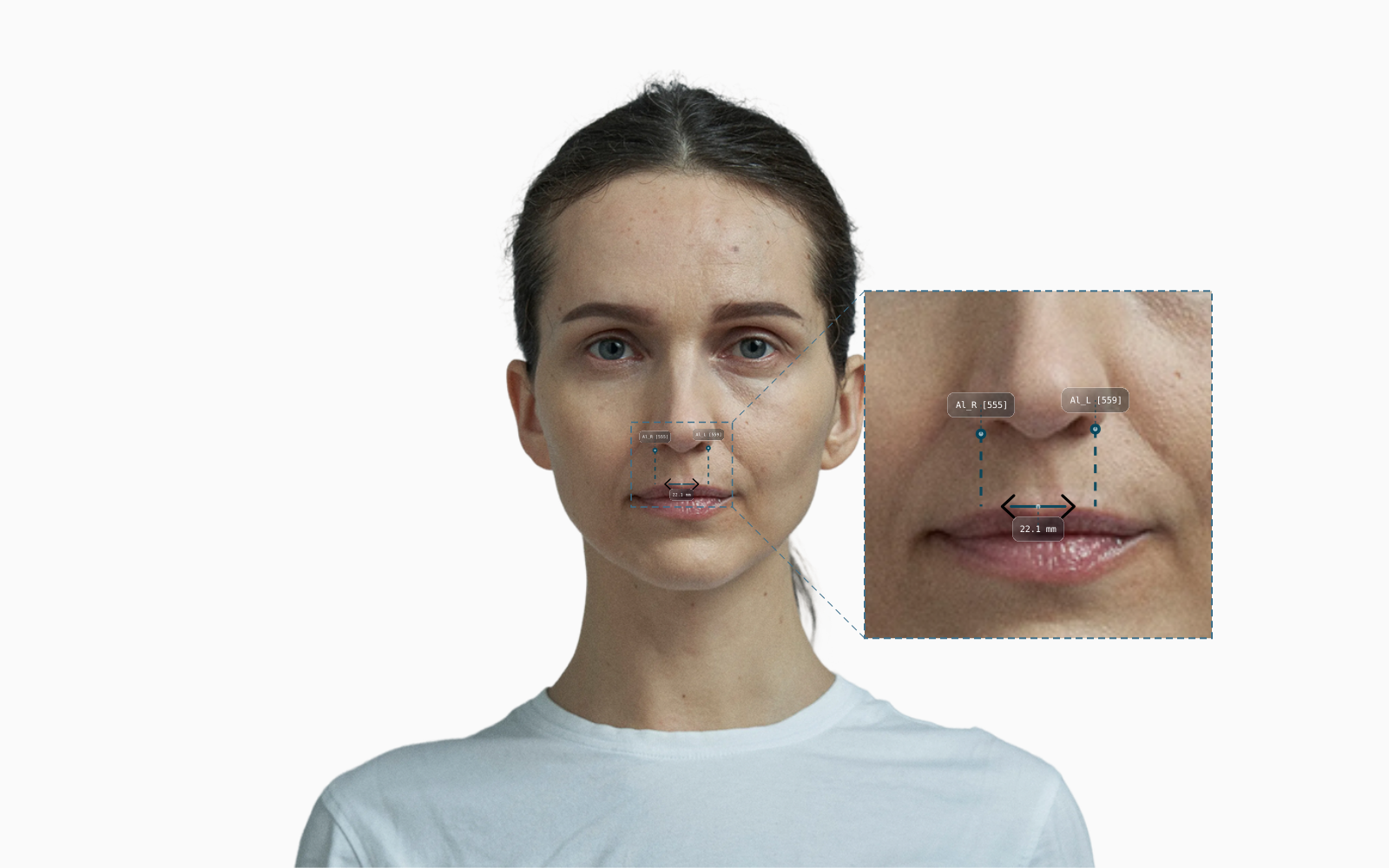
How It's Measured
The alar width is the horizontal distance between the two alar curvature points, the outermost soft-tissue projections on each nostril wing (Leong 2006). On a front-facing photograph, the measurement runs from the right alar landmark (Al-R) to the left alar landmark (Al-L), parallel to the line between the pupils.
With nasal length (N-Sn) and tip projection (Sn-Prn), alar width sets the geometry of the nasal base on the lower third of the face.

Left: the original front-facing photo. Right: the same person with wider nostrils. The alar width goes from 26.9 mm to 30.3 mm, and nothing else in the photo changed.
Why It Matters
Alar width is one of the biggest single drivers of how a nose reads on the face. The eye does not assess the nose in isolation; it compares the nasal base against the eye spacing on either side of it. The rhinoplasty guideline that follows from this is simple: alar width should equal the intercanthal width (EN-EN), the distance between the inner corners of the eyes (Leong 2006). When EN-EN is shorter than Al-Al, the nose looks wide. When the two are equal, the nasal base sits inside the rule of fifths used in classical facial proportion.
Real anatomy rarely hits that ideal. In a study of healthy adult Caucasian noses, the alar width exceeded the intercanthal width in 90 percent of subjects, against an aesthetic target of equality in 100 percent of attractive composite faces (Leong 2006). The gap widens when the comparison moves outside that reference group. Korean adults averaged 39.3 mm in men and 36.7 mm in women on cone-beam CT (Lee 2024), and Black American noses averaged between 38.8 mm and 42.0 mm across three morphological groups (Ofodile 1993).
The nose width question that drives most searches is not academic. It comes up in rhinoplasty consultations, where reducing alar width by two or three millimetres changes how balanced the lower face looks. Treating the Caucasian ideal as universal misreads non-European nasal anatomy, where wider alar bases are normative rather than a defect. For the actual numbers across populations, see the stat cards and demographic table below.
39 mm
Average alar width, adult men (Korean CBCT)
37 mm
Average alar width, adult women (Korean CBCT)
EN-EN = AL-AL
Classical aesthetic ideal (intercanthal equals alar)
Adult average alar width (Al-Al) in mm. Women run about 2-3 mm narrower than men in matched populations. Values vary by population; ethnic ranges sit below in the demographic table.
Demographic Variants
Alar width ranges shift with population and sex. The table below lists lit-supported averages alongside the Caucasian aesthetic ideal that pairs alar width with intercanthal distance. Each row links to the paper that established the value.
Demographic | Ideal / typical alar width | Source |
|---|---|---|
Caucasian, female (aesthetic target) | Al-Al equals intercanthal width; ratio approx 1.0 | |
Caucasian, male (Springer cohort optimum) | Approx 20.8 mm at alar base (Sb-Sb), 36.8 mm at tip | |
East Asian, men (Korean CBCT) | 39.3 mm average | |
East Asian, women (Korean CBCT) | 36.7 mm average | |
Black American, African group | 42.0 mm average at nasal tip (Al-Al) | |
Black American, Afro-Caucasian group | 38.8 mm average at nasal tip (Al-Al) | |
Black American, Afro-Indian group | 41.1 mm average at nasal tip (Al-Al) |
Upload 6 clear photos of your face securely and privately through our online portal.
Drag and drop file To upload
POSES REQUIRED
We measure 160+ facial markers, including skin quality, symmetry, eye shape, brow density, and more.


You’ll receive a plan highlighting your strengths, areas for improvement, and best ways to improve your appearance.
Emma’s Report
January 16, 2026
Explanation
Your forehead wrinkle depth aligns with expectations for your age and demographic, falling on the lower end of our predicted range.
Your Questions
Adult averages cluster around 36 mm to 42 mm for alar width (also called nose width), with men about two to three millimetres wider than women in matched populations. Korean adult cone-beam CT data put the female average at 36.7 mm and the male average at 39.3 mm (Lee 2024). Black American noses span 38.8 mm to 42.0 mm across morphological groups (Ofodile 1993). Caucasian samples sit lower, with female alar base averages around 20 to 21 mm in surgical planning data (Springer 2008).
The classical aesthetic ideal is that alar width should equal the intercanthal width, the distance between the inner corners of the eyes (Leong 2006). It is the rule of fifths applied to the lower face. In healthy Caucasian noses the actual ratio is wider in 90 percent of subjects, so most real noses do not match the ideal. Among aesthetically rated composite female faces the equality holds in 100 percent of cases (Leong 2006). Treat the ideal as one reference, not a universal target.
Alar width is measured on a front-facing photograph as the horizontal distance between Al-R and Al-L, the outermost soft-tissue points on each nostril wing (Leong 2006). The line runs parallel to the pupillary axis. Clinicians distinguish this from the alar base width (Ac-Ac), measured at the point where the nostril meets the cheek, which is the cleaner reference for rhinoplasty planning because it ignores nostril flare.
Alar width differs substantially by population. Black American noses average between 38.8 mm and 42.0 mm at the tip across three morphological groups documented by Ofodile (Ofodile 1993). Korean adults average 36.7 mm in women and 39.3 mm in men (Lee 2024). Caucasian surgical optimum data put the alar base at roughly 20 to 21 mm in women (Springer 2008). The Caucasian EN-EN = AL-AL rule does not transfer cleanly to wider nasal phenotypes.
Yes. Alar base reduction is a separate manoeuvre from dorsal rhinoplasty. It narrows the nostrils through a wedge excision at the nasal sill or alar groove (Cobo 2010). It is reserved for noses with genuine alar flare or excess alar base width, because over-correction leaves a pinched look. In Hispanic and African phenotypes, surgeons often combine alar base reduction with tip projection to keep proportions intact rather than chasing a Caucasian alar-to-intercanthal ratio (Cobo 2010).