1
Upload Your Photos
Upload 6 clear photos of your face securely and privately through our online portal.
Drag and drop file To upload
POSES REQUIRED


The nasofrontal angle is the wedge that opens at the nasion, where the forehead steps back into the bridge of the nose. Taken on a side profile between glabella, nasion, and pronasale, it captures the depth of the radix and the slope of the dorsum in one number, and it does most of the work in deciding whether a profile reads soft or strong.
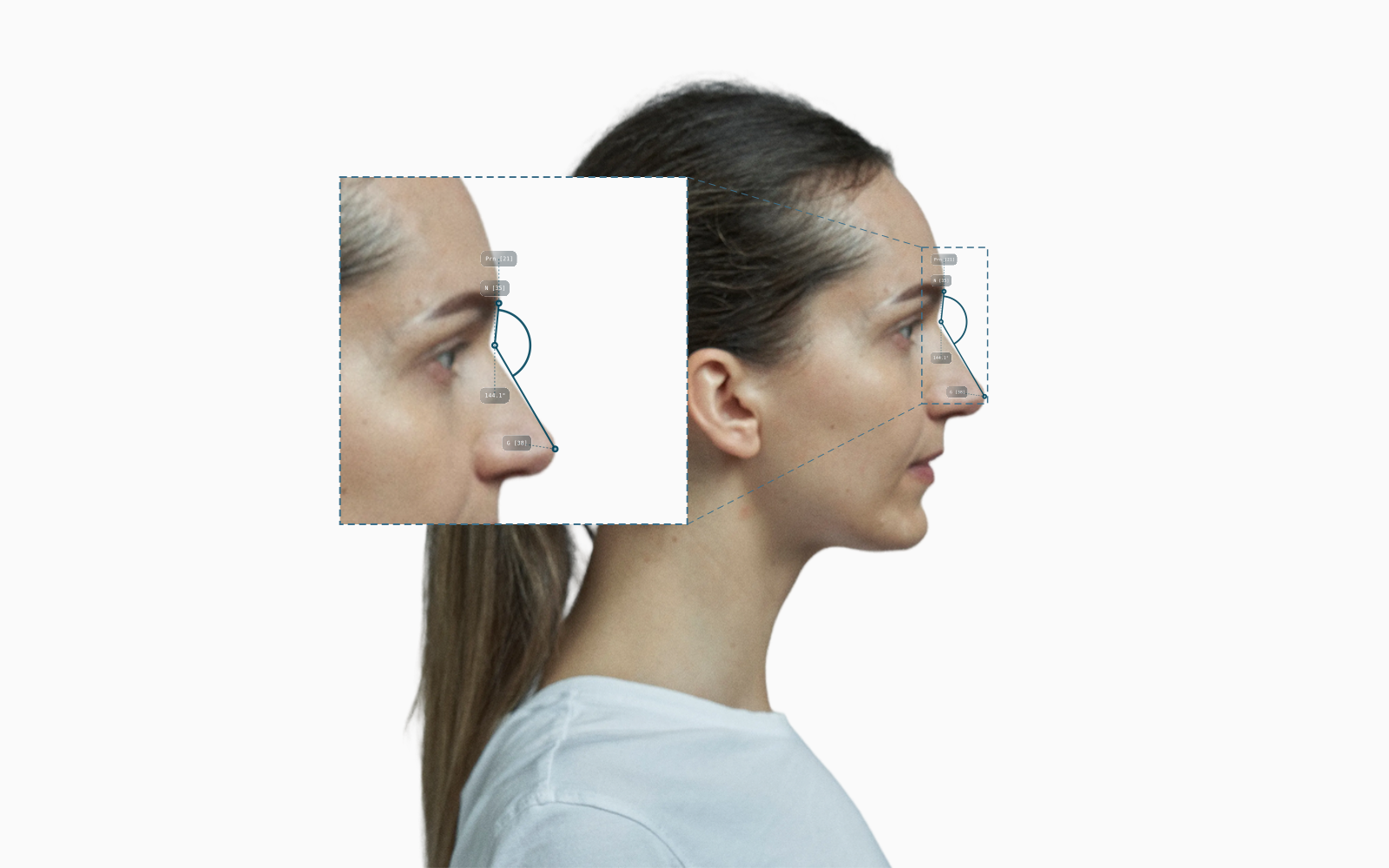
How It's Measured
The nasofrontal angle is a three-point angle taken on a side profile, with the apex at the nasion where the forehead steps back into the nasal bridge.
Drawing tangent lines from N up to G and from N down to Prn produces the wedge that quantifies how cleanly the forehead steps back into the nose.

Left: the original side-profile photo. Right: the same person with a softer bridge at the brow. The nasofrontal angle goes from 145.9° to 149.5°, and nothing else in the photo changed.
Why It Matters
The nasofrontal angle sits at the boundary between two large facial blocks, the forehead and the nose, so a small shift at the nasion changes how both of them read. In rhinoplasty practice the angle is a primary driver of the radix lie, and Powell and Humphreys' aesthetic ideal of 115° to 130° is still the most cited Western reference (Leong & White, 2006). Below that range the profile reads as a deep, sculpted radix with a strong dorsum. Above 140°, the transition flattens and the nose looks as if it begins higher on the face than it actually does.
The angle is also a sex-dimorphism signal. In a survey of preferences for nasion position on White North Americans, Mowlavi and colleagues found that a soft nasal dorsum with a deeper nasofrontal angle reads as feminine, while a prominent radix with a shallow angle reads as masculine and was rated unattractive on female profiles (Mowlavi et al., 2004). A Powell-style 120° target therefore works well on a male nose but tends to over-masculinise a female nose, where the literature centres closer to 130° to 135° (Uzun et al., 2014); (Goel et al., 2023).
One more thing makes this measurement useful in surgical planning: the nasofrontal angle can be changed without touching the tip. Both the glabellar limb and the dorsal limb meet at the nasion, so the angle opens or closes when the radix is augmented or the dorsum is lowered, while tip projection and rotation stay where they were (Mowlavi et al., 2004). The cards and table below give the specific values by population.
115°–130°
Men
130°–135°
Women
120°–140°
Typical Range
These ranges shift with ethnicity and the position of the nasion. See the table below for population-specific values.
Demographic Variants
Ideal nasofrontal angle ranges shift by population. Each row links to the paper that established the measurement for that group.
Demographic | Ideal range | Source |
|---|---|---|
Caucasian (Powell/Humphreys ideal) | 115°–130° | |
Caucasian women, observed average | ~134° | |
Turkish women | 133.16° ± 8.88° | |
Turkish men | 123.85° ± 13.23° | |
North-East Indian women | 134.63° | |
North-East Indian men | 129.43° |
Upload 6 clear photos of your face securely and privately through our online portal.
Drag and drop file To upload
POSES REQUIRED
We measure 160+ facial markers, including skin quality, symmetry, eye shape, brow density, and more.


You’ll receive a plan highlighting your strengths, areas for improvement, and best ways to improve your appearance.
Emma’s Report
January 16, 2026
Explanation
Your forehead wrinkle depth aligns with expectations for your age and demographic, falling on the lower end of our predicted range.
Your Questions
The most cited Western reference, attributed to Powell and Humphreys, places the ideal nasofrontal angle at 115° to 130° (Leong & White, 2006). Healthy populations sit slightly above that, with Caucasian women averaging around 134° and men around 130° (Mowlavi et al., 2004). Treat the Powell range as a phenotype-conditional surgical target, not a universal ideal. Values north of it can still read as elegant on a feminine profile.
Women tend to carry a more obtuse nasofrontal angle than men by 5° to 10°, with the deeper angle producing a softer transition from forehead to nose. Across populations, female means cluster around 130° to 135° (Uzun et al., 2014: 133.16° ± 8.88°; Goel et al., 2023: 134.63°) while male means cluster around 123° to 130° (Uzun: 123.85° ± 13.23°; Goel: 129.43°). The same anatomical feature read as masculine on a man can read as too strong on a woman, which is why surgical targets are sex-specific.
A "deep" nasofrontal angle in clinical language means a more obtuse value, a shallower notch at the nasion where the forehead flows smoothly into the nose with little step-down. Mowlavi and colleagues report that a soft dorsum paired with a deeper nasofrontal angle reads as feminine, while a prominent radix with a shallow angle reads as masculine. A deep angle on a male nose tends to be corrected with radix augmentation in rhinoplasty (Mowlavi et al., 2004).
The nasofrontal angle is measured on a side profile as the three-point angle G-N-Prn, with the apex at the nasion. A line is drawn tangent to the forehead through the glabella, a second line tangent to the dorsum through the nasion to the pronasale, and the angle between them quantifies the depth of the radix (Mowlavi et al., 2004). Some authors split the angle into upper and lower components with a true horizontal at the nasion; here we use the full G-N-Prn convention.