1
Upload Your Photos
Upload 6 clear photos of your face securely and privately through our online portal.
Drag and drop file To upload
POSES REQUIRED


The submental-cervical angle, also called the cervicomental angle in clinical literature, is the angle formed where the underside of the chin meets the front of the neck. A more acute angle sharpens the jawline and reads as youthful; an obtuse one blunts the chin-neck transition and reads as fullness or a double chin.
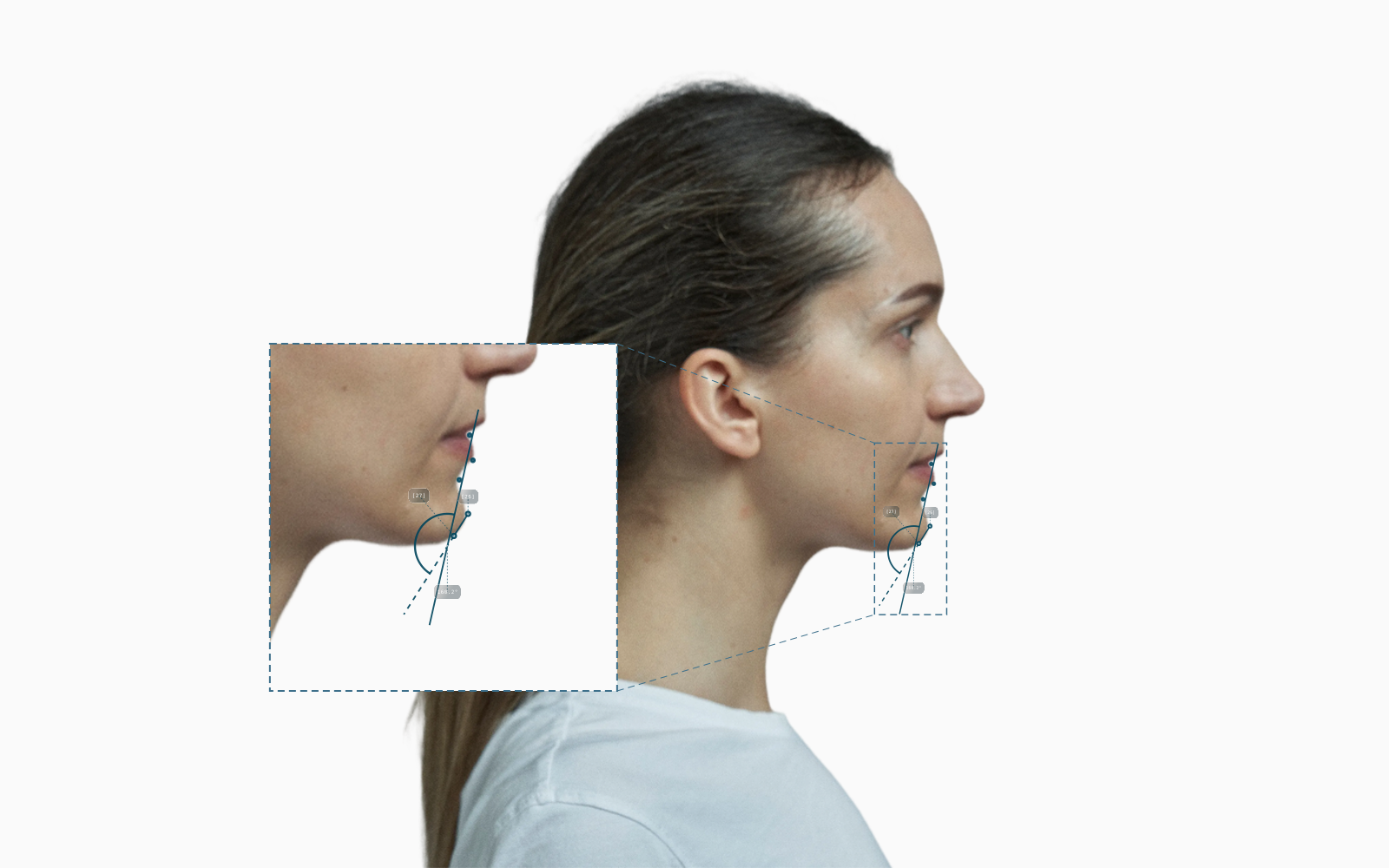
The submental-cervical angle is taken from a side-profile photograph in natural head position. It is the angle between the submental plane (running along the underside of the chin) and the cervical plane (running down the front of the neck), with its vertex at the cervical point.
A crisp angle near 105 to 120 degrees reads as a defined cervicomental junction; a flatter, more obtuse one signals soft-tissue fullness, a low hyoid, or loose platysma.

Left: the original side-profile photo. Right: the same person with a sharper chin-to-neck angle. The submental cervical angle goes from 162.6° to 159.1°, and nothing else in the photo changed.
The submental-cervical angle is one of the strongest signals of a defined jawline on the profile view. The two clinical criteria most-cited for a youthful neck are a distinct inferior mandibular border and a submental-neck angle between 105 and 120 degrees (Naini, 2014). An angle wider than this reads as a blunted cervicomental junction; it is one of the most common drivers of the perceived double chin, even on lean profiles, and frequently accompanies platysmal banding in the aging neck (Matarasso et al., 1999).
Population means run somewhat higher than the youthful ideal. Sommerville's submental-neck angle averages 126 degrees in men and 121 degrees in women, while the related mentocervical angle (using the E-line) averages 120 to 132 degrees (Sforza, 2010). The widely repeated 90 degree ideal is best read as the extreme end of normal variation rather than a universal target (Naini, 2014). Neck girth and the visibility of the thyroid prominence also drive how the cervicomental contour is read by observers, so the angle should never be evaluated in isolation (Amir et al., 2019).
Clinically, the cervicomental angle is the headline metric in submental-fat treatment. The Phase III ATX-101 trials for Kybella used it as a primary efficacy endpoint, and submental fat is the dominant distortion of the anterior cervicomental triangle that patients call a double chin (Humphrey et al., 2016); (Ingargiola et al., 2017). Massive weight loss can collapse the same angle in the opposite direction by loosening platysma support (2024 systematic review). See the stat-cards and demographic table below for the actual numeric ranges.
115°–130°
Men
110°–125°
Women
105°–120°
Youthful Ideal
These values vary depending on individual facial structure, weight, and age. Sommerville averages cited in Sforza (2010) and Naini (2014).
Ideal submental-cervical angles cluster within a narrow band, but population means run wider than the clinical target. Each row links to the canonical paper that established the value, with the cervicomental synonym used in older literature noted where relevant.
Demographic | Ideal range | Source |
|---|---|---|
Youthful Caucasian adults (clinical target) | 105°–120° | |
Adult men (Sommerville population mean) | ≈ 126° | |
Adult women (Sommerville population mean) | ≈ 121° | |
Mentocervical angle (E-line tangent, all adults) | 120°–132° | |
Post-Kybella treatment (mean improvement) | ≈ 5° tighter |
Upload 6 clear photos of your face securely and privately through our online portal.
Drag and drop file To upload
POSES REQUIRED
We measure 160+ facial markers, including skin quality, symmetry, eye shape, brow density, and more.


You’ll receive a plan highlighting your strengths, areas for improvement, and best ways to improve your appearance.
Emma’s Report
January 16, 2026
Explanation
Your forehead wrinkle depth aligns with expectations for your age and demographic, falling on the lower end of our predicted range.
Your Questions
A youthful submental-cervical angle sits between 105 and 120 degrees, the range used clinically to describe a defined cervicomental junction (Naini, 2014). Population averages run a little wider. Sommerville reported a mean submental-neck angle of 126 degrees in men and 121 degrees in women, while the related mentocervical angle averages 120 to 132 degrees (Sforza, 2010). The often-quoted 90 degree ideal is the very sharp end of normal variation rather than a universal target.
A blunted cervicomental angle (wider than about 120 degrees) means the underside of the chin meets the front of the neck at a softer, less-defined transition. It is one of the most common causes of the visible double chin, and the dominant distortion of the anterior cervicomental triangle in patients seeking submental contouring (Ingargiola et al., 2017). The four anatomical drivers are submental fat, a low or anterior hyoid, platysmal banding, and skin laxity. Only the first responds reliably to non-surgical treatment (Matarasso et al., 1999).
Sometimes, but not always. When the obtuse angle is driven by submental fat, weight loss tightens the cervicomental contour and the angle visibly sharpens. When the angle is driven by a low hyoid bone or congenital soft-tissue thickness, weight loss has little effect. Palpation and lateral cephalograms are used clinically to tell these apart (Sforza, 2010). Massive weight loss can also blunt the angle in the opposite direction, by leaving redundant skin and weaker platysmal support that no longer holds the cervicomental shape (2024 systematic review).
Yes, almost always in the direction of widening. Aging loosens the platysma and skin of the anterior neck, lets the submental soft tissue descend, and progressively opens the cervicomental angle (Matarasso et al., 1999). Palpation and the skin-laxity test let clinicians separate true fat accumulation from redundant skin and platysmal banding, and that distinction decides whether Kybella, neck liposuction, or a full neck lift is the right intervention (Naini, 2014).
If submental fat is the driver, yes. Phase III trials of ATX-101 (Kybella) used the cervicomental angle as a primary efficacy endpoint and showed measurable tightening across multiple treatment sessions (Humphrey et al., 2016). Cryolipolysis produces similar but slower changes (Ingargiola et al., 2017). When the obtuse angle is driven by platysmal laxity or a low hyoid, surgery is the better-evidence path. Submental liposuction with platysmaplasty, or a full neck lift, will outperform Kybella alone.