1
Upload Your Photos
Upload 6 clear photos of your face securely and privately through our online portal.
Drag and drop file To upload
POSES REQUIRED


The upper to lower lip ratio compares the height of the upper vermilion to the lower vermilion on a frontal portrait, also written as the 1:1.6 lip ratio in lip-filler literature. A balanced lower lip noticeably thicker than the upper is the proportion that observers in eye-tracking studies rate as most attractive in both sexes.

How It's Measured
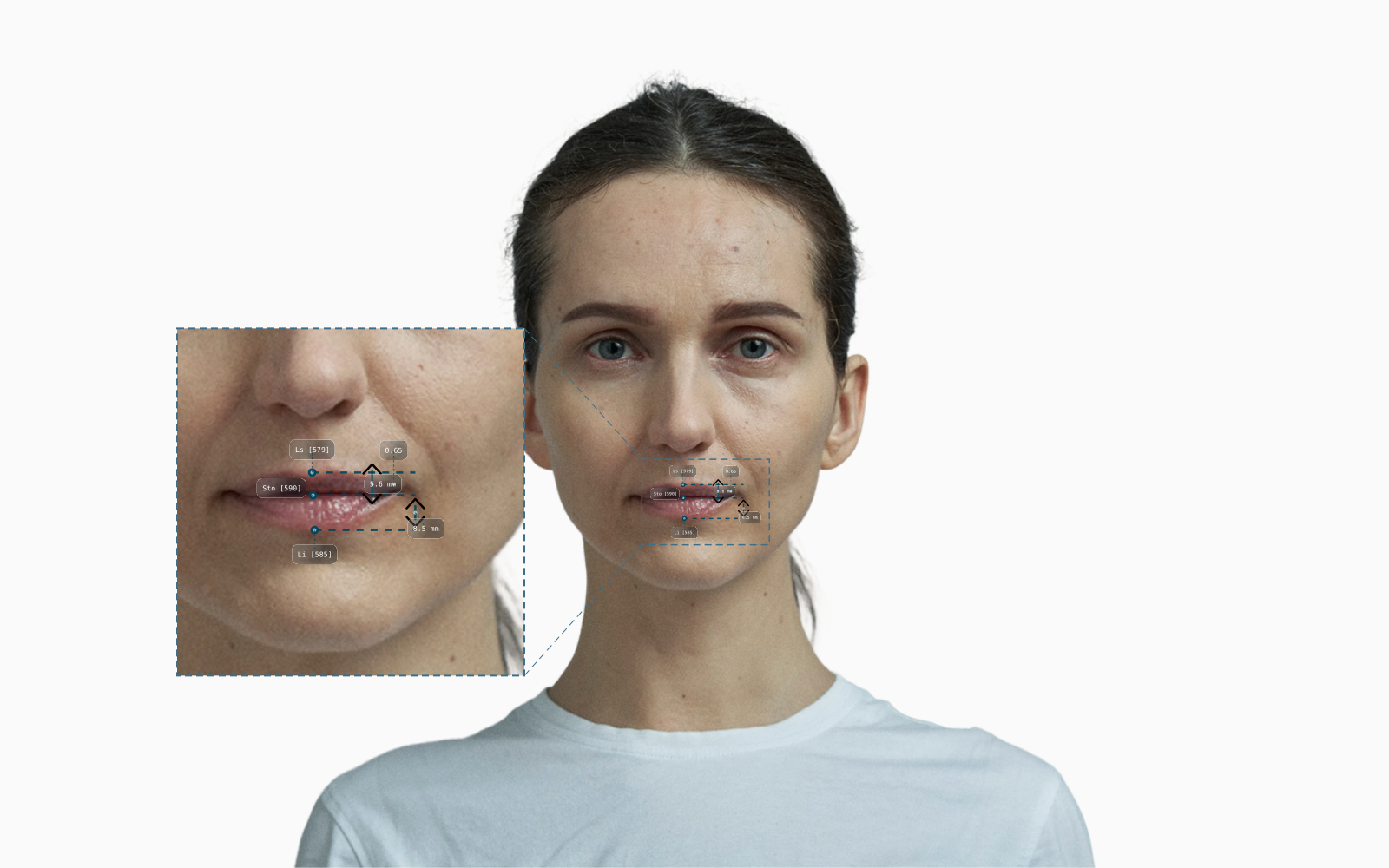
The upper to lower lip ratio is read on a relaxed front-facing portrait. The numerator is the vertical distance from labrale superius (Ls, the central peak of the upper vermilion border) down to stomion (Sto, the midpoint where the lips meet at rest). The denominator is the distance from Sto down to labrale inferius (Li, the midpoint of the lower vermilion border) (Naini, 2011).
A small ratio (e.g. 1:2) means the lower lip dominates and the upper lip reads thin; a value closer to 1:1 means the two lips are visually balanced in height. The measurement isolates pure vermilion thickness, so it stays separate from philtrum length, lip projection, or chin depth.
Left: the original front-facing photo. Right: the same person with a fuller upper lip. The upper-to-lower lip ratio goes from 0.76 to 0.86, and nothing else in the photo changed.
Why It Matters
The upper to lower lip ratio governs which half of the mouth carries visual weight, and the literature is clear that a thicker lower lip reads as more attractive in both sexes (Heydenrych et al., 2024). In a 101-observer eye-tracking and survey study, the lower vermilion thickness to lower lip ergotrid ratio rated most attractive was 1:1.6 in both men and women. That is a lower lip noticeably fuller than the structural skin above it, with the upper vermilion read as the supporting subunit rather than the lead.
Classical anthropometry sets the same direction with different numbers. Naini reports adult Caucasian upper lip heights of 22 ± 2 mm in men and 20 ± 2 mm in women, against lower lip and chin block heights of roughly 47 mm in men and 44 mm in women (Naini, 2011). Leonardo da Vinci treated the upper lip as one third of the lower lip and chin block; Albrecht Dürer pushed it to one quarter. Both canons predicted the same outcome modern eye-tracking confirms: the lower lip should dominate the vertical balance of the mouth.
That balance is what makes lip aesthetic planning population-conditional. Sagittal lip-vermilion classifications across cephalometric samples show that upper and lower vermilion thicknesses move together as a pair. Patients with thin retruded upper vermilions also tend to have thin retruded lower vermilions, and vice versa (Solem et al., 2013). Treating the upper lip in isolation, or chasing a 1:1 visual balance, drags the mouth away from the ratio observers actually rate as most attractive. See the stat cards and demographic table below for the values.
1 : 1.5
Typical upper to lower lip ratio, adult men
1 : 1.6
Most attractive lower-lip vermilion ratio, both sexes
1 : 1.5–1 : 2
Range across Caucasian, Persian, and East Asian samples
Figures from frontal-portrait anthropometry on adult samples. Individual values vary with ethnicity, age, and lip projection.
Demographic Variants
Upper to lower lip ratios vary by population and sex. The table below shows lit-supported ranges drawn from anthropometric and perception studies; each row links to the canonical paper for that group.
Demographic | Ideal upper to lower lip ratio | Source |
|---|---|---|
Adult Caucasian women | 1 : 1.5 to 1 : 2 (lower lip dominates) | |
Adult Caucasian men | 1 : 1.4 to 1 : 1.8 (less lower-lip dominance) | |
Adolescent Persian sample | Upper vermilion height higher in girls than boys, lower vermilion similar | |
Cephalometric classification (mixed) | Upper and lower vermilion thicknesses correlate; thin upper rarely sits over a full lower | |
Classical canon (Da Vinci / Dürer) | Upper lip 1/3 to 1/4 of lower-lip-and-chin block |
Upload 6 clear photos of your face securely and privately through our online portal.
Drag and drop file To upload
POSES REQUIRED
We measure 160+ facial markers, including skin quality, symmetry, eye shape, brow density, and more.


You’ll receive a plan highlighting your strengths, areas for improvement, and best ways to improve your appearance.
Emma’s Report
January 16, 2026
Explanation
Your forehead wrinkle depth aligns with expectations for your age and demographic, falling on the lower end of our predicted range.
Your Questions
The most-cited target from contemporary lip aesthetics research is a lower lip roughly 1.5 to 1.6 times thicker than the upper lip, written as a 1:1.5 to 1:1.6 upper to lower ratio (Heydenrych et al., 2024). This is the band that 101 observers in an eye-tracking study rated most attractive across both sexes; values closer to 1:1 (equal upper and lower) consistently ranked least attractive.
In a survey-and-eye-tracking study by Heydenrych and colleagues, the most attractive lower-lip vermilion to lower-lip ergotrid ratio was 1:1.6 for both men and women, while the upper-lip vermilion to upper-lip ergotrid ratio rated most attractive was 1:2 in women and 1:3 in men (Heydenrych et al., 2024). Translated into upper:lower lip height, the implication is that a lower lip noticeably fuller than the upper reads as most attractive, with the gender-specific phrasing tilting feminine for fuller lower lips and masculine for more compact ones.
Measure with the mouth closed at rest on a front-facing portrait. Mark three midline points: labrale superius (Ls) at the central peak of the upper vermilion border, stomion (Sto) where the lips meet at the midline, and labrale inferius (Li) at the central low point of the lower vermilion border (Naini, 2011). The upper to lower lip ratio is the vertical distance Ls to Sto divided by the vertical distance Sto to Li, expressed as 1:N.
Yes. Upper and lower lip vermilion both thin with age as the orbicularis oris loses bulk and the vermilion border flattens, but the upper lip is structurally more vulnerable to volume loss and vertical lengthening between subnasale and stomion (Penna et al., 2015). The result is that the upper to lower lip ratio drifts wider with age. The upper lip looks thinner relative to the lower even when the lower is also losing volume in absolute terms. Naini also notes that upper lip thickness peaks around age 14 in females and 16 in males before declining (Naini, 2011).
Hyaluronic acid fillers can rebalance the upper to lower lip ratio when the discrepancy is volumetric rather than skeletal. A meta-analysis of 24 trials concluded that HA fillers reliably increase vermilion height and patient-reported aesthetic outcomes (Czumbel et al., 2021). The clinically important caveat is that patients who already have thicker lips at baseline often score worse on attractiveness after augmentation, so the goal is restoring the natural 1:1.5 to 1:1.6 band, not maximising volume on either lip. Discuss target ratio with an injector who measures pre-treatment.