1
Upload Your Photos
Upload 6 clear photos of your face securely and privately through our online portal.
Drag and drop file To upload
POSES REQUIRED


The philtrum length, also called the mid-philtral height in clinical literature, is the vertical distance from the base of the nose (subnasale) to the centre of the upper lip border (labrale superius). It is one of the standard measurements clinicians use to read lip aesthetics, because it controls how youthful and feminine the lower face looks. A short philtrum keeps the upper teeth slightly visible and the mouth balanced. A long philtrum stretches the upper lip and reads older.
How It's Measured
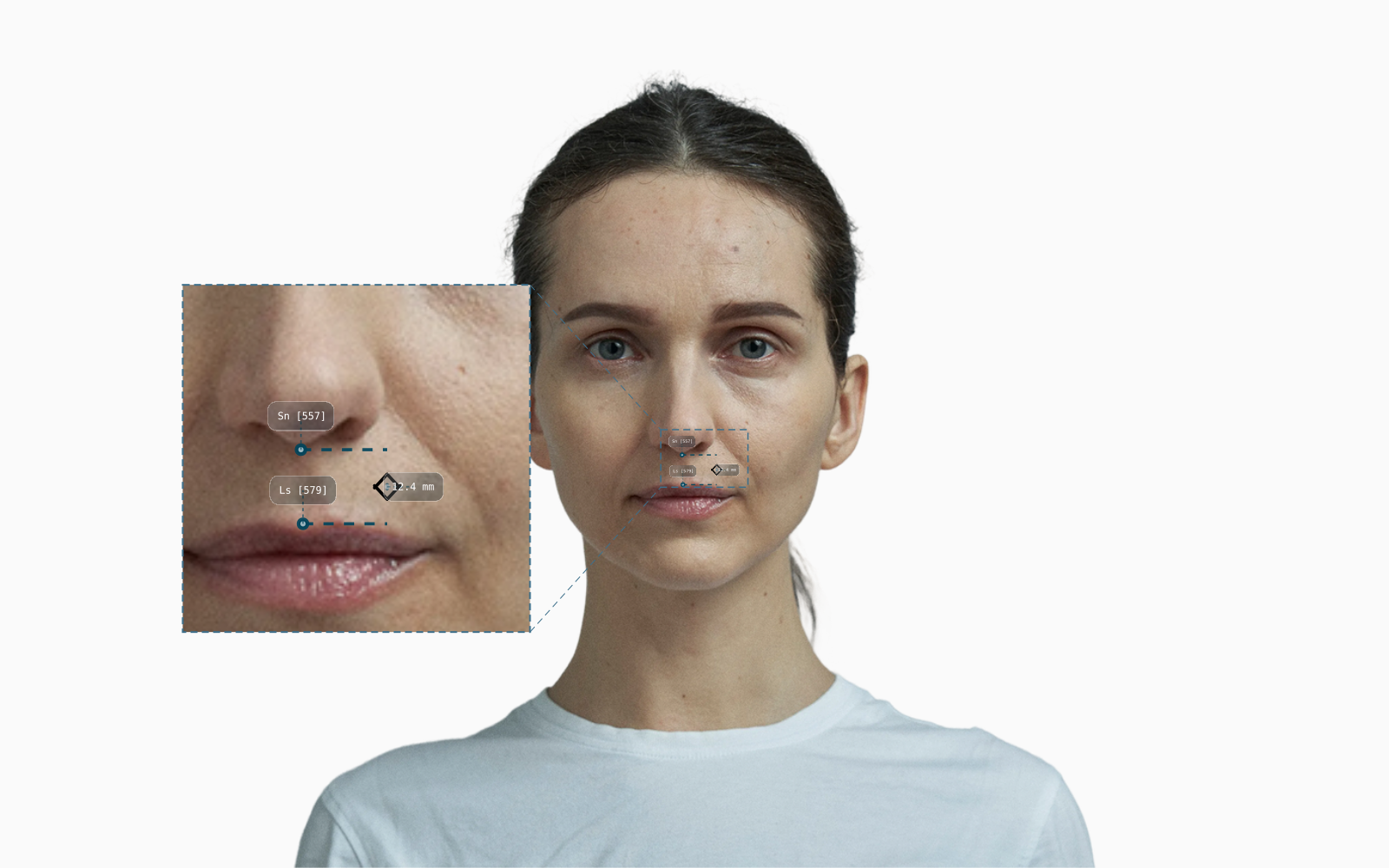
The philtrum length is read on a front-facing photograph as the vertical distance between two soft-tissue landmarks on the central upper lip (Naini, 2022). The two landmarks anchor the measurement to the cutaneous philtrum, the dimpled region directly below the nose.
Sn (subnasale): the point where the columella of the nose meets the upper lip skin, at the centre of the nasal base.
Ls (labrale superius): the midpoint of the upper lip vermilion border, sitting in the central dip of the Cupid's bow.
The distance from Sn straight down to Ls, measured along the true vertical with the head in natural head position, is the philtrum length. Because Ls is the vermilion border and not the lowest dip of the Cupid's bow, clinical sources sometimes report the closely related mid-philtral height (Sn-Sts) instead. Both anchor the upper lip's vertical position and predict whether the mouth reads youthful or aged.

Left: the original front-facing photo. Right: the same person with a longer philtrum. The philtrum length goes from 10.9 mm to 13.9 mm, and nothing else in the photo changed.
Why It Matters
Philtrum length controls how much of the upper teeth shows at rest, how the upper lip drapes, and how youthful the lower face reads. In adult women the mid-philtral height averages 20 ± 2 mm, and in adult men 22 ± 2 mm (Naini, 2022). Shorter values keep the upper incisors slightly visible and let the lip sit fuller and more lifted. Longer values hide the teeth, flatten the upper lip, and pull the lower face toward an older silhouette.
The philtrum elongates with age. Penna and colleagues used a graded classification of perioral ageing to show that progressive lengthening of the cutaneous upper lip is one of the earliest visible signs of midface ageing, together with vermilion thinning and loss of Cupid's bow definition (Penna et al., 2014). Short philtrum length is one of the few facial features whose youthful version actually reads more youthful and not just more average. The subnasal lip-lift was designed around this finding. It works by surgically reducing the Sn-Ls distance by a few millimetres.
Sex and ethnicity both move the band. The classical anthropometric norms were drawn almost entirely from North American Caucasian subjects (Naini, 2022), and revisions in Afro-American and Arabian populations show different baseline lip proportions (Farkas et al., 2000); (Al-Khatib et al., 2015). A single global ideal misreads non-Caucasian faces. The demographic table below shows where each population actually sits.
22 ± 2 mm
Mid-philtral height, adult men
20 ± 2 mm
Mid-philtral height, adult women
Elongates
Philtrum length with age
Mid-philtral height (Sn-Ls vertical distance) varies by sex and individual lip morphology. Numbers shown are clinical means and should not be read as universal ideals.
Demographic Variants
Ideal philtrum length varies by population and life stage. The table below shows lit-supported mid-philtral height ranges, with the canonical paper that established each value.
Demographic | Mid-philtral height (Sn-Ls) | Source |
|---|---|---|
Adult women (Caucasian) | 20 ± 2 mm | |
Adult men (Caucasian) | 22 ± 2 mm | |
Adolescents (growth phase) | 1–3 mm shorter than commissure height | |
Older adults (40+) | Progressively longer than baseline |
Upload 6 clear photos of your face securely and privately through our online portal.
Drag and drop file To upload
POSES REQUIRED
We measure 160+ facial markers, including skin quality, symmetry, eye shape, brow density, and more.


You’ll receive a plan highlighting your strengths, areas for improvement, and best ways to improve your appearance.
Emma’s Report
January 16, 2026
Explanation
Your forehead wrinkle depth aligns with expectations for your age and demographic, falling on the lower end of our predicted range.
Your Questions
A youthful, balanced philtrum length sits at roughly 20 mm in adult women and 22 mm in adult men, give or take 2 mm, drawn from Farkas's Caucasian anthropometric norms (Naini, 2022). Below that band the upper teeth tend to show at rest and the mouth reads younger; above it the upper lip lengthens and the lower face reads older. The number is a useful anchor, but it is not a universal ideal. Ethnic norms and the rest of the face shift the band.
Philtrum length is measured on a frontal photograph as the straight vertical distance from subnasale (Sn), where the columella meets the upper lip skin, to labrale superius (Ls), the midpoint of the upper lip vermilion border (Naini, 2022). The head must sit in natural head position with the lips lightly in contact, otherwise lip parting or chin tilt distort the value. Clinical sources sometimes report the closely related mid-philtral height (Sn-Sts) instead.
Average mid-philtral height in healthy Caucasian adults is around 22 mm in men and 20 mm in women, with a standard deviation of about 2 mm (Naini, 2022). Norms drawn from Afro-American and Arabian populations show modestly different baseline lip proportions and should not be compared against the Caucasian band one-to-one (Farkas et al., 2000); (Al-Khatib et al., 2015).
A short philtrum length keeps the upper incisors slightly visible at rest, which signals youth, and it lets the upper lip drape with more vermilion show. Both cues are tied to perceived attractiveness and femininity in eye-tracking studies of lip aesthetics (JEADV lip aesthetics study, 2024). The relationship is not linear. A philtrum that is too short risks an inverted-arc upper-lip morphology where the mid-philtrum sits noticeably lower than the oral commissures, which reads as a hard frown rather than as youthful (Naini, 2022).
Yes. The cutaneous upper lip elongates progressively with age, increasing the Sn-Ls distance and dropping the position of the Cupid's bow, even when underlying skeletal proportions stay constant (Penna et al., 2014). It is one of the earliest visible signs of midface ageing, and the anatomical reason subnasal lip-lift surgery targets the Sn-Ls segment specifically, removing a few millimetres of skin to restore a shorter philtrum.