1
Upload Your Photos
Upload 6 clear photos of your face securely and privately through our online portal.
Drag and drop file To upload
POSES REQUIRED


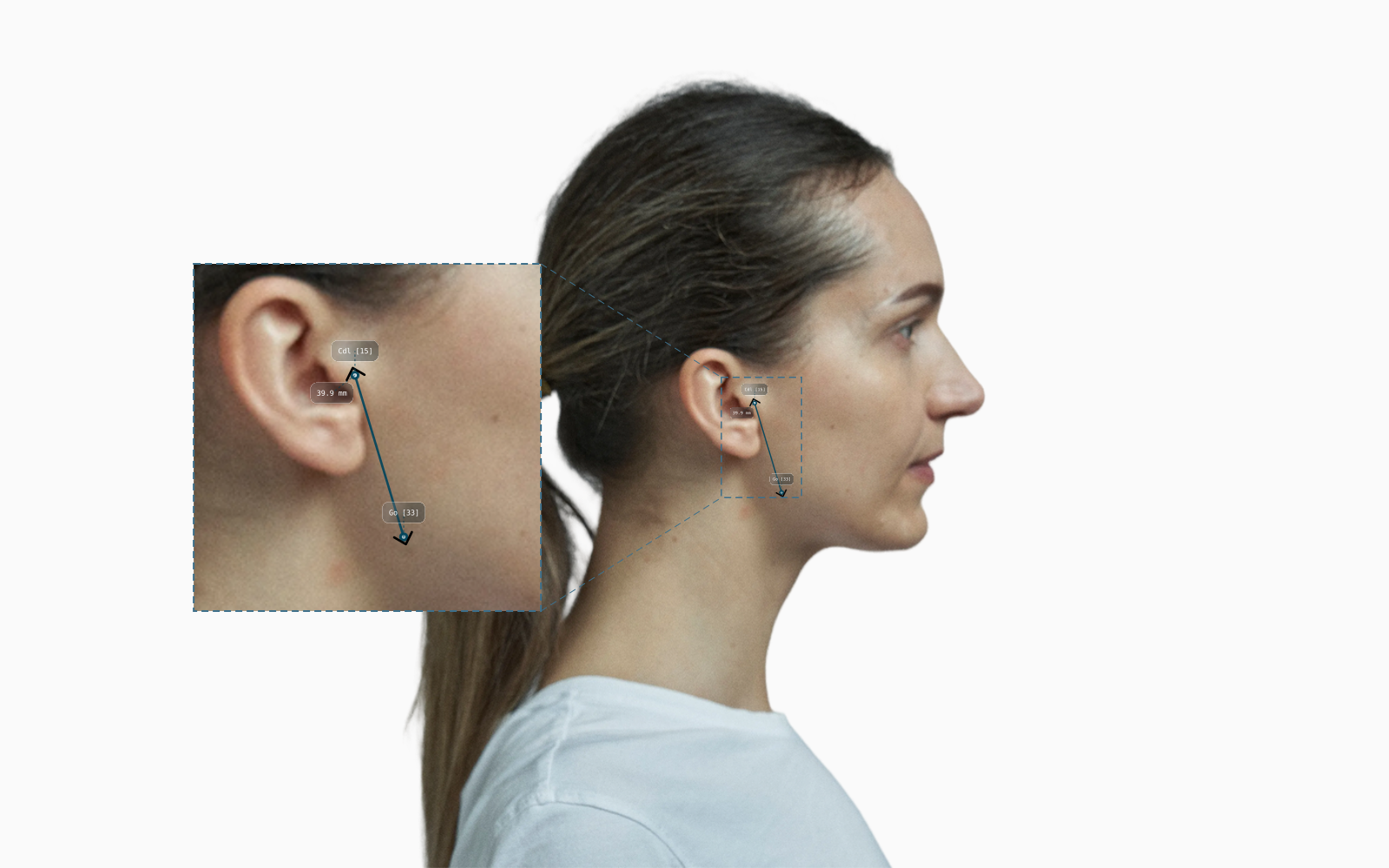
The ramus length is the vertical height of the mandibular ramus from the condylion (Cdl) at the temporomandibular joint down to the gonion (Go) at the jaw angle. The same measurement is known as the mandibular ramus in cephalometric literature. It runs along the back, vertical portion of the lower jaw that anchors the masseter and joins the lower face to the skull base, and it sets the posterior pillar of the jawline alongside the gonial angle and mandibular body length.
How It's Measured
Ramus length is read on a right-profile photograph as the straight vertical distance between two landmarks on the lower jaw (Naini, 2022). Both points sit along the back edge of the mandible, so the measurement captures how tall the posterior pillar of the lower face is.
A taller ramus drops the jaw angle lower relative to the ear and gives the lower face more vertical support at the back, which reads as a more rectangular, structured lower third. A shorter ramus pulls the gonion up closer to the ear, shortening the back edge of the jawline and narrowing the lower-face envelope.

Left: the original side-profile photo. Right: the same person with a shorter back of the jaw. The ramus length goes from 51.9 mm to 47.6 mm, and nothing else in the photo changed.
Why It Matters
The ramus length sits next to the gonial angle and the mandibular body length as one of the main inputs into lower-face shape. The vertical ramus is what gives the male jaw its square character. On a typical male profile the ramus drops down close to vertically from the ear region and turns anteriorly with a pronounced gonial angle (Naini, 2022). On a typical female profile the same posterior edge carries a gentler curve, so the jawline reads as more rounded.
Clinically, the ramus matters beyond looks. Changes in the vertical ramus are what produce the square jaw seen in male faces, and mandible size has been shown to respond to low doses of testosterone when boys are given testosterone to treat delayed puberty (Boothroyd et al., 2005). In one direct measurement study, men had significantly larger ramus size than women (t=3.39, p=.001), and the trait is used routinely for sex determination in forensic analysis. A short ramus combined with a steep mandibular plane angle is the classic Class II hyperdivergent (long-face) pattern. A long ramus combined with a forward-rotating mandible produces the Class III square-jaw pattern. Most orthognathic surgical planning hinges on knowing which one a patient has.
Ranges vary by population and sex. US norms put adult male skeletal ramus height (Condylion-Gonion) at 66 ± 4 mm against UK norms at 59 ± 4 mm, with female values roughly 4 to 6 mm shorter on both sides of the Atlantic (Naini, 2022). The "ideal" ramus is therefore phenotype-dependent. What reads as masculine in a European sample is unremarkable in a population with a longer baseline ramus. The bands in the table below show where the value sits against the population the face belongs to.
45–55 mm
Soft-tissue ramus length, adult women
50–65 mm
Soft-tissue ramus length, adult men
5 : 7
Ramus to mandibular body length ratio (Co-Go : Go-Gn)
Soft-tissue ramus length on the side profile, from the tragus-area condylion proxy to gonion. These values vary depending on individual facial structure and background.
Demographic Variants
Ideal ramus length varies by population and sex. The table below shows lit-supported skeletal ranges for Condylion-Gonion (Co-Go), the cephalometric measurement closest to the soft-tissue ramus length read on a side-profile photograph.
Demographic | Ramus height (Co-Go) | Source |
|---|---|---|
US adult men | 66 ± 4 mm | |
US adult women | 61 ± 2 mm | |
UK adult men | 59 ± 4 mm | |
UK adult women | 55 ± 4 mm |
Upload 6 clear photos of your face securely and privately through our online portal.
Drag and drop file To upload
POSES REQUIRED
We measure 160+ facial markers, including skin quality, symmetry, eye shape, brow density, and more.


You’ll receive a plan highlighting your strengths, areas for improvement, and best ways to improve your appearance.
Emma’s Report
January 16, 2026
Explanation
Your forehead wrinkle depth aligns with expectations for your age and demographic, falling on the lower end of our predicted range.
Your Questions
A good ramus length is one that sits inside the normative band for your sex and population and is proportional to your mandibular body length. In adult women a Condylion-Gonion skeletal height around 55 to 61 mm is typical. In adult men the typical band is 59 to 66 mm (Naini, 2022). The absolute number matters less than the proportion. The ramus height should hold roughly a 5:7 relationship with the mandibular body length, so a short ramus paired with a long body reads as imbalanced even when both values sit inside their separate normative bands.
Ramus length is the straight vertical distance from the condylion (Cdl, at the top of the mandibular ramus near the tragus) to the gonion (Go, at the jaw angle), read on a right-profile photograph. The soft-tissue version uses the skin landmark closest to the tragus as the upper point. The skeletal version uses the bony condyle as imaged on a lateral cephalogram (Naini, 2022). Both versions are vertical distances, but the soft-tissue value usually differs slightly from the skeletal value because the skin envelope adds tissue thickness over the bone.
The ramus is bone, so once skeletal growth is complete it cannot lengthen on its own. Surgical lengthening uses a sagittal split or vertical ramus osteotomy to move the bone segment, common in orthognathic surgery for patients with a short ramus and a hyperdivergent face (Naini, 2022). Non-surgical changes are limited to soft-tissue work. Masseter hypertrophy from heavy chewing or jaw training, and jaw filler placed at the gonion, broaden the gonial region but do not change the underlying vertical height of the ramus.
Ramus length is strongly genetic. Mandible morphology is laid down during craniofacial growth and shows clear heritability. Sex differences in ramus size between men and women (t=3.39, p=.001) are driven largely by testosterone-mediated growth at puberty (Boothroyd et al., 2005). Environmental factors like chewing load and breathing pattern can shift the gonial angle and the mandibular plane somewhat during growth, but the absolute vertical height of the ramus is set primarily by the genome and the hormone profile.
Chewing increases masseter muscle bulk and can modestly affect mandibular bone deposition during the growth years, but it does not lengthen an adult ramus. Hard-food diets in childhood are associated with broader mandibular development and better occlusion (Boo Gordillo et al., 2024), and the mandible responds to mechanical load during growth. Once the growth plates close, the vertical height of the ramus is fixed. Masseter hypertrophy from heavy chewing changes the soft-tissue width of the jaw, not the bone height.