1
Upload Your Photos
Upload 6 clear photos of your face securely and privately through our online portal.
Drag and drop file To upload
POSES REQUIRED


Mentolabial depth measures the soft-tissue groove between the lower lip and chin, also known as the labiomental fold or mentolabial sulcus. It sets how strongly the chin reads in profile. A balanced fold gives the chin a clean edge; a flat one washes the lower face out, a deep one signals a recessed lip or an over-prominent chin underneath.
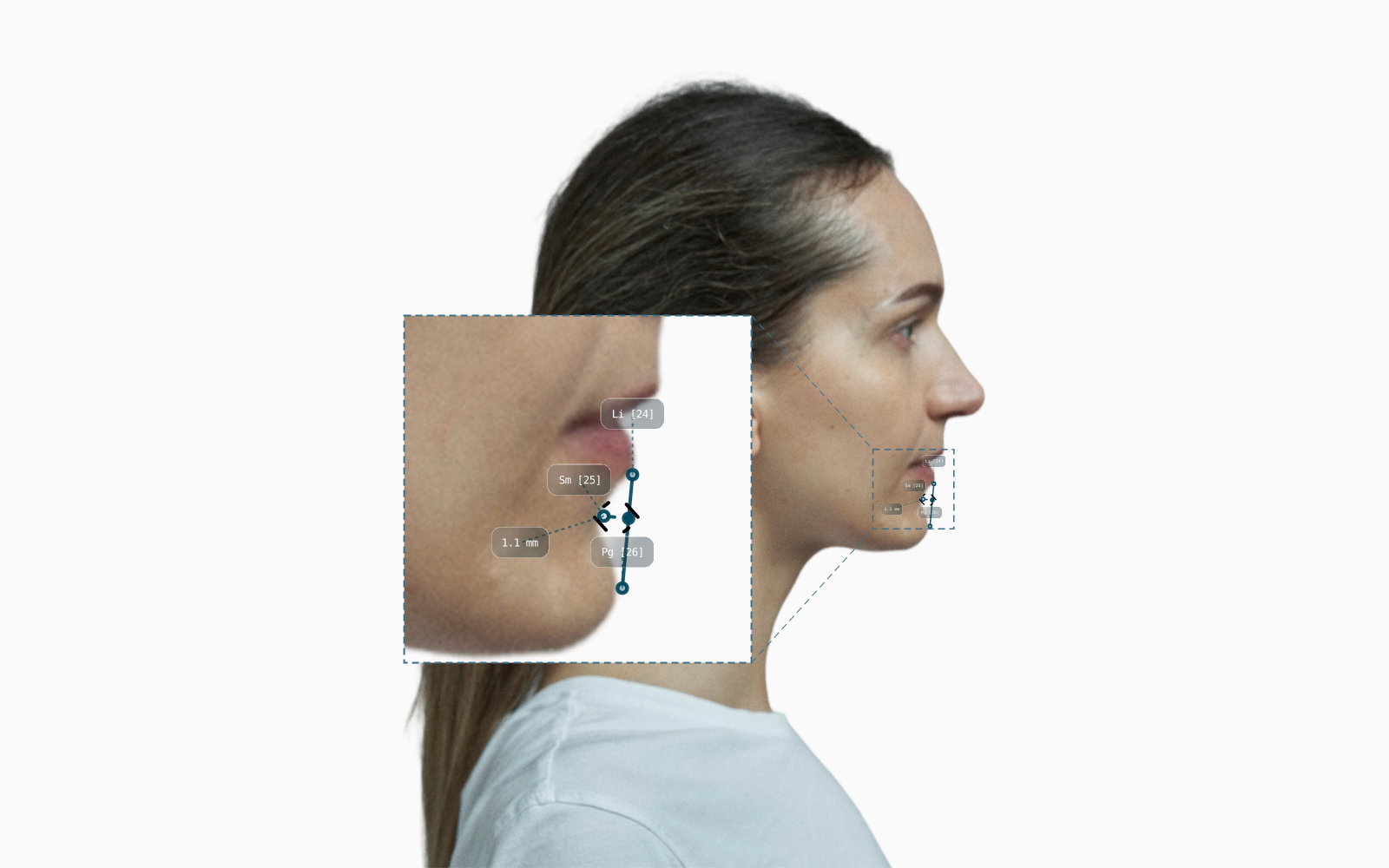
How It's Measured
Mentolabial depth is the perpendicular distance from the deepest point of the labiomental fold to a straight line connecting the lower-lip vermilion border with soft-tissue pogonion. The wider that gap, the deeper the fold reads in profile. The reading uses three soft-tissue landmarks:
What it tells you is whether the chin and lower lip sit in balance, or whether one is pushed out of place relative to the other (Naini, 2011).

Left: the original side-profile photo. Right: the same person with a deeper chin crease. The mentolabial depth goes from 5.9 mm to 6.8 mm, and nothing else in the photo changed.
Why It Matters
The labiomental fold is the cleanest single read on whether the chin is balanced against the lower lip. A fold around 4 to 6 mm gives the chin pad a defined break from the lip and reads as a strong chin (Naini, 2011). Drop below 2 mm and the lip and chin merge into one undifferentiated mass. Push past 8 mm and the chin starts to look pinched off from the rest of the face.
Sex moves the normal value. Adult means sit near 6 mm in men against 4 mm in women, tracked back to the greater bony chin prominence in male skeletons. A 6 mm reading on a female profile reads masculine. A 3 mm reading on a male profile reads under-defined. The most common diagnostic mistake is treating one number as the ideal across both sexes.
The mentolabial fold also moves as a side effect of every chin and lower-jaw procedure. Sagittal advancement of the chin sharpens it, vertical lengthening flattens it, mandibular advancement can exaggerate it. Surgeons therefore use the morphology as a diagnostic anchor before deciding between genioplasty, filler, or mandibular surgery (Stella and Naini, 2019). The ranges below give the typical norms by sex.
4–8 mm
Men
2–6 mm
Women
2–8 mm
Typical Range
These values vary depending on individual facial structure and background.
Demographic Variants
Mentolabial depth varies by sex. The rows below summarise the lit-supported norms.
Demographic | Ideal range | Source |
|---|---|---|
Adult women | 4 ± 2 mm (typical ~4 mm) | |
Adult men | 4 ± 2 mm (typical ~6 mm) |
Upload 6 clear photos of your face securely and privately through our online portal.
Drag and drop file To upload
POSES REQUIRED
We measure 160+ facial markers, including skin quality, symmetry, eye shape, brow density, and more.


You’ll receive a plan highlighting your strengths, areas for improvement, and best ways to improve your appearance.
Emma’s Report
January 16, 2026
Explanation
Your forehead wrinkle depth aligns with expectations for your age and demographic, falling on the lower end of our predicted range.
Your Questions
Adults sit around 4 ± 2 mm, with the mentolabial fold slightly deeper in men (around 6 mm) than in women (around 4 mm) because the male chin pad is more prominent (Naini, 2011). Readings between 2 and 8 mm fall within the typical aesthetic range. Outside that band the fold reads either flat or excessively deep.
A deep mentolabial fold usually signals mandibular retrusion (a Class II skeletal pattern), an everted lower lip, or a short lower anterior face height with mandibular overclosure (Naini, 2011). In each case the lower lip sits behind a more prominent chin, which exaggerates the labiomental groove.
There are three common routes. Hyaluronic acid filler can camouflage the labiomental depression and is reversible if you do not like the result. Advancement genioplasty brings the chin forward to even out the groove. Orthognathic mandibular advancement corrects the underlying skeletal class when the deformity sits at the bone level (Stella and Naini, 2019).
Yes. Soft-tissue descent in the lower face, lower-lip volume loss, and chin pad ptosis all combine to deepen the labiomental groove with age (Goldberg et al., 2008). The same patients usually see a deeper nasolabial fold and downturned oral commissures at the same time.